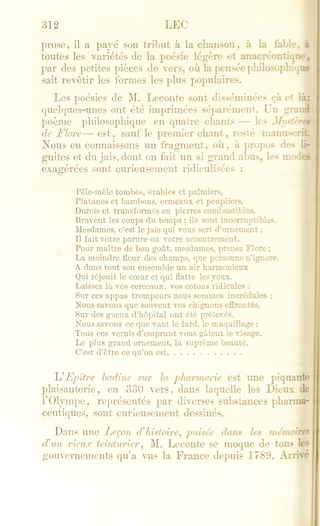
Pêle-mêle tombés, érables et palmiers,

Poet
Alfred-Etienne Leconte
Form
Alexandrine
Open the page in the book
The page this poem fills. Each opens in the Le Parnasse médical français reader.

Hover or tap a word to see its match.

Fallen pell-mell, maples and palms,

Plane trees and bamboos, elms and poplars,

Hardened and transformed into combustible stones,

Brave the blows of time; they are incorruptible.

Ladies, it is jet that serves as your ornament;

It makes up your finery or your attire.

For a master of good taste, ladies, take Flora;

The humblest field flower, that no one is ignorant of,

Has in its whole being a harmonious air

That gladdens the heart and flatters the eyes.

Leave aside your hoops, your ridiculous cottons:

About these deceitful charms we are incredulous;

We know that often your brazen chignons,

Have been taken from hospital beggars.

We know the worth of rouge, of makeup;

All these borrowed varnishes spoil your face.

The greatest ornament, the supreme beauty,

Is to be what one is

Pêle-mêle tombés, érables et palmiers,

Platanes et bambous, ormeaux et peupliers,

Durcis et transformés en pierres combustibles,

Bravent les coups du temps ; ils sont incorruptibles.

Mesdames, c'est le jais qui vous sert d'ornement ;

Il fait votre parure ou votre accoutrement.

Pour maître de bon goût, mesdames, prenez Flore ;

La moindre fleur des champs, que personne n'ignore,

A dans tout son ensemble un air harmonieux

Qui réjouit le cœur et qui flatte les yeux.

Laissez là vos cerceaux, vos cotons ridicules :

Sur ces appas trompeurs nous sommes incrédules ;

Nous savons que souvent vos chignons effrontés,

Sur des gueux d'hôpital ont été prélevés.

Nous savons ce que vaut le fard, le maquillage ;

Tous ces vernis d'emprunt vous gâtent le visage.

Le plus grand ornement, la suprême beauté,

C'est d'être ce qu'on est
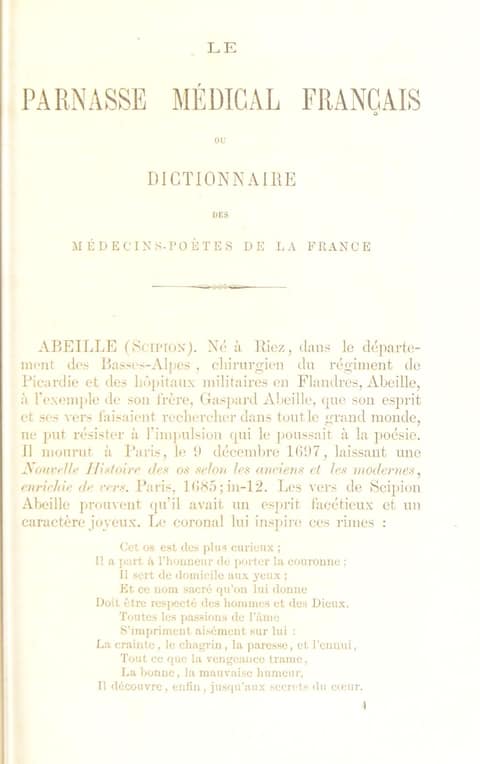
Title page of Le Parnasse médical français
Title page of Le Parnasse médical français , 1874

About this text

Provenance

This digital edition is derived from the Wellcome Collection copy of Achille Chéreau's 1874 dictionary of French physician-poets. The current reader uses the reacquired Wellcome IIIF JPEG corpus as the facsimile source of record.

Methodology

Each page is treated as a page-level unit. The page image remains the authority for the edition. Machine OCR is used as source OCR and reading aid, then corrected into French transcription, then translated into English. Word links connect the English translation to the French transcription and locations on the scans. Fifteen uncertain word-link decisions remain unlinked. Some links highlight only the text because the source word could not be located on the scan.

Rights

The source item is attributed to Wellcome Collection and marked with the Creative Commons Public Domain Mark. Poet Doctor's presentation adds generated transcription, translation, navigation metadata, and editorial context. No access control or anti-bulk-download measure should conflict with the public-domain status of the source material.

Original scans: Wellcome Collection ( Public Domain Mark 1.0 ).

Historian’s note. This text records the medicine of its own time, and later evidence has replaced most of it. It is not medical advice. We read it as history, and we ask what, if anything, connects it to medicine today. More on how we read old medical books