Hover or tap a word to see its match.
"Nature, neighbor, as a partial mother,
Has made the share between us two too unequal.
Planted the same day, by my slender trunk,
Yours is surpassed by at least a cubit.
I unite within me elegance and strength.
Seeing my white bark shine in the sun,
A poet once paid me this compliment:
'Greetings, Hamadryad in the silver dress.'
Well! I have a good heart, and truly I am distressed
When I see you, neighbor, crooked, hunched, rough,
Growing painfully near my straight stem."
Thus spoke, like a boastful youth,
The Birch addressing his neighbor the Oak.
The latter replied: "Pity carries you
Much too far, my lord, and, with all due respect,
I glimpse our destinies from a completely different aspect.
You grow faster, and that is your advantage;
But, tell me, which of us reaches the greatest age?
I grant you a century and I am being generous.
My brow, after a thousand years, rises into the heavens;
And what is made of you, my beautiful Hamadryad?
Fagots for the oven, stakes for a palisade.
For the vault of a temple or the flanks of a ship,
Did one ever resort to the elegant birch?
This three-decker that traverses the plain of Neptune,
To discover a world, was once an oak."
Time is the test of serious merit.
How many brilliant, fashionable authors pass quickly!
Dorat is already old; after two thousand years,
We still reread both Virgil and Tacitus.
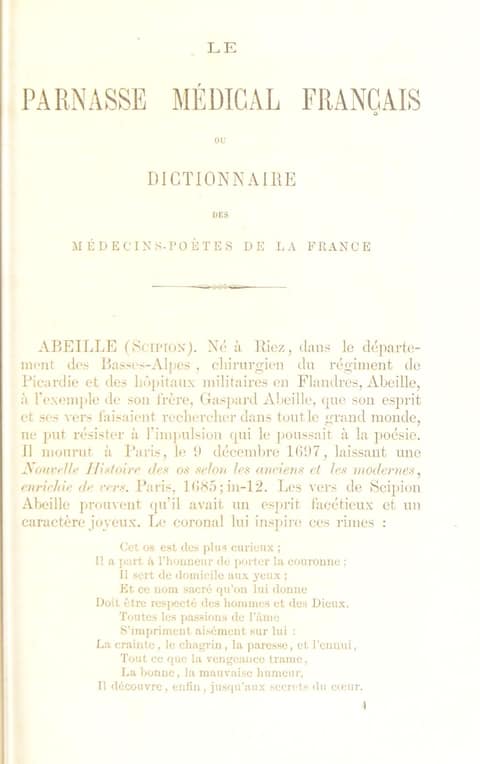
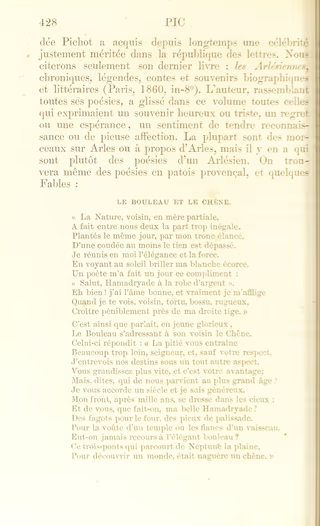
« La Nature, voisin, en mère partiale,
A fait entre nous deux la part trop inégale.
Plantés le même jour, par mon tronc élancé,
D'une coudée au moins le tien est dépassé.
Je réunis en moi l'élégance et la force.
En voyant au soleil briller ma blanche écorce,
Un poète m'a fait un jour ce compliment :
« Salut, Hamadryade à la robe d'argent ».
Eh bien ! j'ai l'âme bonne, et vraiment je m'afflige
Quand je te vois, voisin, tortu, bossu, rugueux,
Croître péniblement près de ma droite tige. »
C'est ainsi que parlait, en jeune glorieux,
Le Bouleau s'adressant à son voisin le Chêne.
Celui-ci répondit : « La pitié vous entraîne
Beaucoup trop loin, seigneur, et, sauf votre respect,
J'entrevois nos destins sous un tout autre aspect.
Vous grandissez plus vite, et c'est votre avantage;
Mais, dites, qui de nous parvient au plus grand âge ?
Je vous accorde un siècle et je suis généreux.
Mon front, après mille ans, se dresse dans les cieux ;
Et de vous, que fait-on, ma belle Hamadryade ?
Des fagots pour le four, des pieux de palissade.
Pour la voûte d'un temple ou les flancs d'un vaisseau,
Eut-on jamais recours à l'élégant bouleau ?
Ce trois-ponts qui parcourt de Neptune la plaine,
Pour découvrir un monde, était naguère un chêne. »
Du mérite sérieux l'épreuve, c'est le temps.
Que de brillants auteurs de mode passent vite !
Dorat est déjà vieux; au bout de deux mille ans,
Nous relisons toujours et Virgile et Tacite.