Hover or tap a word to see its match.
Save her! save her! Fill within her chest
The exhausting voids, the bloody pool!
From her burning palm tear away these slow fires!
Let the cough, the homicidal sweats be extinguished!...
You are silent, doctor!... But!... your livid lips!...
Does one die at seventeen!
At seventeen! my God! when her ingenuous soul
Scarcely hears the call of an unknown voice!
When Love, enchained beneath that gaze so sweet,
Already seeks the flowers worthy of her adornment!...
The tomb will untie the modest belt!
A coffin will be her husband!
And art still boasts! Art! sterile vanity
Which only knows how to exhale a useless complaint!...
Alas! I saw her fade every day!
Magnolia flower dried at your root,
Oh! how sadly upon the stem inclines
Your calyx dead without love!
My poor sister!... Already your beautiful blond curls
Trail beneath the lace inert, their waves sparse!
Your fingers sink, weary of a languishing effort!
Your eye is heavy with tears!... What a frightful thought,
What somber echo murmurs to your wounded soul
That you adorn yourself for death!
I put to sleep forever your mute pupil;
I tied, without seeing it, the undulating lace
Whose clear shadow your beautiful brow once loved;
I sadly offered you the perfumed hyacinth;
I went once more to fetch your beloved lark,
Poor bird who remained voiceless!
I broke that inexorable, impious mirror,
Which could not feign life to your gaze.
I joined your two hands; then, with a final kiss
I brushed upon your cheek, distraught, unseeing, pale,
Trembling, more dead than you, that fatal spot
Which I no longer dared to look upon.
Thus your long blue eyes and their long eyelid
Your beautiful hands, your charming brow, beneath a stone...
What have I said!... For the poor there are no tombs!
Even his remains expire! Yes! beneath the cold clay,
His outraged remains have not even an asylum:
The proud bone expels the bone!
Gillonne, on the earth, where man himself effaces
The imperceptible trace of his so fleeting happiness,
If I ask in vain for the tomb where you slept,
Your image is alive in my faithful soul:
At night, I see you again, gentle, modest, beautiful,
In the cell where I moan.
Oh! always recount to me the merit of pure hearts!
Wither the false eye, lurking beneath a hypocritical glass!
Paint the soul, virtue in suave colors!
O Gillonne, O my sister, O my second mother,
Console me always! I loved you first,
Receive my flowers first!
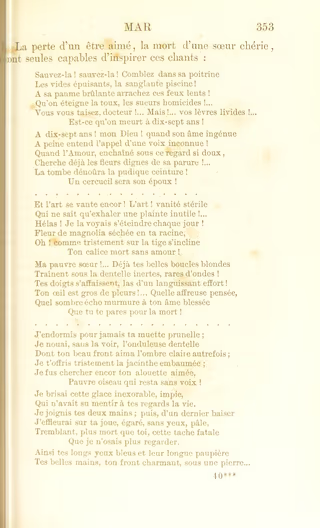
Sauvez-la ! sauvez-la ! Comblez dans sa poitrine
Les vides épuisants, la sanglante piscine !
A sa paume brûlante arrachez ces feux lents !
Qu'on éteigne la toux, les sueurs homicides !...
Vous vous taisez, docteur !... Mais !... vos lèvres livides !...
Est-ce qu'on meurt à dix-sept ans !
A dix-sept ans ! mon Dieu ! quand son âme ingénue
A peine entend l'appel d'une voix inconnue !
Quand l'Amour, enchaîné sous ce regard si doux,
Cherche déjà les fleurs dignes de sa parure !...
La tombe dénoûra la pudique ceinture !
Un cercueil sera son époux !
Et l'art se vante encor ! L'art ! vanité stérile
Qui ne sait qu'exhaler une plainte inutile !...
Hélas ! Je la voyais s'éteindre chaque jour !
Fleur de magnolia séchée en ta racine,
Oh ! comme tristement sur la tige s'incline
Ton calice mort sans amour !
Ma pauvre sœur !... Déjà tes belles boucles blondes
Traînent sous la dentelle inertes, rares d'ondes !
Tes doigts s'affaissent, las d'un languissant effort !
Ton œil est gros de pleurs !... Quelle affreuse pensée,
Quel sombre écho murmure à ton âme blessée
Que tu te pares pour la mort !
J'endormis pour jamais ta muette prunelle ;
Je nouai, sans la voir, l'onduleuse dentelle
Dont ton beau front aima l'ombre claire autrefois ;
Je t'offris tristement la jacinthe embaumée ;
Je fus chercher encor ton alouette aimée,
Pauvre oiseau qui resta sans voix !
Je brisai cette glace inexorable, impie,
Qui n'avait su mentir à tes regards la vie.
Je joignis tes deux mains ; puis, d'un dernier baiser
J'effleurai sur ta joue, égaré, sans yeux, pâle,
Tremblant, plus mort que toi, cette tache fatale
Que je n'osais plus regarder.
Ainsi tes longs yeux bleus et leur longue paupière
Tes belles mains, ton front charmant, sous une pierre...
Qu'ai-je dit!... Pour le pauvre il n'est pas de tombeaux !
Son débris même expire ! Oui ! sous la froide argile,
Ses restes outragés n'ont pas même un asile :
L'os superbe en expulse l'os !
Gillonne, sur la terre, où l'homme même efface
De son bonheur si court l'imperceptible trace,
Si je demande en vain la tombe où tu dormis,
Ton image est vivante en mon âme fidèle :
La nuit, je te revois douce, modeste, belle,
Dans la cellule où je gémis.
Oh ! redis-moi toujours des cœurs purs le mérite !
Flétris l'œil faux, tapi sous un verre hypocrite !
Peins l'âme, la vertu de suaves couleurs !
O Gillonne, ô ma sœur, ô ma seconde mère,
Console-moi toujours ! Je t'aimai la première,
Reçois la première mes fleurs !