Hover or tap a word to see its match.
Suddenly a great cry entered my chest,
With my soul. It was my blonde Catherine,
My beautiful curly-haired child, whose eyes are lakes,
Whom violent death was carrying off in its arms.
The old retiarius had, with a sure hand,
Bound the sweet creature with the fatal knot,
With the assistance of the convulsion,
Always ready at the moment of teething.
Oh! the convulsion! Terror of mothers!
Purveyor of mourning and bitter tears!
The sobs engendered by this insidious evil
Would drown out all the sounds of the earth and the heavens.
Ah! how many graves it causes to be dug! how many planks
It causes to be fitted together! It is our white doves
That this monster needs, and our fruits in their blossoms,
And our little lambs, all bathed in our tears,
And the adored brows, laden with our caresses,
And the purest, finally, of the purest intoxications.
When the maternal cry, of terror and alarm,
Into my stunned heart had entered like a weapon,
I rushed forward. Great God! What a sight! Eye lifeless,
Pupil dilated, motionless; the complexion
Livid, lip blue and at times trembling;
Limbs limp; the head unsteady,
And, without the support of the arm, falling back by its weight;
Insensibility, burning brow and cold feet...
O terror of the hearth! O despair of the father
Who feels, at the forearm, the artery barely beating,
And says to himself: Mighty God, do I still have time?
O God, already the rattle
Adds to this scene its guttural note.
What to do? What to attempt? Pale, silent,
The father then rises, looking to the heavens,
Plunges into the temples, into the brow of the poor adored one,
As into his own heart, a sharpened blade,
And cuts three vessels marked with dark azure.
Her blood, — dear innocent, — thick, sticky, dark,
Escapes drop by drop...
O joy! Is it possible!
There passes over her brow like an invisible breath!
First she moans; no matter; it is her voice!
Then her eye, still pale, opens and seeks to recognize;
Then one sees, by degrees, thought reborn there;
Then, finally, she speaks, and says: Gagot, gagot!
Good God, be blessed! It was a little word
That she had invented in her joyful delirium,
Which she often said and which made us laugh...
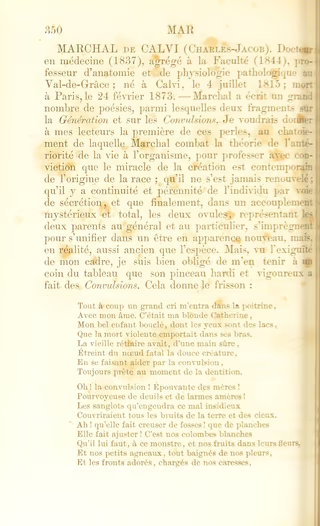
Tout à coup un grand cri m'entra dans la poitrine,
Avec mon âme. C'était ma blonde Catherine,
Mon bel enfant bouclé, dont les yeux sont des lacs,
Que la mort violente emportait dans ses bras.
La vieille rétiaire avait, d'une main sûre,
Étreint du nœud fatal la douce créature,
En se faisant aider par la convulsion,
Toujours prête au moment de la dentition.
Oh ! la convulsion ! Épouvante des mères !
Pourvoyeuse de deuils et de larmes amères !
Les sanglots qu'engendra ce mal insidieux
Couvriraient tous les bruits de la terre et des cieux.
Ah ! qu'elle fait creuser de fosses ! que de planches
Elle fait ajuster ! C'est nos colombes blanches
Qu'il lui faut, à ce monstre, et nos fruits dans leurs fleurs,
Et nos petits agneaux, tout baignés de nos pleurs,
Et les fronts adorés, chargés de nos caresses,
Et le plus pur, enfin, des plus pures ivresses.
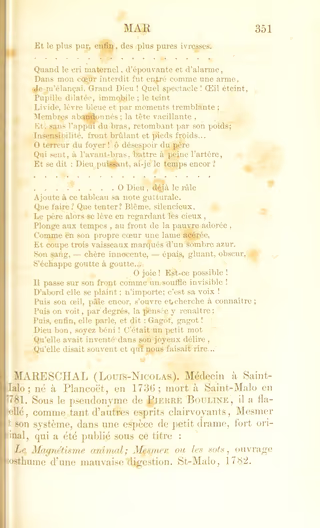
Quand le cri maternel, d'épouvante et d'alarme,
Dans mon cœur interdit fut entré comme une arme,
Je m'élançai. Grand Dieu ! Quel spectacle ! Œil éteint,
Pupille dilatée, immobile ; le teint
Livide, lèvre bleue et par moments tremblante ;
Membres abandonnés ; la tête vacillante,
Et, sans l'appui du bras, retombant par son poids ;
Insensibilité, front brûlant et pieds froids...
O terreur du foyer ! ô désespoir du père
Qui sent, à l'avant-bras, battre à peine l'artère,
Et se dit : Dieu puissant, ai-je le temps encor ?
O Dieu, déjà le râle
Ajoute à ce tableau sa note gutturale.
Que faire ? Que tenter ? Blême, silencieux,
Le père alors se lève en regardant les cieux,
Plonge aux tempes, au front de la pauvre adorée,
Comme en son propre cœur une lame acérée,
Et coupe trois vaisseaux marqués d'un sombre azur.
Son sang, — chère innocente, — épais, gluant, obscur,
S'échappe goutte à goutte...
O joie ! Est-ce possible !
Il passe sur son front comme un souffle invisible !
D'abord elle se plaint ; n'importe ; c'est sa voix !
Puis son œil, pâle encor, s'ouvre et cherche à connaître ;
Puis on voit, par degrés, la pensée y renaître ;
Puis, enfin, elle parle, et dit : Gagot, gagot !
Dieu bon, soyez béni ! C'était un petit mot
Qu'elle avait inventé dans son joyeux délire,
Qu'elle disait souvent et qui nous faisait rire...