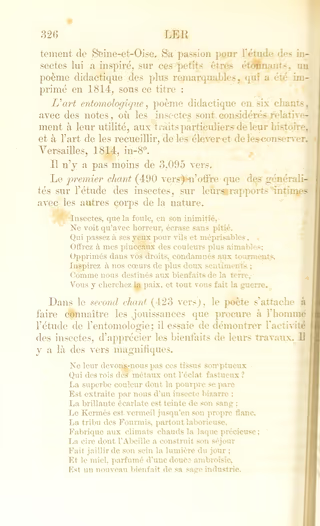
Insectes, que la foule, en son inimitié,

Poet
Le Roux
Form
Alexandrine
Open the page in the book
The page this poem fills. Each opens in the Le Parnasse médical français reader.

Hover or tap a word to see its match.

Insects, which the crowd, in its enmity,

Sees only with horror, crushes without pity,

Which pass in its eyes as vile and despicable,

Offer to my brushes more amiable colors;

Oppressed in your rights, condemned to torments,

Inspire in our hearts sweeter sentiments;

Like us destined for the bounties of the earth,

You seek peace there, and everything wages war on you.

Insectes, que la foule, en son inimitié,

Ne voit qu'avec horreur, écrase sans pitié,

Qui passez à ses yeux pour vils et méprisables,

Offrez à mes pinceaux des couleurs plus aimables ;

Opprimés dans vos droits, condamnés aux tourments,

Inspirez à nos cœurs de plus doux sentiments ;

Comme nous destinés aux bienfaits de la terre,

Vous y cherchez la paix, et tout vous fait la guerre.
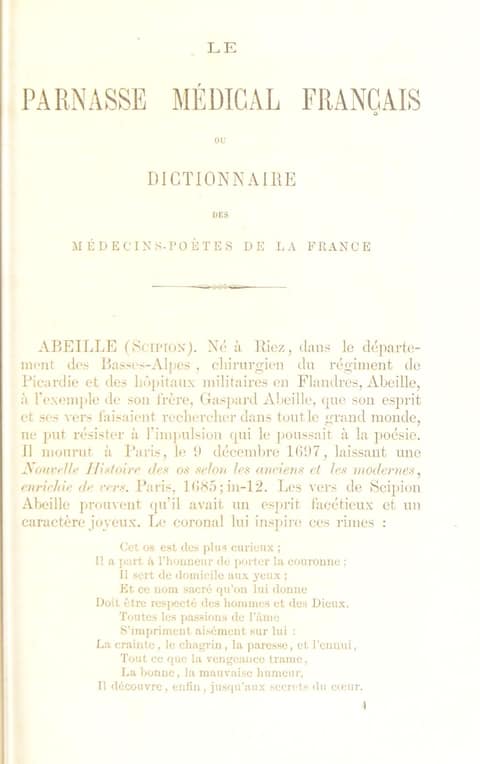
Title page of Le Parnasse médical français
Title page of Le Parnasse médical français , 1874

About this text

Provenance

This digital edition is derived from the Wellcome Collection copy of Achille Chéreau's 1874 dictionary of French physician-poets. The current reader uses the reacquired Wellcome IIIF JPEG corpus as the facsimile source of record.

Methodology

Each page is treated as a page-level unit. The page image remains the authority for the edition. Machine OCR is used as source OCR and reading aid, then corrected into French transcription, then translated into English. Word links connect the English translation to the French transcription and locations on the scans. Fifteen uncertain word-link decisions remain unlinked. Some links highlight only the text because the source word could not be located on the scan.

Rights

The source item is attributed to Wellcome Collection and marked with the Creative Commons Public Domain Mark. Poet Doctor's presentation adds generated transcription, translation, navigation metadata, and editorial context. No access control or anti-bulk-download measure should conflict with the public-domain status of the source material.

Original scans: Wellcome Collection ( Public Domain Mark 1.0 ).

Historian’s note. This text records the medicine of its own time, and later evidence has replaced most of it. It is not medical advice. We read it as history, and we ask what, if anything, connects it to medicine today. More on how we read old medical books