Hover or tap a word to see its match.
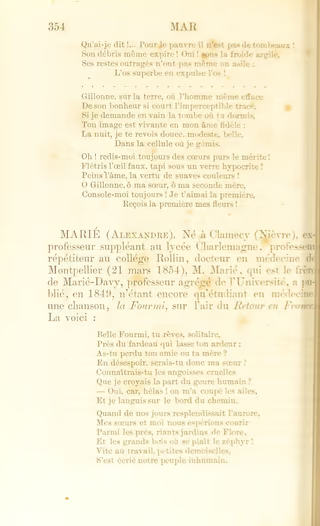
Beautiful Ant, you dream, solitary,
Near the burden that wearies your ardor;
Have you lost your friend or your mother?
In despair, would you then be my sister?
Would you know the cruel anguishes
That I believed the lot of the human race?
— Yes, for, alas! they have cut my wings,
And I languish by the edge of the path.
When the dawn of our days shone bright,
My sisters and I hoped to run
Among the meadows, laughing gardens of Flora,
And the great woods where the zephyr delights!
Quickly to work, little ladies,
Cried out our inhuman people.
Then, without pity, they cut off my wings,
And I languish by the side of the road.
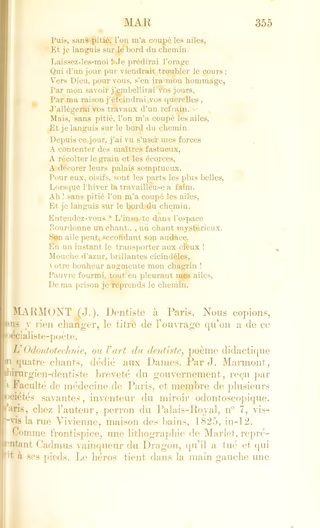
Leave them to me! I will predict the storm
That would disturb the course of a clear day;
Towards God, for you, my homage will ascend,
By my knowledge I will embellish your days,
By my reason I will extinguish your quarrels,
I will lighten your labors with a refrain.
But, without pity, they cut off my wings,
And I languish by the side of the road.
Since that day, I have seen my strength wear out
In satisfying ostentatious masters,
In harvesting the grain and the bark,
In decorating their sumptuous palaces.
For them, idle, are the finest shares,
While in winter the worker goes hungry.
Ah! without pity they cut off my wings,
And I languish by the side of the road.
Do you hear? The insect in space
Hums a song.., a mysterious song.
Its wing can, assisting its boldness,
In an instant transport it to the heavens!
Azure fly, brilliant tiger beetles,
Your happiness increases my sorrow!
Poor ant, while weeping for my wings,
I take up once more the path to my prison.
Belle Fourmi, tu rêves, solitaire,
Près du fardeau qui lasse ton ardeur ;
As-tu perdu ton amie ou ta mère ?
En désespoir, serais-tu donc ma sœur ?
Connaîtrais-tu les angoisses cruelles
Que je croyais la part du genre humain ?
— Oui, car, hélas ! on m'a coupé les ailes,
Et je languis sur le bord du chemin.
Quand de nos jours resplendissait l'aurore,
Mes sœurs et moi nous espérions courir
Parmi les prés, riants jardins de Flore,
Et les grands bois où se plaît le zéphyr !
Vite au travail, petites demoiselles,
S'est écrié notre peuple inhumain.
Puis, sans pitié, l'on m'a coupé les ailes,
Et je languis sur le bord du chemin.
Laissez-les-moi ! Je prédirai l'orage
Qui d'un jour pur viendrait troubler le cours ;
Vers Dieu, pour vous, s'en ira mon hommage,
Par mon savoir j'embellirai vos jours,
Par ma raison j'éteindrai vos querelles,
J'allégerai vos travaux d'un refrain.
Mais, sans pitié, l'on m'a coupé les ailes,
Et je languis sur le bord du chemin.
Depuis ce jour, j'ai vu s'user mes forces
A contenter des maîtres fastueux,
A récolter le grain et les écorces,
A décorer leurs palais somptueux.
Pour eux, oisifs, sont les parts les plus belles,
Lorsque l'hiver la travailleuse a faim.
Ah ! sans pitié l'on m'a coupé les ailes,
Et je languis sur le bord du chemin.
Entendez-vous ? L'insecte dans l'espace
Bourdonne un chant.., un chant mystérieux.
Son aile peut, secondant son audace,
En un instant le transporter aux cieux !
Mouche d'azur, brillantes cicindèles,
Votre bonheur augmente mon chagrin !
Pauvre fourmi, tout en pleurant mes ailes,
De ma prison je reprends le chemin.