Hover or tap a word to see its match.
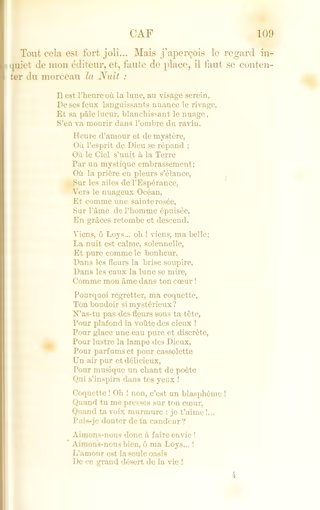
It is the hour when the moon, with serene face,
Tints the shore with its languishing fires,
And its pale gleam, whitening the cloud,
Goes to die in the shadow of the ravine.
Hour of love and of mystery,
Where the spirit of God spreads;
Where Heaven unites with Earth
In a mystic embrace;
Where tearful prayer soars,
On the wings of Hope,
Toward the cloudy Ocean,
And like a holy dew,
Upon the exhausted soul of man,
Falls back and descends in graces.
Come, O Loys... oh! come, my beauty;
The night is calm, solemn,
And pure as happiness.
In the flowers the breeze sighs,
In the waters the moon is mirrored,
Like my soul in your heart!
Why regret, my coquette,
Your so mysterious boudoir?
Do you not have flowers beneath your head,
For a ceiling the vault of the heavens!
For a mirror a pure and discreet water,
For a chandelier the lamp of the Gods,
For perfumes and for a cassolette
A pure and delicious air,
For music a poet's song
That drew inspiration from your eyes!
Coquette! Oh! no, it is a blasphemy!
When you press me to your heart,
When your voice murmurs: I love you!...
Can I doubt your candor?
Let us love each other then to make others envious!
Let us love each other well, O my Loys...!
Love is the only oasis
Of this great desert of life!
Il est l'heure où la lune, au visage serein,
De ses feux languissants nuance le rivage,
Et sa pâle lueur, blanchissant le nuage,
S'en va mourir dans l'ombre du ravin.
Heure d'amour et de mystère,
Où l'esprit de Dieu se répand ;
Où le Ciel s'unit à la Terre
Par un mystique embrassement;
Où la prière en pleurs s'élance,
Sur les ailes de l'Espérance,
Vers le nuageux Océan,
Et comme une sainte rosée,
Sur l'âme de l'homme épuisée,
En grâces retombe et descend.
Viens, ô Loys... oh ! viens, ma belle;
La nuit est calme, solennelle,
Et pure comme le bonheur.
Dans les fleurs la brise soupire,
Dans les eaux la lune se mire,
Comme mon âme dans ton cœur !
Pourquoi regretter, ma coquette,
Ton boudoir si mystérieux ?
N'as-tu pas des fleurs sous ta tête,
Pour plafond la voûte des cieux !
Pour glace une eau pure et discrète,
Pour lustre la lampe des Dieux,
Pour parfums et pour cassolette
Un air pur et délicieux,
Pour musique un chant de poète
Qui s'inspira dans tes yeux !
Coquette ! Oh ! non, c'est un blasphème !
Quand tu me presses sur ton cœur,
Quand ta voix murmure : je t'aime !...
Puis-je douter de ta candeur ?
Aimons-nous donc à faire envie !
Aimons-nous bien, ô ma Loys... !
L'amour est la seule oasis
De ce grand désert de la vie !