Hover or tap a word to see its match.
A child was playing by the edge of a river,
Sometimes running after a butterfly,
Sometimes picking on the lawn
The spring daisy;
When, suddenly, to his gaze,
A superb water lily presents itself,
Whose golden corolla was swaying in the wind.
The flower tempts our little boy,
Who wants to pick it right away.
But surrounded by tall grass,
Positioned several feet from the edge,
The plant was difficult to approach:
Moreover, the river was deep.
What does our reckless one do? His body leaning over the water,
With one hand he clings to some weak rush,
Without thinking of the peril of his foolish enterprise:
Thus risking twenty times taking a plunge,
Towards the object of his desire
He extends his other hand, manages to grasp it,
Waves it proudly above his head,
And, his eye radiating with pleasure,
He quickly runs to present his conquest to his mother
But, in his inconstant mood,
Whether from disgust, or from thoughtlessness,
The child, soon after, abandoned this flower,
For which he had just risked his life.
Frivolous in his tastes, fickle and light,
Man, for a caprice, braves danger.
Should he gather the fruit of his perseverance,
One sees him, skimming the cup of pleasures,
Soon repudiate, with indifference,
What had been the object of his ardent desires.
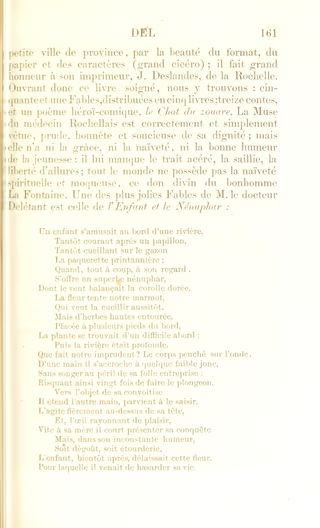
Un enfant s'amusait au bord d'une rivière,
Tantôt courant après un papillon,
Tantôt cueillant sur le gazon
La paquerette printannière ;
Quand, tout à coup, à son regard ,
S'offre un superbe nénuphar,
Dont le vent balançait la corolle dorée.
La fleur tente notre marmot,
Qui veut la cueillir aussitôt.
Mais d'herbes hautes entourée,
Placée à plusieurs pieds du bord,
La plante se trouvait d'un difficile abord :
Puis la rivière était profonde.
Que fait notre imprudent ? Le corps penché sur l'onde,
D'une main il s'accroche à quelque faible jonc,
Sans songer au péril de sa folle entreprise :
Risquant ainsi vingt fois de faire le plongeon,
Vers l'objet de sa convoitise
Il étend l'autre main, parvient à le saisir,
L'agite fièrement au-dessus de sa tête,
Et, l'œil rayonnant de plaisir,
Vite à sa mère il court présenter sa conquête
Mais, dans son inconstante humeur,
Soit dégoût, soit étourderie,
L'enfant, bientôt après, délaissait cette fleur,
Pour laquelle il venait de hasarder sa vie.
Frivole dans ses goûts, versatile et léger,
L'homme, pour un caprice, affronte le danger.
Recueille-t-il le fruit de sa persévérance,
On le voit, effleurant la coupe des plaisirs,
Répudier bientôt, avec indifférence,
Ce qui faisait l'objet de ses ardents désirs.