Hover or tap a word to see its match.
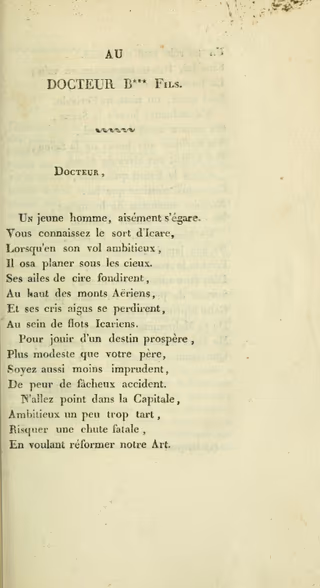
A young man easily goes astray.
You know the fate of Icarus,
When in his ambitious flight,
He dared to soar beneath the heavens.
His wings of wax melted,
At the summit of the Aërian mountains,
And his piercing cries were lost,
Within the Icarian waves.
To enjoy a prosperous destiny,
More modest than your father,
Be also less imprudent,
For fear of an unfortunate accident.
Do not go to the Capital,
Ambitious a little too late,
To risk a fatal fall,
By wanting to reform our Art.
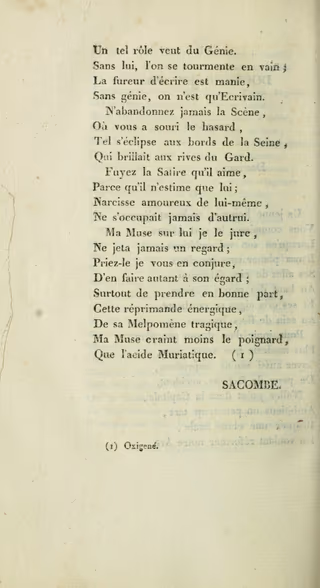
Such a role requires Genius.
Without it, one torments oneself in vain;
The fury to write is a mania,
Without genius, one is merely a Writer.
Never abandon the Stage,
Where chance has smiled upon you,
Such a one is eclipsed on the banks of the Seine,
Who shone on the banks of the Gard.
Flee the Satire that he loves,
Because he esteems only himself;
Narcissus, in love with himself,
Never concerned himself with others.
My Muse upon him, I swear,
Never cast a glance;
Beg him, I implore you,
To do the same toward her;
Above all to take in good part,
This energetic reprimand,
Of his tragic Melpomene,
My Muse fears the dagger less,
Than Muriatic acid.
UN jeune homme, aisément s'égare.
Vous connaissez le sort d'Icare,
Lorsqu'en son vol ambitieux ,
Il osa planer sous les cieux.
Ses ailes de cire fondirent ,
Au haut des monts Aëriens ,
Et ses cris aigus se perdirent ,
Au sein de flots Icariens.
Pour jouir d'un destin prospère ,
Plus modeste que votre père ,
Soyez aussi moins imprudent ,
De peur de fâcheux accident.
N'allez point dans la Capitale ,
Ambitieux un peu trop tart ,
Risquer une chute fatale ,
En voulant réformer notre Art.
Un tel rôle veut du Génie.
Sans lui, l'on se tourmente en vain ;
La fureur d'écrire est manie,
Sans génie, on n'est qu'Ecrivain.
N'abandonnez jamais la Scène ,
Où vous a souri le hasard ,
Tel s'éclipse aux bords de la Seine ,
Qui brillait aux rives du Gard.
Fuyez la Satire qu'il aime ,
Parce qu'il n'estime que lui ;
Narcisse amoureux de lui-même ,
Ne s'occupait jamais d'autrui.
Ma Muse sur lui je le jure ,
Ne jeta jamais un regard ;
Priez-le je vous en conjure,
D'en faire autant à son égard ;
Surtout de prendre en bonne part,
Cette réprimande énergique,
De sa Melpomène tragique ,
Ma Muse craint moins le poignard ,
Que l'acide Muriatique.