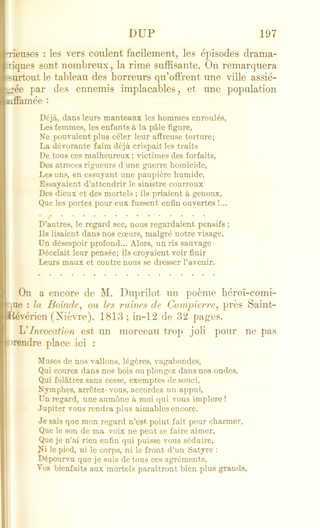
Déjà, dans leurs manteaux les hommes enroulés,

Poet
Jean-Baptiste-Louis Duprilot
Form
Alexandrine
Open the page in the book
The page this poem fills. Each opens in the Le Parnasse médical français reader.

Hover or tap a word to see its match.

Already, the men wrapped in their cloaks,

The women, the children with pale faces,

Could no longer conceal their frightful torture;

Devouring hunger already contorted the features

Of all these wretches; victims of the crimes,

Of the atrocious rigors of a homicidal war,

Some, wiping a wet eyelid,

Tried to soften the sinister wrath

Of gods and mortals; they prayed on their knees,

That the gates might finally be opened for them!...

Others, with dry gaze, looked at us pensively;

They read in our hearts, despite our faces,

A profound despair... Then, a savage laugh

Revealed their thought; they believed they saw end

Their ills and the future rise up against us.

Déjà, dans leurs manteaux les hommes enroulés,

Les femmes, les enfants à la pâle figure,

Ne pouvaient plus céler leur affreuse torture;

La dévorante faim déjà crispait les traits

De tous ces malheureux ; victimes des forfaits,

Des atroces rigueurs d'une guerre homicide,

Les uns, en essuyant une paupière humide,

Essayaient d'attendrir le sinistre courroux

Des dieux et des mortels ; ils priaient à genoux,

Que les portes pour eux fussent enfin ouvertes !...

D'autres, le regard sec, nous regardaient pensifs ;

Ils lisaient dans nos cœurs, malgré notre visage,

Un désespoir profond... Alors, un ris sauvage

Décelait leur pensée; ils croyaient voir finir

Leurs maux et contre nous se dresser l'avenir.
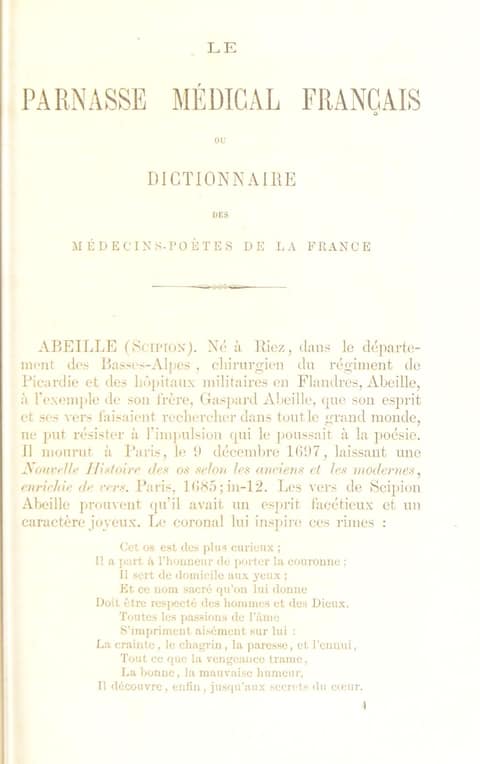
Title page of Le Parnasse médical français
Title page of Le Parnasse médical français , 1874

About this text

Provenance

This digital edition is derived from the Wellcome Collection copy of Achille Chéreau's 1874 dictionary of French physician-poets. The current reader uses the reacquired Wellcome IIIF JPEG corpus as the facsimile source of record.

Methodology

Each page is treated as a page-level unit. The page image remains the authority for the edition. Machine OCR is used as source OCR and reading aid, then corrected into French transcription, then translated into English. Word links connect the English translation to the French transcription and locations on the scans. Fifteen uncertain word-link decisions remain unlinked. Some links highlight only the text because the source word could not be located on the scan.

Rights

The source item is attributed to Wellcome Collection and marked with the Creative Commons Public Domain Mark. Poet Doctor's presentation adds generated transcription, translation, navigation metadata, and editorial context. No access control or anti-bulk-download measure should conflict with the public-domain status of the source material.

Original scans: Wellcome Collection ( Public Domain Mark 1.0 ).

Historian’s note. This text records the medicine of its own time, and later evidence has replaced most of it. It is not medical advice. We read it as history, and we ask what, if anything, connects it to medicine today. More on how we read old medical books