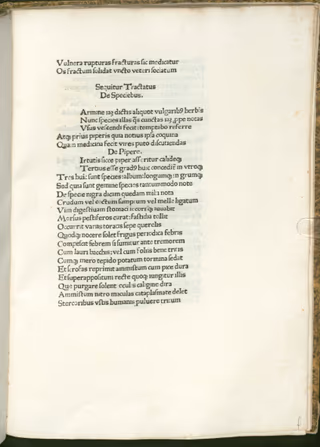
Sequitur Tractatus De Speciebus.

Poet
Macer
Form
Hexameter
Open the page in the book
The page this poem fills. Each opens in the De viribus herbarum reader.

Hover or tap a word to see its match.

Some common herbs having now been described in verse,

I will now attempt to relate those spices,

almost all of which the practice of eating has now made known.

And first I think the virtues of pepper must be discussed,

because the kitchen itself has made it more known

than medicine has.

Armine iaꝫ dictis aliquot vulgaribꝰ herbis

Nunc ſpecies illas qͣs cunctas iaꝫ ꝓpe notas

Vſus veſcendi fecit: temptabo referre

Atqꝫ prius piperis quia notius ipſa coquina

Quam medicina fecit vires puto diſcutiendas
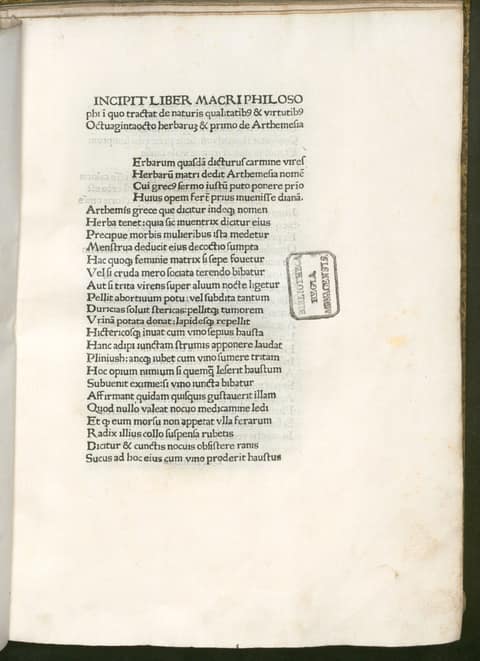
Title page of De viribus herbarum
Title page of De viribus herbarum , 1477

About this text

Provenance

This digital edition is derived from the Bayerische Staatsbibliothek digitization of an early printed edition of De viribus herbarum, the Latin herbal poem traditionally attributed to Macer Floridus or Odo of Meung.

Methodology

Each scan is treated as a page-level unit. The page image remains the authority for the edition. Local Kraken OCR was used as a reading aid, then Gemini generated scan-grounded Latin transcription and English translation from the images, the OCR aid, and the approved glossary. Word links connect the English translation to the Latin transcription and locations on the scans. 95 uncertain word-link decisions remain unlinked. Some links highlight only the text because the source word could not be located on the scan.

Rights

The BSB IIIF manifest declares the digital surrogate under the Public Domain Mark 1.0. Poet Doctor's presentation adds generated OCR, transcription, translation, navigation metadata, and editorial context.

Original scans: Bayerische Staatsbibliothek ( Public Domain Mark 1.0 ).

Historian’s note. This text records the medicine of its own time, and later evidence has replaced most of it. It is not medical advice. We read it as history, and we ask what, if anything, connects it to medicine today. More on how we read old medical books