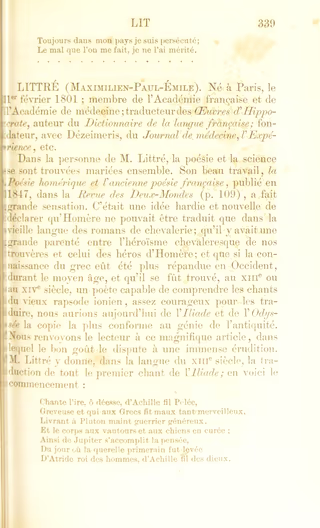
Chante l'ire, ô déesse, d'Achille fil Pélée,

Poet
Maximilien-Paul-Émile Littré
Form
Alexandrin
Open the page in the book
The pages this poem fills. Each opens in the Le Parnasse médical français reader.

Hover or tap a word to see its match.

Sing the wrath, O goddess, of Achilles son of Peleus,

Grievous, and which to the Greeks caused ills so astounding,

Delivering to Pluto many a noble warrior,

And the body to vultures and to dogs as quarry;

Thus was the thought of Jupiter fulfilled,

From the day when the quarrel was first raised

Of Atrides king of men, of Achilles son of the gods.

Among the immortals, who troubled their courage?

Apollo. Toward the king he bore such ill will,

That into the host he cast the plague and the people perished,

Since Atrides did outrage to the priest Chryses.

Chryses came to the ships of swift wake

To free for a great ransom his daughter from servitude;

Bearing in his hands from the god of the far-shooting bow

The fillet and golden scepter, and praying to all the Greeks,

Above all the two Atrides, who have such great lordship...

Chante l'ire, ô déesse, d'Achille fil Pélée,

Greveuse et qui aux Grecs fit maux tant merveilleux,

Livrant à Pluton maint guerrier généreux,

Et le corps aux vautours et aux chiens en curée ;

Ainsi de Jupiter s'accomplit la pensée,

Du jour où la querelle primerain fut levée

D'Atride roi des hommes, d'Achille fil des dieux.

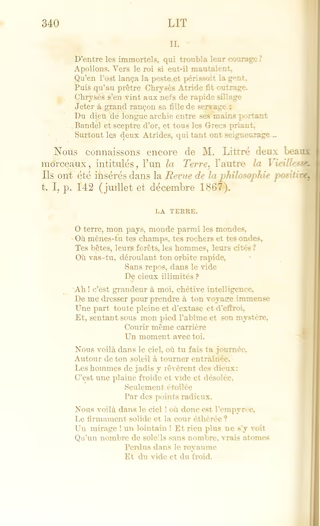
D'entre les immortels, qui troubla leur courage ?

Apollons. Vers le roi si eut-il mautalent,

Qu'en l'ost lança la peste et périssoit la gent,

Puis qu'au prêtre Chrysès Atride fit outrage.

Chrysès s'en vint aux nefs de rapide sillage

Jeter à grand rançon sa fille de servage ;

Du dieu de longue archie entre ses mains portant

Bandel et sceptre d'or, et tous les Grecs priant,

Surtout les deux Atrides, qui tant ont seigneurage...
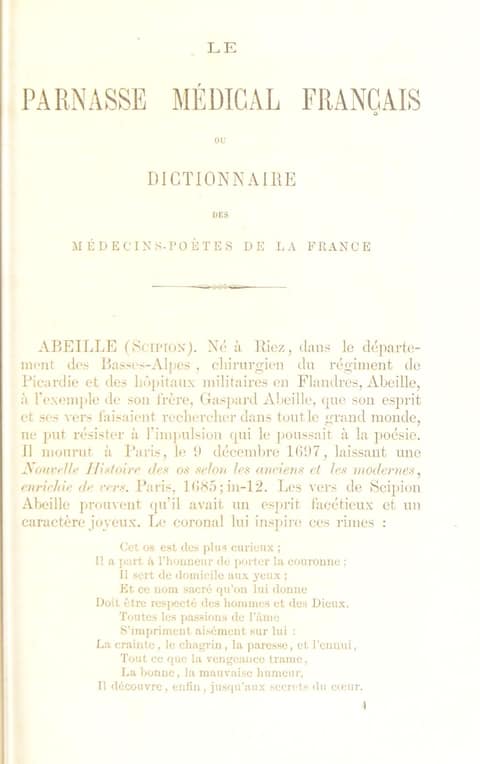
Title page of Le Parnasse médical français
Title page of Le Parnasse médical français , 1874

About this text

Provenance

This digital edition is derived from the Wellcome Collection copy of Achille Chéreau's 1874 dictionary of French physician-poets. The current reader uses the reacquired Wellcome IIIF JPEG corpus as the facsimile source of record.

Methodology

Each page is treated as a page-level unit. The page image remains the authority for the edition. Machine OCR is used as source OCR and reading aid, then corrected into French transcription, then translated into English. Word links connect the English translation to the French transcription and locations on the scans. Fifteen uncertain word-link decisions remain unlinked. Some links highlight only the text because the source word could not be located on the scan.

Rights

The source item is attributed to Wellcome Collection and marked with the Creative Commons Public Domain Mark. Poet Doctor's presentation adds generated transcription, translation, navigation metadata, and editorial context. No access control or anti-bulk-download measure should conflict with the public-domain status of the source material.

Original scans: Wellcome Collection ( Public Domain Mark 1.0 ).

Historian’s note. This text records the medicine of its own time, and later evidence has replaced most of it. It is not medical advice. We read it as history, and we ask what, if anything, connects it to medicine today. More on how we read old medical books