Hover or tap a word to see its match.
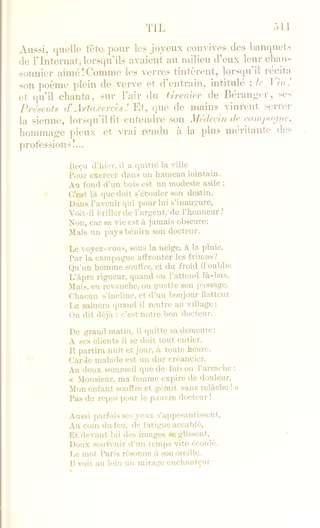
Qualified yesterday, he left the city
To practice in a distant hamlet.
Deep in a wood is a modest refuge;
That is where his destiny must unfold.
In the future that opens up for him,
Does he see the gleam of money, of honor?
No, for his life is forever obscure;
But a region will bless its doctor.
Do you see him, in the snow, in the rain,
Across the countryside braving the frost?
Should a man suffer, he forgets the cold's
Bitter rigor, when he is awaited yonder.
But, in return, they watch for him to pass,
Everyone bows, and with a flattering good day
Will greet him when he returns to the village;
They already say: he is our good doctor.
Early in the morning, he leaves his dwelling;
He owes himself entirely to his patients.
He will set out night and day, at any hour,
For the sick man is a harsh creditor.
From sweet sleep how many times is he torn:
"Sir, my wife is dying of pain,
My child suffers and moans without respite!"
No rest for the poor doctor!
And so sometimes his eyes grow heavy,
By the fireside, overwhelmed by fatigue,
And before him images slip by,
Sweet memory of a time quickly passed.
The word Paris rings in his ear,
He sees in the distance an enchanting mirage
But it is a dream, and sadly he awakens:
What regrets for the poor doctor!
Courage then! the more arduous the task,
And the better one does, when one knows how to fulfill it.
To the blows of fate show an insensible soul.
Do your duty, without ever faltering;
And when the sum of your days shall end.
The peasants will say to each other: what a misfortune!
He lived like a brave and worthy man:
May God grant peace to our good doctor!
Reçu d'hier, il a quitté la ville
Pour exercer dans un hameau lointain.
Au fond d'un bois est un modeste asile ;
C'est là que doit s'écouler son destin.
Dans l'avenir qui pour lui s'inaugure,
Voit-il briller de l'argent, de l'honneur ?
Non, car sa vie est à jamais obscure ;
Mais un pays bénira son docteur.
Le voyez-vous, sous la neige, à la pluie,
Par la campagne affronter les frimas ?
Qu'un homme souffre, et du froid il oublie
L'âpre rigueur, quand on l'attend là-bas.
Mais, en revanche, on guette son passage,
Chacun s'incline, et d'un bonjour flatteur
Le saluera quand il rentre au village ;
On dit déjà : c'est notre bon docteur.
De grand matin, il quitte sa demeure ;
A ses clients il se doit tout entier.
Il partira nuit et jour, à toute heure,
Car le malade est un dur créancier.
Au doux sommeil que de fois on l'arrache :
« Monsieur, ma femme expire de douleur,
Mon enfant souffre et gémit sans relâche ! »
Pas de repos pour le pauvre docteur !
Aussi parfois ses yeux s'appesantissent,
Au coin du feu, de fatigue accablé,
Et devant lui des images se glissent,
Doux souvenir d'un temps vite écoulé.
Le mot Paris résonne à son oreille,
Il voit au loin un mirage enchanteur
Mais c'est un songe, et triste il se réveille :
Que de regrets pour le pauvre docteur !
Courage donc ! plus la tâche est pénible,
Et mieux on fait, quand on sait la remplir.
Aux coups du sort montre une âme insensible.
Fais ton devoir, sans jamais défaillir;
Et de tes jours quand finira la somme.
Les paysans se diront : quel malheur !
Il a vécu comme un brave et digne homme :
Dieu fasse paix à notre bon docteur !