Hover or tap a word to see its match.
He was a tall old man, lean, of upright stature,
The scythe of time had notched his face;
But, much more than the years, obstinate thoughts
Had marked their crease upon his furrowed features.
The unruly locks of his whitened hair,
Making breaches everywhere in his broad-brimmed felt hat,
Snowed upon the lapels and the high collar
Of an overcoat falling lower than the calves.
His tangled eyebrows, a sort of gray bramble,
Covered strange eyes, such as in churchmen
One sometimes sees, for whom the temporal
Has no more secrets than the spiritual.
And indeed, from the summits where renown is founded,
He often looked beyond this world.
He was beneficent; they called him gruff,
And even rather untender to the patient who hurried to him.
Although one could not cite, among those whom wealth
Counts as favorites as well as the nobility,
A single consulting room more frequented than his.
He was what one calls a great practitioner.
One day he was asked, by an express letter,
To go, to a dwelling whose address was given,
To visit Madame Bourrichon as soon as possible.
"Bourrichon!" he said to himself. "Is that a name?
"I have certainly never known, from Adam or Eve,
"Madame Bourrichon. Besides, unless I am dreaming,
"In that cul-de-sac are hideous hovels,
"Where the price of my care is too high for beggars."
The letter, however, said: "I implore you!"
In short, he sets off and alights before a hovel.
"Madame Bourrichon? — Sixth-floor corridor!
— Sixth floor, good Lord!" He climbs up all the same.
A key left in the door attested
That one could enter without knocking. He enters; she was sleeping.
With an inquisitive eye he surveys the garret
And sits down. She, at the noise, wakes up, and, haggard,
Adjusting her cap, explains to the physician
That, seeing no end to a lung ailment,
She appeals to him, prince of science;
That she expects salvation from his experience;
That she is wrong to have summoned him to a slum,
But that she knew him formerly at her masters' house;
And that certainly Madame the Countess
Would not blame her for this boldness.
He scrutinizes the chest, interrogates the sound,
And all the noises that breathing makes.
The examination finished, the prescription written:
"— Will ten francs be enough, Monsieur, for the visit?"
But he, straightening up and deepening his voice:
"— No, Madame, I do not climb up to the rooftops
For less than three louis!" Then, drawing from his pocket
Sixty francs in gold, he approaches the lady,
Slips them into her hand, reaches the corridor,
And, if he were not deceased, would, I believe, still be running.
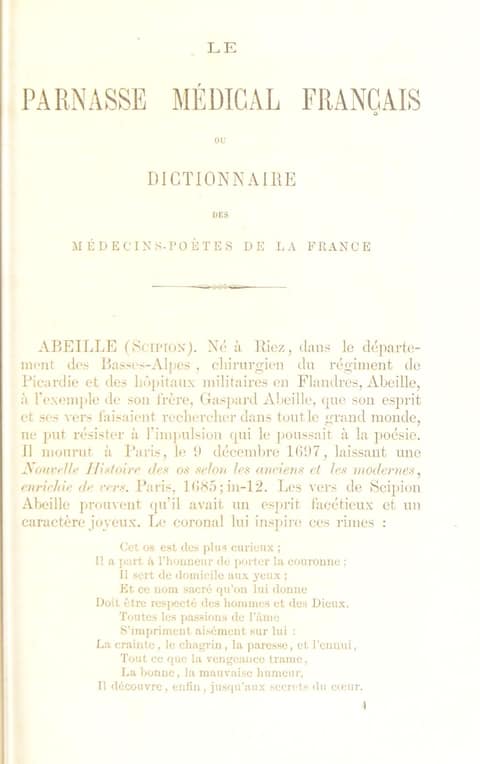
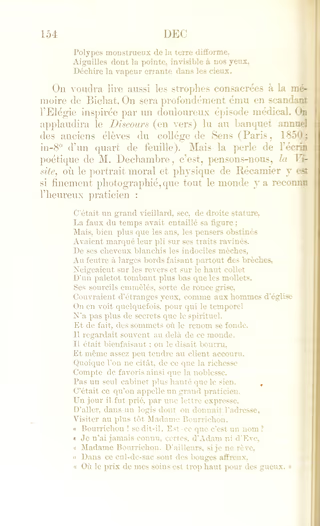
C'était un grand vieillard, sec, de droite stature,
La faux du temps avait entaillé sa figure ;
Mais, bien plus que les ans, les pensers obstinés
Avaient marqué leur pli sur ses traits ravinés.
De ses cheveux blanchis les indociles mèches,
Au feutre à larges bords faisant partout des brèches,
Neigeaient sur les revers et sur le haut collet
D'un paletot tombant plus bas que les mollets.
Ses sourcils emmêlés, sorte de ronce grise,
Couvraient d'étranges yeux, comme aux hommes d'église
On en voit quelquefois, pour qui le temporel
N'a pas plus de secrets que le spirituel.
Et de fait, des sommets où le renom se fonde,
Il regardait souvent au delà de ce monde.
Il était bienfaisant ; on le disait bourru,
Et même assez peu tendre au client accouru.
Quoique l'on ne citât, de ce que la richesse
Compte de favoris ainsi que la noblesse,
Pas un seul cabinet plus hanté que le sien.
C'était ce qu'on appelle un grand praticien.
Un jour il fut prié, par une lettre expresse,
D'aller, dans un logis dont on donnait l'adresse,
Visiter au plus tôt Madame Bourrichon.
« Bourrichon ! se dit-il. Est-ce que c'est un nom ?
« Je n'ai jamais connu, certes, d'Adam ni d'Eve,
« Madame Bourrichon. D'ailleurs, si je ne rêve,
« Dans ce cul-de-sac sont des bouges affreux,
« Où le prix de mes soins est trop haut pour des gueux. »
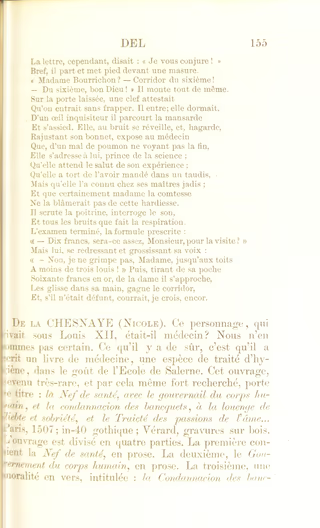
La lettre, cependant, disait : « Je vous conjure ! »
Bref, il part et met pied devant une masure.
« Madame Bourrichon ? — Corridor du sixième !
— Du sixième, bon Dieu ! » Il monte tout de même.
Sur la porte laissée, une clef attestait
Qu'on entrait sans frapper. Il entre ; elle dormait.
D'un œil inquisiteur il parcourt la mansarde
Et s'assied. Elle, au bruit se réveille, et, hagarde,
Rajustant son bonnet, expose au médecin
Que, d'un mal de poumon ne voyant pas la fin,
Elle s'adresse à lui, prince de la science ;
Qu'elle attend le salut de son expérience ;
Qu'elle a tort de l'avoir mandé dans un taudis,
Mais qu'elle l'a connu chez ses maîtres jadis ;
Et que certainement madame la comtesse
Ne la blâmerait pas de cette hardiesse.
Il scrute la poitrine, interroge le son,
Et tous les bruits que fait la respiration.
L'examen terminé, la formule prescrite :
« — Dix francs, sera-ce assez, Monsieur, pour la visite ? »
Mais lui, se redressant et grossissant sa voix :
« — Non, je ne grimpe pas, Madame, jusqu'aux toits
A moins de trois louis ! » Puis, tirant de sa poche
Soixante francs en or, de la dame il s'approche,
Les glisse dans sa main, gagne le corridor,
Et, s'il n'était défunt, courrait, je crois, encor.