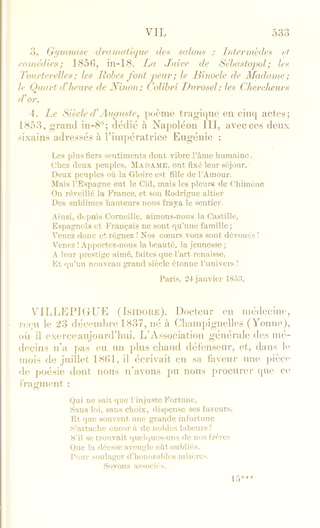
Les plus fiers sentiments dont vibre l'âme humaine,

Poet
VILLEMIN
Form
Alexandrin
Open the page in the book
The page this poem fills. Each opens in the Le Parnasse médical français reader.

Hover or tap a word to see its match.

The proudest sentiments with which the human soul vibrates,

Among two peoples, MADAM, have fixed their abode,

Two peoples where Glory is the daughter of Love.

But Spain had the Cid, but the tears of Chimène

Awakened France, and her haughty Rodrigue

Cleared for us the path to sublime heights.

Thus, since Corneille, we have loved Castile,

Spaniards and French are but one family;

Come then and reign! Our hearts are devoted to you!

Come! Bring us beauty, youth;

By their beloved prestige, let art be reborn,

And let a great new century astonish the universe!

Les plus fiers sentiments dont vibre l'âme humaine,

Chez deux peuples, MADAME, ont fixé leur séjour,

Deux peuples où la Gloire est fille de l'Amour.

Mais l'Espagne eut le Cid, mais les pleurs de Chimène

On réveillé la France, et son Rodrigue altier

Des sublimes hauteurs nous fraya le sentier.

Ainsi, depuis Corneille, aimons-nous la Castille,

Espagnols et Français ne sont qu'une famille ;

Venez donc et régnez ! Nos cœurs vous sont dévoués !

Venez ! Apportez-nous la beauté, la jeunesse ;

A leur prestige aimé, faites que l'art renaisse,

Et qu'un nouveau grand siècle étonne l'univers !
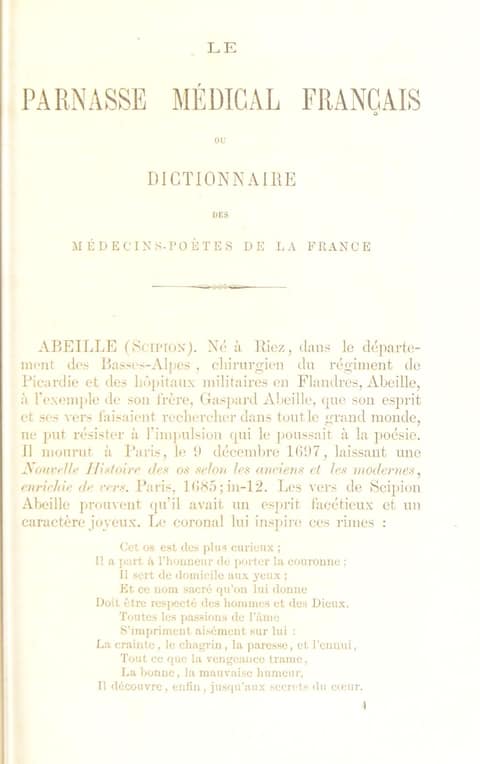
Title page of Le Parnasse médical français
Title page of Le Parnasse médical français , 1874

About this text

Provenance

This digital edition is derived from the Wellcome Collection copy of Achille Chéreau's 1874 dictionary of French physician-poets. The current reader uses the reacquired Wellcome IIIF JPEG corpus as the facsimile source of record.

Methodology

Each page is treated as a page-level unit. The page image remains the authority for the edition. Machine OCR is used as source OCR and reading aid, then corrected into French transcription, then translated into English. Word links connect the English translation to the French transcription and locations on the scans. Fifteen uncertain word-link decisions remain unlinked. Some links highlight only the text because the source word could not be located on the scan.

Rights

The source item is attributed to Wellcome Collection and marked with the Creative Commons Public Domain Mark. Poet Doctor's presentation adds generated transcription, translation, navigation metadata, and editorial context. No access control or anti-bulk-download measure should conflict with the public-domain status of the source material.

Original scans: Wellcome Collection ( Public Domain Mark 1.0 ).

Historian’s note. This text records the medicine of its own time, and later evidence has replaced most of it. It is not medical advice. We read it as history, and we ask what, if anything, connects it to medicine today. More on how we read old medical books