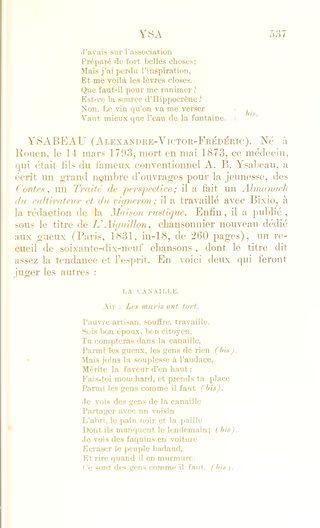
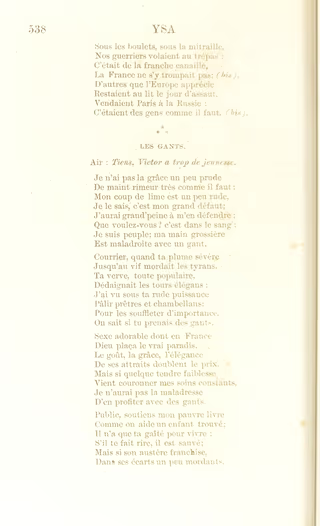
LA CANAILLE.

Poet
YSABEAU
Form
Octosyllabe
Open the page in the book
The pages this poem fills. Each opens in the Le Parnasse médical français reader.

Hover or tap a word to see its match.

Poor artisan, suffer, work.

Be a good husband, a good citizen,

You will count among the rabble,

Among the beggars, the people of no account (bis).

But join suppleness to audacity,

Merit the favor from above;

Become an informer, and take your place

Among respectable people (bis).

I see people of the rabble

Sharing with a neighbor

The shelter, the black bread and the straw

Which they will lack the next day; (bis).

I see scoundrels in carriages

Crushing the gawking populace,

And laughing when they murmur about it:

They are respectable people. (bis).

Beneath the cannonballs, beneath the grapeshot,

Our warriors flew to their death:

They were outright rabble,

France made no mistake about it; (bis).

Others whom Europe appreciates

Stayed in bed on the day of the assault,

Sold Paris to Russia:

They were proper people. (bis).

Pauvre artisan, souffre, travaille.

Sois bon époux, bon citoyen,

Tu compteras dans la canaille,

Parmi les gueux, les gens de rien (bis).

Mais joins la souplesse à l'audace,

Mérite la faveur d'en haut;

Fais-toi mouchard, et prends ta place

Parmi les gens comme il faut (bis).

Je vois des gens de la canaille

Partager avec un voisin

L'abri, le pain noir et la paille

Dont ils manquent le lendemain; (bis).

Je vois des faquins en voiture

Ecraser le peuple badaud,

Et rire quand il en murmure:

Ce sont des gens comme il faut. (bis).

Sous les boulets, sous la mitraille,

Nos guerriers volaient au trépas :

C'était de la franche canaille,

La France ne s'y trompait pas; (bis).

D'autres que l'Europe apprécie

Restaient au lit le jour d'assaut,

Vendaient Paris à la Russie :

C'étaient des gens comme il faut. (bis).
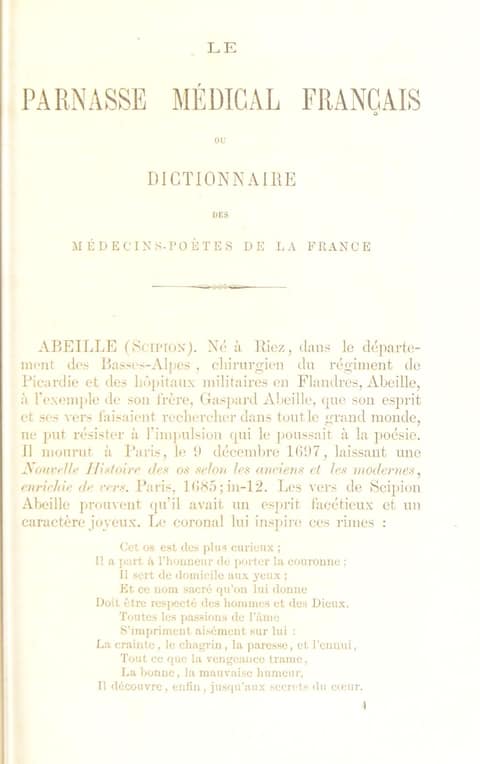
Title page of Le Parnasse médical français
Title page of Le Parnasse médical français , 1874

About this text

Provenance

This digital edition is derived from the Wellcome Collection copy of Achille Chéreau's 1874 dictionary of French physician-poets. The current reader uses the reacquired Wellcome IIIF JPEG corpus as the facsimile source of record.

Methodology

Each page is treated as a page-level unit. The page image remains the authority for the edition. Machine OCR is used as source OCR and reading aid, then corrected into French transcription, then translated into English. Word links connect the English translation to the French transcription and locations on the scans. Fifteen uncertain word-link decisions remain unlinked. Some links highlight only the text because the source word could not be located on the scan.

Rights

The source item is attributed to Wellcome Collection and marked with the Creative Commons Public Domain Mark. Poet Doctor's presentation adds generated transcription, translation, navigation metadata, and editorial context. No access control or anti-bulk-download measure should conflict with the public-domain status of the source material.

Original scans: Wellcome Collection ( Public Domain Mark 1.0 ).

Historian’s note. This text records the medicine of its own time, and later evidence has replaced most of it. It is not medical advice. We read it as history, and we ask what, if anything, connects it to medicine today. More on how we read old medical books