Hover or tap a word to see its match.
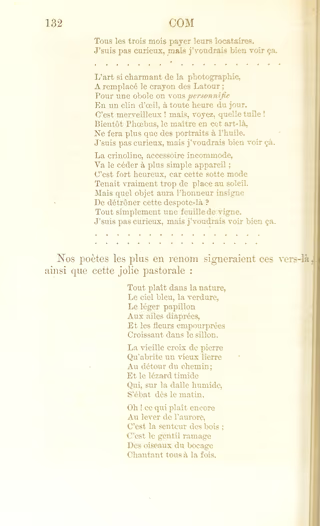
Everything is pleasing in nature,
The blue sky, the greenery,
The light butterfly
With variegated wings,
And the crimson flowers
Growing in the furrow.
The old stone cross
Sheltered by an old ivy
At the bend in the road;
And the timid lizard
Who, on the damp flagstone,
Frolics from early morning.
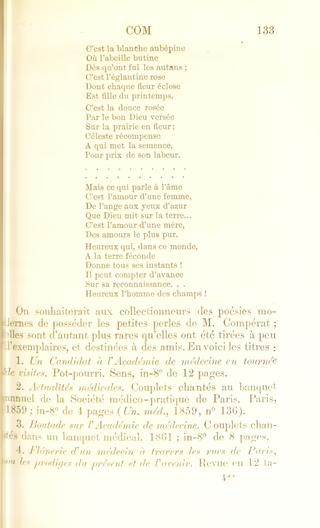
Oh! what pleases further
At the break of dawn,
Is the scent of the woods;
Is the gentle warbling
Of the birds in the grove
All singing at once.
It is the white hawthorn
Where the bee gathers nectar
As soon as the gales have fled;
It is the pink sweetbrier
Whose every blossoming flower
Is a daughter of spring.
It is the sweet dew
Poured by the good Lord
Upon the meadow in bloom;
A heavenly reward
To him who sows the seed,
As the price of his labor.
But what speaks to the soul
Is the love of a woman,
Of the blue-eyed angel
Whom God placed upon the earth...
It is the love of a mother,
The purest of loves.
Happy is he who, in this world,
Gives all his moments
To the fruitful earth!
He can count in advance
On its gratitude. . .
Happy is the man of the fields!
Tout plaît dans la nature,
Le ciel bleu, la verdure,
Le léger papillon
Aux ailes diaprées,
Et les fleurs empourprées
Croissant dans le sillon.
La vieille croix de pierre
Qu'abrite un vieux lierre
Au détour du chemin ;
Et le lézard timide
Qui, sur la dalle humide,
S'ébat dès le matin.
Oh ! ce qui plaît encore
Au lever de l'aurore,
C'est la senteur des bois ;
C'est le gentil ramage
Des oiseaux du bocage
Chantant tous à la fois.
C'est la blanche aubépine
Où l'abeille butine
Dès qu'ont fui les autans ;
C'est l'églantine rose
Dont chaque fleur éclose
Est fille du printemps.
C'est la douce rosée
Par le bon Dieu versée
Sur la prairie en fleur ;
Céleste récompense
A qui met la semence,
Pour prix de son labeur.
Mais ce qui parle à l'âme
C'est l'amour d'une femme,
De l'ange aux yeux d'azur
Que Dieu mit sur la terre...
C'est l'amour d'une mère,
Des amours le plus pur.
Heureux qui, dans ce monde,
A la terre féconde
Donne tous ses instants !
Il peut compter d'avance
Sur sa reconnaissance. . .
Heureux l'homme des champs !