F U N G I.

Poet
Baptista Fiera
Form
Elegiac couplet
Open the page in the book
The pages this poem fills. Each opens in the Coena, sive De cibariorum virtutibus reader.

Hover or tap a word to see its match.

You could bear the twelve provocations of evils,

O Book, the mushrooms: let that be a care for the cook.

It is enough to say that the eleven, moist with sudden putrefaction,

Are chilling and excessively heavy.

Yet although these differ among themselves; Claudius ate

More harmful boleti when his wife gave them.

If they please you, you should beware the contagion of fierce iron,

And everything rotten, along with poisonous places.

Every one harms the head and the stomach: it veils the senses

With darkness: and is a ruinous plague to the heart.

And unless you have drunk the pure medicines of health-bringing Salernian,

the path of urine will scarcely be fit.

Farewell, mushroom: I am not at all surprised that you are born in a single night.

Thus do all harmful things hasten with a rapid foot.

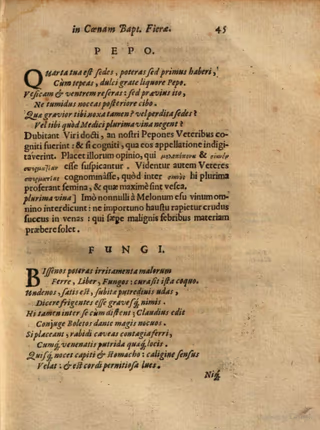
BIſſenos poteras irritamenta malorum

Ferre, Liber, Fungos: cura ſit iſta coquo.

Vndenos, ſatis eſt, ſubitæ putredinis udas,

Dicere frigentes eſſe graveſq́; nimis.

Hi tamen inter ſe cùm diſtent; Claudius edit

Conjuge Boletos dante magis nocuos.

Si placeant, rabidi caveas contagia ferri,

Cumq́; venenatis putrida quæq́; locis.

Quiſq́; nocet capiti & ſtomacho: caligine ſenſus

Velat: & eſt cordi pernitioſa lues.

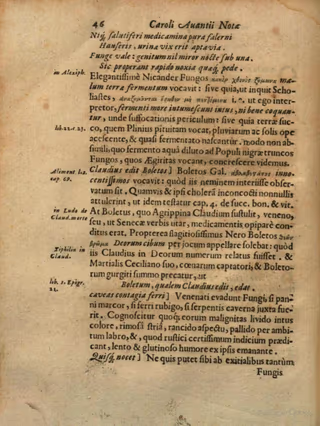
Niqꝫ ſalutiferi medicamina pura ſalerni

Hauſeris, urinæ vix erit apta via.

Funge vale : genitum nil miror nocte ſub una.

Sic properant rapido noxia quæqꝫ pede.
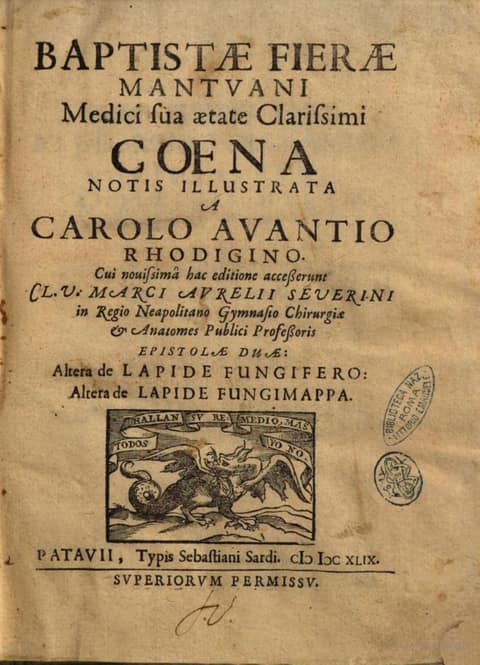
Title page of Coena, sive De cibariorum virtutibus
Title page of Coena, sive De cibariorum virtutibus , 1649

About this text

Provenance

This digital edition is derived from the Internet Archive copy of Battista Fiera's 1649 _Coena, sive De cibariorum virtutibus_, a Latin medical dinner poem with Carlo Avanzi's notes and related material.

Methodology

Each scan is treated as a page-level unit. The page image remains the authority for the edition. Local Kraken OCR used the Reichenau Latin early-print model as a reading aid, then Gemini generated scan-grounded Latin transcription and scholarly English translation from the images, the OCR aid, and the approved glossary. Word links connect the English translation to the Latin transcription and locations on the scans. 32 uncertain word-link decisions remain unlinked. Some links highlight only the text because the source word could not be located on the scan.

Rights

The Internet Archive metadata and IIIF manifest record the digital surrogate under the Creative Commons Public Domain Mark 1.0. Poet Doctor's presentation adds generated OCR, transcription, translation, navigation metadata, and editorial context.

Original scans: Internet Archive / Google Books ( Public Domain Mark 1.0 ).

Historian’s note. This text records the medicine of its own time, and later evidence has replaced most of it. It is not medical advice. We read it as history, and we ask what, if anything, connects it to medicine today. More on how we read old medical books