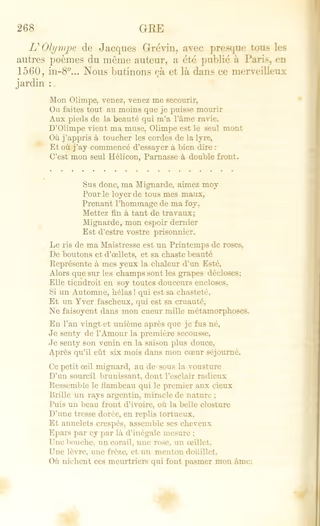
Le ris de ma Maistresse est un Printemps de roses,

Poet
GRÉVIN (Jacques)
Form
Alexandrine
Open the page in the book
The page this poem fills. Each opens in the Le Parnasse médical français reader.

Hover or tap a word to see its match.

The laughter of my Mistress is a Springtime of roses,

Of buds and carnations, and her chaste beauty

Represents to my eyes the warmth of a Summer,

When upon the fields the grapes are unclosed;

She would hold within herself all sweetness enclosed,

If an Autumn, alas! which is her chastity,

And a vexing Winter, which is her cruelty,

Did not work a thousand metamorphoses in my heart.

Le ris de ma Maistresse est un Printemps de roses,

De boutons et d'œllets, et sa chaste beauté

Représente à mes yeux la chaleur d'un Esté,

Alors que sur les champs sont les grapes décloses;

Elle tiendroit en soy toutes douceurs encloses,

Si un Automne, hélas ! qui est sa chasteté,

Et un Yver fascheux, qui est sa cruauté,

Ne faisoyent dans mon cueur mille métamorphoses.
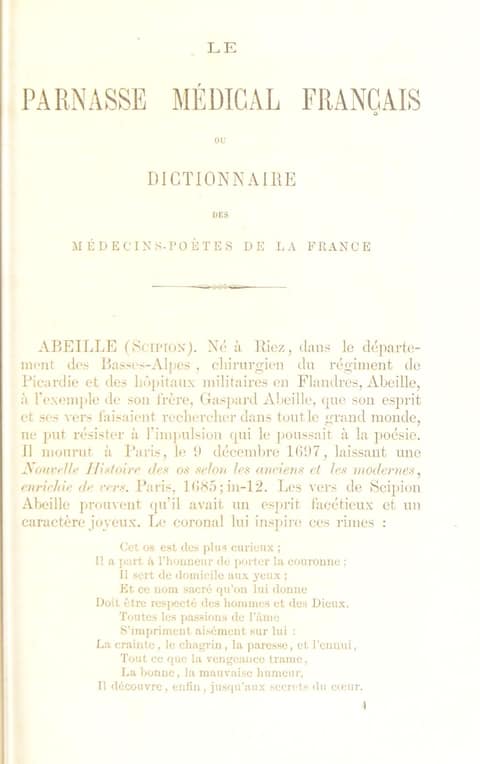
Title page of Le Parnasse médical français
Title page of Le Parnasse médical français , 1874

About this text

Provenance

This digital edition is derived from the Wellcome Collection copy of Achille Chéreau's 1874 dictionary of French physician-poets. The current reader uses the reacquired Wellcome IIIF JPEG corpus as the facsimile source of record.

Methodology

Each page is treated as a page-level unit. The page image remains the authority for the edition. Machine OCR is used as source OCR and reading aid, then corrected into French transcription, then translated into English. Word links connect the English translation to the French transcription and locations on the scans. Fifteen uncertain word-link decisions remain unlinked. Some links highlight only the text because the source word could not be located on the scan.

Rights

The source item is attributed to Wellcome Collection and marked with the Creative Commons Public Domain Mark. Poet Doctor's presentation adds generated transcription, translation, navigation metadata, and editorial context. No access control or anti-bulk-download measure should conflict with the public-domain status of the source material.

Original scans: Wellcome Collection ( Public Domain Mark 1.0 ).

Historian’s note. This text records the medicine of its own time, and later evidence has replaced most of it. It is not medical advice. We read it as history, and we ask what, if anything, connects it to medicine today. More on how we read old medical books