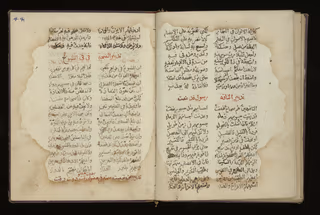
The page this poem fills. Each opens in the Ibn Sina's Urjuza fi al-tibb and other medical works in MS Arabic 129 reader.

Convalescents are healthy people whose bodies have weakened / their bodies are like traces that have faded

Their bodies have remained with barely a breath of life / and their bodies lack blood

Observe, if their bodies are afflicted with emaciation / over a long time

Then restore it little by little / and do not incline with them towards haste

Or if it occurred in a short time / then restore it much by much

But gently or gradually / until the bodies are seen in relief

Give them light food / so strengthen it in them, and with wholesome water

Keep them to rest and tranquility / for there is softness in their nerves

And incline towards treating the souls / with the goodness of a companion and a drinking partner

Give them good scents / and every flower fragrant with perfume

Employ joys and singing / and prevent them from sorrows and hardship

Have them enter the tub and the bath / and do not prolong their stay therein

Seat them in wholesome water / and pour oil over the limbs

And do not approve of vigorous massage / for it causes feverishness in him

الناقهين هم صحاح ضعفت اجسامهم مثل رسوم قد عفت

قد بقيت جسومهم ذماء وعدمت اجسامهم الدماء

انظر فان ابتليت بالنحول جسومهم في زمن طويل

فرده بالقليل فالقليل ولا تمل فيهم الى التعجيل

او حدث في زمن قصير فرده بالكثير فالكثير

لكن بلطف او على تدريج حتى يرى الجسوم في تفريج

اعطهم اللطيف من غذاء فاقوه فيهم وبماء هني

الزمهم الدعة والسكينا فان في الاعصاب منهم لينا

ومل الى العلاج في النفوس بطيب النديم والجليس

اعطهم الطيب من روائح وكل زهر بالعبير فائح

استعمل الافراح والغناء وامنعهم الاحزان والعناء

ادخلهم الابزن والحماما ولا تطل فيه لهم مقاما

اجلسهم في هني الماء وارسل الدهن على الاعضاء

ولا ترض دلكة الذكاء فانه يحدث فيه وعكاء
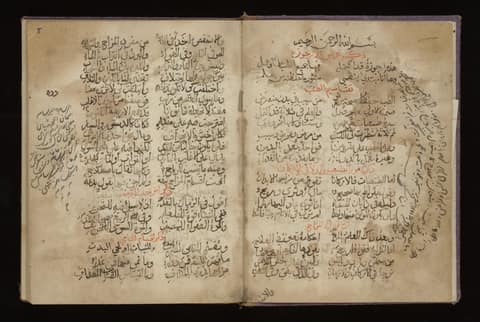
Title page of Ibn Sina's Urjuza fi al-tibb and other medical works in MS Arabic 129
Title page of Ibn Sina's Urjuza fi al-tibb and other medical works in MS Arabic 129 , 1700

About this text

Provenance

MS Arabic 129 is a handwritten Arabic medical volume held by Wellcome Collection in London. It is a composite manuscript: a single volume that brings together 11 separate works. They cover bloodletting, circumcision, the seasons, anatomy, the pulse, and urine, and most are in verse. Most of the verse in this edition is Ibn Sina's Urjuza fi al-tibb, a long poem on medicine, identified from the catalog card in the scans and from the poem's opening lines. Wellcome also names Ibn al-Tilmidh and Ibn Makki among the authors. Shams al-Din ibn Makki wrote three short poems here, and some pieces cannot be identified from the book. The manuscript is undated, and Wellcome estimates it as 18th century.

Methodology

Each scan is treated as a page-level unit. The page image remains the authority for the edition. Local Arabic Kraken OCR was weak and used only as auxiliary context; Gemini generated scan-grounded Arabic transcription and English translation primarily from the manuscript images and the approved glossary. Some word links remain uncertain, and some words have no reliable location on the scan.

Rights

The Wellcome Collection source record marks the digital surrogate with the Public Domain Mark 1.0. Poet Doctor's presentation adds generated OCR, transcription, translation, navigation metadata, and editorial context.

Original scans: Wellcome Collection ( Public Domain Mark 1.0 ).

Historian’s note. This text records the medicine of its own time, and later evidence has replaced most of it. It is not medical advice. We read it as history, and we ask what, if anything, connects it to medicine today. More on how we read old medical books