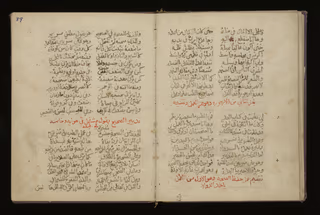
تقسيم عمل حفظ الصحة وهو الأول من العمل بأخذ الدواء

Poet
Ibn Sina
Form
Rajaz
Open the page in the book
The page this poem fills. Each opens in the Ibn Sina's Urjuza fi al-tibb and other medical works in MS Arabic 129 reader.

Hover or tap a word to see its match.

And the preservation of health in the healthy person / is by an absolute, explicit statement.

And for the one whose health is not perfect, / and it is of two kinds in practice:

That whose weakness is established in his entire being, / at every time among his times,

Like the old man, the convalescent, or the child, / for their weakness is different in actuality.

And one in whose body a sign is seen, / from which it is feared that he will be seen as ill,

Like someone whose weakness is seen through a clear deficiency / in his skin, his flesh, and his bone,

Like someone whose stomach is seen as weak, / cold by its nature, and feeble,

And from it is that whose affliction is in the womb, / like epilepsy, its bleeding, or a tumor,

And either it is seen according to ages, / and in one time rather than another time,

Like the one whose temperament is distinct in his youth, / his faculties weakening in his old age,

And a dry one who weakens in the autumn, / and in the summer is not weak.

والحفظ للصحة في الصحيح / هو بقول مطلق صريح

وللذي صحته لم تكمل / وهو على ضربين عند العمل

ما ضعفه يثبت بكل ذاته / كل وقت كان من أوقاته

كالشيخ والناقه أو كالطفل / فضعفهم مختلف بالفعل

ومن يرى في جسمه دليلا / يخاف منه أن يرى عليلا

كمن يرى الضعف بنقص يقين / في جلده أو لحمه وعظمه

كمن يرى معدته ضعيفة / باردة بطبعها سخيفة

ومنه ما آفته في الرحم / كالصرع سيلان دمه أوورم

وإما يرى حسب الاسنان / وفي زمان دون ما زمان

كمبين المزاج في صباه / ضعفت وفي كبره قواه

ويابس يضعف في الخريف / وفي المصيف ليس بالضعيف
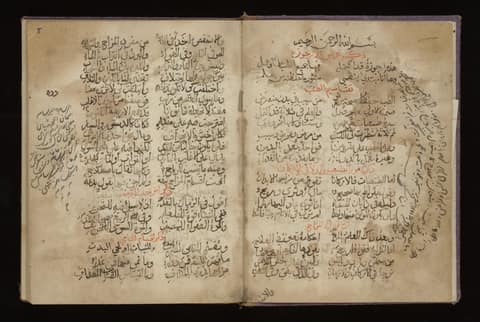
Title page of Ibn Sina's Urjuza fi al-tibb and other medical works in MS Arabic 129
Title page of Ibn Sina's Urjuza fi al-tibb and other medical works in MS Arabic 129 , 1700

About this text

Provenance

MS Arabic 129 is a handwritten Arabic medical volume held by Wellcome Collection in London. It is a composite manuscript: a single volume that brings together 11 separate works. They cover bloodletting, circumcision, the seasons, anatomy, the pulse, and urine, and most are in verse. Most of the verse in this edition is Ibn Sina's Urjuza fi al-tibb, a long poem on medicine, identified from the catalog card in the scans and from the poem's opening lines. Wellcome also names Ibn al-Tilmidh and Ibn Makki among the authors. Shams al-Din ibn Makki wrote three short poems here, and some pieces cannot be identified from the book. The manuscript is undated, and Wellcome estimates it as 18th century.

Methodology

Each scan is treated as a page-level unit. The page image remains the authority for the edition. Local Arabic Kraken OCR was weak and used only as auxiliary context; Gemini generated scan-grounded Arabic transcription and English translation primarily from the manuscript images and the approved glossary. Some word links remain uncertain, and some words have no reliable location on the scan.

Rights

The Wellcome Collection source record marks the digital surrogate with the Public Domain Mark 1.0. Poet Doctor's presentation adds generated OCR, transcription, translation, navigation metadata, and editorial context.

Original scans: Wellcome Collection ( Public Domain Mark 1.0 ).

Historian’s note. This text records the medicine of its own time, and later evidence has replaced most of it. It is not medical advice. We read it as history, and we ask what, if anything, connects it to medicine today. More on how we read old medical books