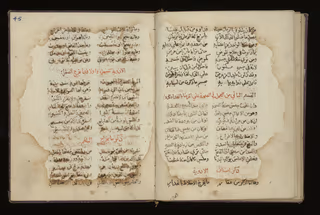
The Second Section on Practice Regarding the Health of the Sick with Food and Medication

القسم الثاني من العمل في الصحة علي المرضا بالغذا والدواء

Poet
Ibn Sina
Form
Rajaz
Open the page in the book
The page this poem fills. Each opens in the Ibn Sina's Urjuza fi al-tibb and other medical works in MS Arabic 129 reader.

And if I have arranged the genre of preserving health, / I am beginning with curing illness.

And it is one genre of practice: / you counter a thing with its opposite.

If it is from heat, then by cooling it, / or if it is from coldness, then by the opposite.

Or if it is from softness, then by drying, / or if it is from dryness, then by the contrary.

And treat repletion by evacuation / from all the organs and the brain.

And opening relates to obstructions, / and reduction to an excess in number.

And the obstruction is closed until opened, / until you see its corruption has been unblocked.

And roughening what is smooth harms the body, / so smooth out what is rough in it.

وان نظمت جنس حفظ الصحه فاني مبتدي ببرء العله

وهو من الاعمال جنس واحد تقابل الشئ بما يضادد

ان كان من حرارة فبترده او كان من برودة فبالضد

او كان عن لين فبالجفاف او كان عن يبس فبالخلاف

والامتلا داويه بالافراغ من سائر الاعضاء والدماغ

والفتح ما تعلق بالسدد والنقص من زياده في العدد

والسدد منغلق الي الفتح حتى تري فساده قد انفتح

وخشن الاملاس يؤذي البدنا وملس ما كان منه خشنا
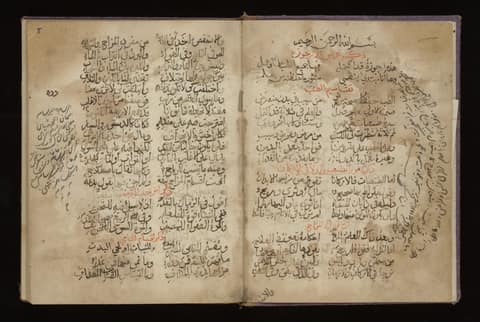
Title page of Ibn Sina's Urjuza fi al-tibb and other medical works in MS Arabic 129
Title page of Ibn Sina's Urjuza fi al-tibb and other medical works in MS Arabic 129 , 1700

About this text

Provenance

MS Arabic 129 is a handwritten Arabic medical volume held by Wellcome Collection in London. It is a composite manuscript: a single volume that brings together 11 separate works. They cover bloodletting, circumcision, the seasons, anatomy, the pulse, and urine, and most are in verse. Most of the verse in this edition is Ibn Sina's Urjuza fi al-tibb, a long poem on medicine, identified from the catalog card in the scans and from the poem's opening lines. Wellcome also names Ibn al-Tilmidh and Ibn Makki among the authors. Shams al-Din ibn Makki wrote three short poems here, and some pieces cannot be identified from the book. The manuscript is undated, and Wellcome estimates it as 18th century.

Methodology

Each scan is treated as a page-level unit. The page image remains the authority for the edition. Local Arabic Kraken OCR was weak and used only as auxiliary context; Gemini generated scan-grounded Arabic transcription and English translation primarily from the manuscript images and the approved glossary. Some word links remain uncertain, and some words have no reliable location on the scan.

Rights

The Wellcome Collection source record marks the digital surrogate with the Public Domain Mark 1.0. Poet Doctor's presentation adds generated OCR, transcription, translation, navigation metadata, and editorial context.

Original scans: Wellcome Collection ( Public Domain Mark 1.0 ).

Historian’s note. This text records the medicine of its own time, and later evidence has replaced most of it. It is not medical advice. We read it as history, and we ask what, if anything, connects it to medicine today. More on how we read old medical books