Hover or tap a word to see its match.
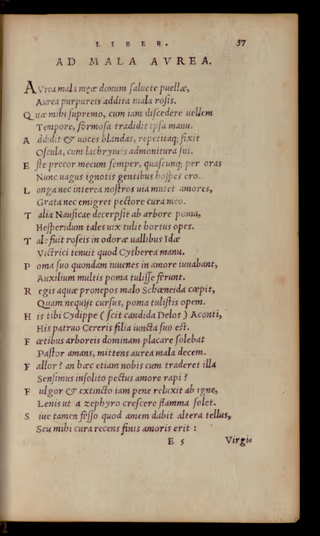
Hail, golden apples, gift of my girl,
Golden apples added to purple roses.
Which to me at the final moment, when I was already wishing to depart,
She herself handed over with her beautiful hand.
She added coaxing words too, and planted repeated
Kisses, meaning to remind me of herself with tears.
Be with me always, I pray, across whatever shores
I shall now roam as a wandering guest among unknown peoples.
And let not the long journey meanwhile alter our love,
Nor let this pleasing affection depart from my breast.
Such apples Nausicaa plucked from the tree,
Such wealth the garden of the Hesperides scarcely bore.
Such was the one in the rosy valleys of fragrant Ida
That Cytherea held in her victorious hand.
Apples formerly aided youths in their love;
They say apples have brought assistance to many.
The great-grandson of the water's king won Schoeneus's daughter with an apple;
You apples brought the help which running could not.
By these Cydippe was joined to you, Acontius (shining Delos knows it);
By these the daughter of Ceres was joined to her uncle.
With the fruits of trees the loving shepherd used to placate
His mistress, sending ten golden apples.
Am I deceived? Or when she handed these to me,
Did I feel my breast seized by an unwonted love?
And a brightness shone forth again from a fire almost extinguished,
Just as a gentle flame is wont to grow from the zephyr.
Yet whether another land will give me, exhausted, someone to love,
Or a fresh affection will be the end of my love:
It will be a delight to continually remember the beloved maiden,
I shall always be unforgetful of this gift.
AVrea mala meæ donum ſaluete puellæ,
Aurea purpureis addita mala roſis.
Quæ mihi ſupremo, cum iam diſcedere uellem
Tempore, formoſa tradidit ipſa manu.
Addidit & uoces blandas, repetitaq; fixit
Oſcula, cum lachrymis admonitura ſui.
Eſte precor mecum ſemper, quaſcunq; per oras
Nunc uagus ignotis gentibus hoſpes ero.
Longa nec interea noſtros uia mutet amores,
Grata nec emigret pectore cura meo.
Talia Nauſicae decerpſit ab arbore poma,
Heſperidum tales uix tulit hortus opes.
Tale fuit roſeis in odoræ uallibus Idæ
Victrici tenuit quod Cytherea manu.
Poma ſuo quondam iuuenes in amore iuuabant,
Auxilium multis poma tuliſſe ferunt.
Regis aquæ pronepos malo Schœneida cœpit,
Quam nequijt curſus, poma tuliſtis opem.
His tibi Cydippe (ſcit candida Delos) Aconti,
His patruo Cereris filia iuncta ſuo eſt.
Fœtibus arboreis dominam placare ſolebat
Paſtor amans, mittens aurea mala decem.
Fallor? an hæc etiam nobis cum traderet illa
Senſimus inſolito pectus amore rapi?
Fulgor & extincto iam pene reluxit ab igne,
Lenis ut a zephyro creſcere flamma ſolet.
Siue tamen feſſo quod amem dabit altera tellus,
Seu mihi cura recens finis amoris erit:
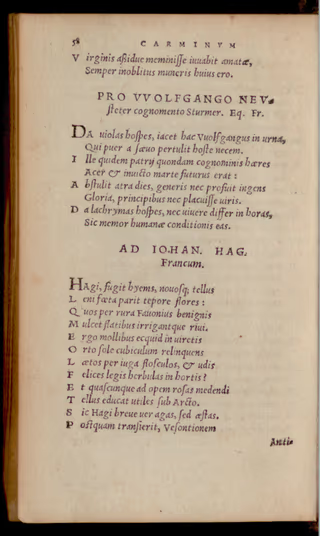
V irginis aſsidue meminiſſe iuuabit amatæ,
Semper inoblitus muneris huius ero.