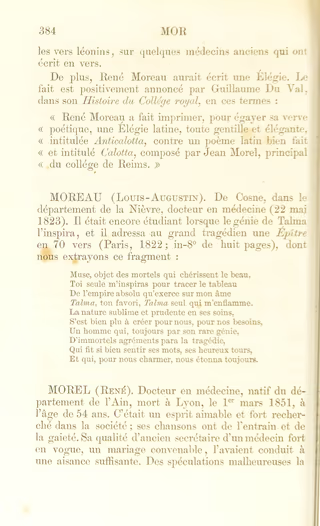
Muse, objet des mortels qui chérissent le beau,

Poet
Louis-Augustin Moreau
Form
Alexandrin
Open the page in the book
The page this poem fills. Each opens in the Le Parnasse médical français reader.

Hover or tap a word to see its match.

Muse, object of mortals who cherish the beautiful,

You alone inspired me to trace the portrait

Of the absolute empire exercised over my soul

By *Talma*, your favorite, *Talma* alone who inflames me.

Nature, sublime and prudent in her cares,

Was well pleased to create for us, for our needs,

A man who, always through his rare genius,

Adorned tragedy with immortal charms,

Who made his words and his happy turns so well felt,

And who, to charm us, always astonished us.

Muse, objet des mortels qui chérissent le beau,

Toi seule m'inspiras pour tracer le tableau

De l'empire absolu qu'exerce sur mon âme

Talma, ton favori, Talma seul qui m'enflamme.

La nature sublime et prudente en ses soins,

S'est bien plu à créer pour nous, pour nos besoins,

Un homme qui, toujours par son rare génie,

D'immortels agréments para la tragédie,

Qui fit si bien sentir ses mots, ses heureux tours,

Et qui, pour nous charmer, nous étonna toujours.
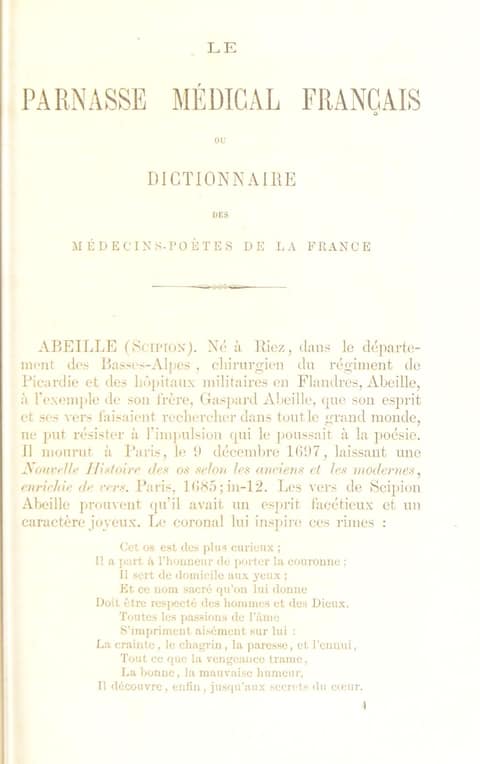
Title page of Le Parnasse médical français
Title page of Le Parnasse médical français , 1874

About this text

Provenance

This digital edition is derived from the Wellcome Collection copy of Achille Chéreau's 1874 dictionary of French physician-poets. The current reader uses the reacquired Wellcome IIIF JPEG corpus as the facsimile source of record.

Methodology

Each page is treated as a page-level unit. The page image remains the authority for the edition. Machine OCR is used as source OCR and reading aid, then corrected into French transcription, then translated into English. Word links connect the English translation to the French transcription and locations on the scans. Fifteen uncertain word-link decisions remain unlinked. Some links highlight only the text because the source word could not be located on the scan.

Rights

The source item is attributed to Wellcome Collection and marked with the Creative Commons Public Domain Mark. Poet Doctor's presentation adds generated transcription, translation, navigation metadata, and editorial context. No access control or anti-bulk-download measure should conflict with the public-domain status of the source material.

Original scans: Wellcome Collection ( Public Domain Mark 1.0 ).

Historian’s note. This text records the medicine of its own time, and later evidence has replaced most of it. It is not medical advice. We read it as history, and we ask what, if anything, connects it to medicine today. More on how we read old medical books