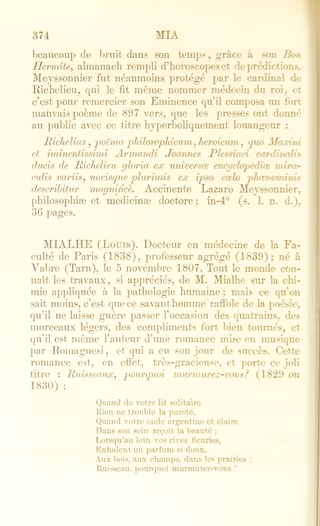
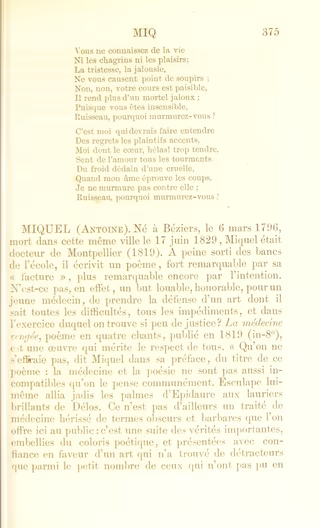
Ruisseaux, pourquoi murmurez-vous?

Poet
Louis Mialhe
Form
Octosyllables
Open the page in the book
The pages this poem fills. Each opens in the Le Parnasse médical français reader.

Hover or tap a word to see its match.

When of your solitary bed

Nothing troubles the purity,

When your clear and silvery wave

Receives beauty in its bosom;

When afar your flowery banks

Exhale so sweet a perfume,

To the woods, to the fields, in the meadows;

Brook, why do you murmur?

You know of life

Neither the sorrows nor the pleasures;

Sadness, jealousy,

Cause you no sighs;

No, no, your course is peaceful,

It makes more than one mortal jealous;

Since you are unfeeling,

Brook, why do you murmur?

It is I who should make heard

The plaintive accents of regret,

I whose heart, alas! too tender,

Feels all the torments of love.

From the cold disdain of a cruel woman,

When my soul suffers the blows,

I do not murmur against her;

Brook, why do you murmur?

Quand de votre lit solitaire

Rien ne trouble la pureté,

Quand votre onde argentine et claire

Dans son sein reçoit la beauté ;

Lorsqu'au loin vos rives fleuries,

Exhalent un parfum si doux,

Aux bois, aux champs, dans les prairies ;

Ruisseau, pourquoi murmurez-vous ?

Vous ne connaissez de la vie

Ni les chagrins ni les plaisirs ;

La tristesse, la jalousie,

Ne vous causent point de soupirs ;

Non, non, votre cours est paisible,

Il rend plus d'un mortel jaloux ;

Puisque vous êtes insensible,

Ruisseau, pourquoi murmurez-vous ?

C'est moi qui devrais faire entendre

Des regrets les plaintifs accents,

Moi dont le cœur, hélas! trop tendre,

Sent de l'amour tous les tourments.

Du froid dédain d'une cruelle,

Quand mon âme éprouve les coups,

Je ne murmure pas contre elle ;

Ruisseau, pourquoi murmurez-vous ?
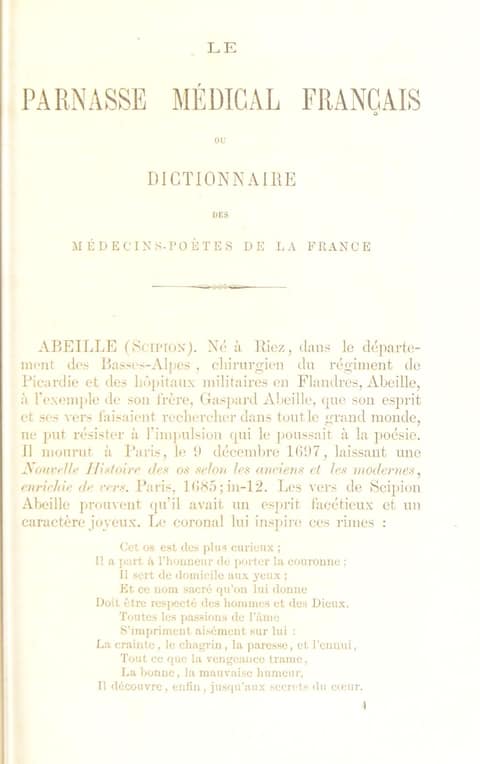
Title page of Le Parnasse médical français
Title page of Le Parnasse médical français , 1874

About this text

Provenance

This digital edition is derived from the Wellcome Collection copy of Achille Chéreau's 1874 dictionary of French physician-poets. The current reader uses the reacquired Wellcome IIIF JPEG corpus as the facsimile source of record.

Methodology

Each page is treated as a page-level unit. The page image remains the authority for the edition. Machine OCR is used as source OCR and reading aid, then corrected into French transcription, then translated into English. Word links connect the English translation to the French transcription and locations on the scans. Fifteen uncertain word-link decisions remain unlinked. Some links highlight only the text because the source word could not be located on the scan.

Rights

The source item is attributed to Wellcome Collection and marked with the Creative Commons Public Domain Mark. Poet Doctor's presentation adds generated transcription, translation, navigation metadata, and editorial context. No access control or anti-bulk-download measure should conflict with the public-domain status of the source material.

Original scans: Wellcome Collection ( Public Domain Mark 1.0 ).

Historian’s note. This text records the medicine of its own time, and later evidence has replaced most of it. It is not medical advice. We read it as history, and we ask what, if anything, connects it to medicine today. More on how we read old medical books