Hover or tap a word to see its match.
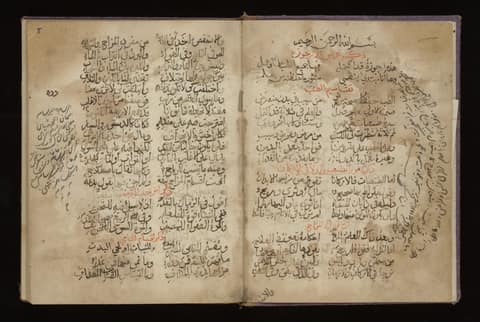
After praising God, the Possessor of Beneficence / an urjuza of elegant meanings
I mention in it the craft of circumcision / apparent, of fine exposition
If you are ordered to circumcise children / and you ensure the sitting and the approach
And adhere to gentleness and do not change / and let it not be seen slackened nor rolled up
Hold with your thumb the tip of the prepuce / and aim with the tip of the razor for the place of the lip
And balance it so that you do not injure the inner lining / at the time of your cutting, O possessors of intelligence
And raise and free, then mount the member / and cut without fear and without delay
And slide down the tip of the razor to the glans / and pull gently, for it is more establishing of correctness
For slackness may slow the descent of the razor / and the sharpness of the instrument, or the calcification
And if he comes to you with a clitoris of apparent growth / then the cutting is like the fingernail, a ruling that has been established
And make room for the adhering part above the anus / and beware lest spasms occur in it
And the totality of prepuces mentioned is five: / flattened, elongated, and pointed,
And that of two shapes, and that with a knob / the people of intelligence and experience know them
And every type has a descent / which whoever has sense understands
The flattened, he cuts it in two pieces / and the elongated one, strip it firmly
And that of two shapes, and that with the point, / we cut it with a stroke, cautiously
And if you find bleeding of blood / then sprinkle it with an astringent drug
Like myrrh, aloes, and sarcocolla / and dragon's blood, which is like nourishment to it
And calcined vitriol roasted with fire / and catechu, gallnuts, with pomegranate flower
Pounded drugs sprinkled with bean flour / and lime and pomegranate, O my friend
And if you find an inner lining that has elongated / and covered the glans and risen
Then hasten and take what has lengthened with the scissors / and cut skin with which you are satisfied
And Javanese mastic and camphor / and the ointment of the four ingredients and the dusting powder
And bring him into the bath after the seventh day / he will heal by the permission of the All-Knowing King
And if your fine circumcision occurs / on the band, without any deviation
Then bring him on the third day / to the station of the first of the bath
And soak him in the basin with its water / so that the dirt comes out with the sponge
And sprinkle him afterwards with astringents / like myrrh, aloes, and every astringent
And the circumcised one will heal, O possessor of understanding / as the people of intelligence and knowledge say
And I have gleaned this rajaz poem / apparent, explicit, and concise
من بعد حمد الله ذي الاحسان / ارجوزة ظريفة المعاني
اذكر فيها صنعة الختان / ظاهرة لطيفة البيان
اذا امرت بختن الاطفال / وتايمن الجلوس والاقبالا
ولازم بترف ولا تغير / ولا يرى مرخى ولا تشمير
امسك بابهامك طرف القلفه / واقصد براس الموس الموضع الشفه
واوزنه كى لا تجرح البطانه / فى وقت قطعك يا ذوي الفطانه
وارفع وحرّر ثم ركّب الاربا / واقطع بلا خوف ولا توانيا
وانزل براس الموسى الفيشا / واجذب برفق فهى للصواب انشا
فالرخو قد يبطى نزول الموسى / وحدت الاله او التكليس
وان اتاك ببظر بادي النمى / فالقطع مثل الظفر حكما قد نمي
وافسح للازق فوق الشرج / واحذر بان يحدث فيه الخلج
وجمله القلفات خمس تذكر / مبرطط ومسبل ومقنّز
وذو الشكالين وذات الضبه / يعرفها اهل الذكا والخبره
وكل صنف فله نزول / يفهمه من يك ذا معقول
من شرطه يقطعه قطعتين / ومسبل جرّده بالتمكين
وذو الشكالين وذات القنّز / نقطعه بضربة ومحترز
وان تجد نزفا من الدماء / فذره بقابض الدواء
كالمر والصبر وانزروت / ودم الاخوين له كالقوت
وقلقطار قد شوي بالنار / والكاد والعفص مع الجلنار
دقوق تذر مع دقيق الفول / والكلس والرمان يا خليلي
وان تجد بطانة قد اسبلت / وسترن الكمرة وقد علت
فاسرع وخذ ما طال بالمقراض / فقطع جلدا انت منه راضي
والمصطكى الجاوي والكافور / ومرهم الاربع والذرور
وادخله بعد السابع الحمام / يبرا باذن الملك العلام
وان يقع ختانك اللطيف / على السوار غير ذي تحريف
فادخله فى ثالث الايام / الى مقام اول الحمام
وانقعه بالحوض يموشه / لتخرج الاوساخ بالسفنجه
وذره من بعد بالقوابض / كالمر والصبر وكل قابض
فيبرا الختون ياذا الفهم / كما يقول اهل الذكا والعلم
وقد لقطت هذه الارجوزة / ظاهرة صريحة وجيزة