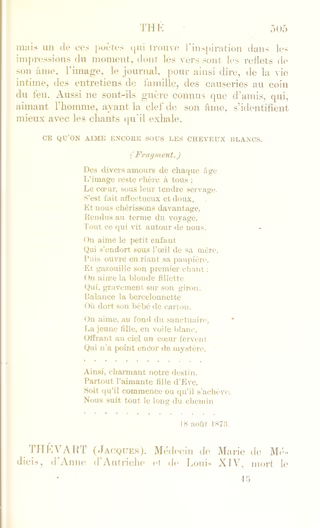
CE QU'ON AIME ENCORE SOUS LES CHEVEUX BLANCS. (Fragment.)

Poet
TESSON (Charles-Gustave)
Form
Octosyllable
Open the page in the book
The page this poem fills. Each opens in the Le Parnasse médical français reader.

Hover or tap a word to see its match.

Of the various loves of each age

The image remains dear to all;

The heart, beneath their tender servitude,

Has become affectionate and gentle,

And we cherish all the more,

Having reached the end of the journey,

Everything that lives around us.

We love the little child

Who falls asleep beneath his mother's eye,

Then laughing opens his eyelids,

And babbles his first song:

We love the little blonde girl

Who, gravely on her lap,

Rocks the little cradle

Where her cardboard baby sleeps.

We love, deep in the sanctuary,

The young girl, in a white veil,

Offering to heaven a fervent heart

Which does not yet hold any mystery.

Thus, charming our destiny,

Everywhere the loving daughter of Eve,

Whether it begins or ends,

Follows us all along the way

Des divers amours de chaque âge

L'image reste chère à tous ;

Le cœur, sous leur tendre servage,

S'est fait affectueux et doux,

Et nous chérissons davantage,

Rendus au terme du voyage,

Tout ce qui vit autour de nous.

On aime le petit enfant

Qui s'endort sous l'œil de sa mère,

Puis ouvre en riant sa paupière,

Et gazouille son premier chant :

On aime la blonde fillette

Qui, gravement sur son giron,

Balance la bercelonnette

Où dort son bébé de carton.

On aime, au fond du sanctuaire,

La jeune fille, en voile blanc,

Offrant au ciel un cœur fervent

Qui n'a point encor de mystère.

Ainsi, charmant notre destin,

Partout l'aimante fille d'Eve,

Soit qu'il commence ou qu'il s'achève,

Nous suit tout le long du chemin
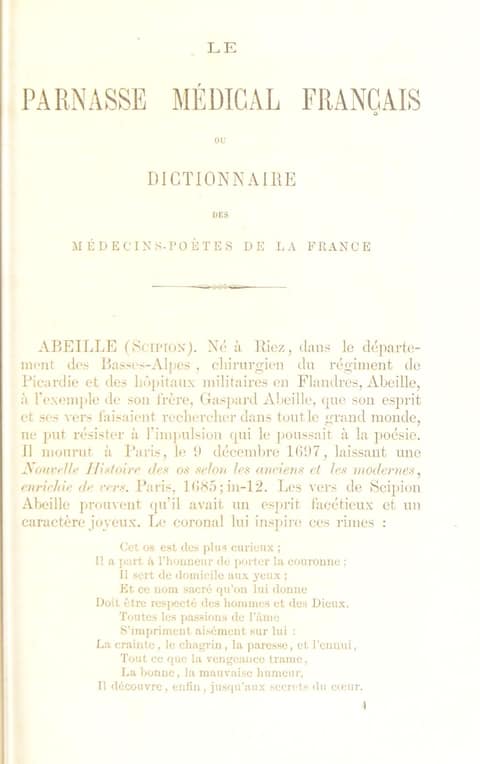
Title page of Le Parnasse médical français
Title page of Le Parnasse médical français , 1874

About this text

Provenance

This digital edition is derived from the Wellcome Collection copy of Achille Chéreau's 1874 dictionary of French physician-poets. The current reader uses the reacquired Wellcome IIIF JPEG corpus as the facsimile source of record.

Methodology

Each page is treated as a page-level unit. The page image remains the authority for the edition. Machine OCR is used as source OCR and reading aid, then corrected into French transcription, then translated into English. Word links connect the English translation to the French transcription and locations on the scans. Fifteen uncertain word-link decisions remain unlinked. Some links highlight only the text because the source word could not be located on the scan.

Rights

The source item is attributed to Wellcome Collection and marked with the Creative Commons Public Domain Mark. Poet Doctor's presentation adds generated transcription, translation, navigation metadata, and editorial context. No access control or anti-bulk-download measure should conflict with the public-domain status of the source material.

Original scans: Wellcome Collection ( Public Domain Mark 1.0 ).

Historian’s note. This text records the medicine of its own time, and later evidence has replaced most of it. It is not medical advice. We read it as history, and we ask what, if anything, connects it to medicine today. More on how we read old medical books