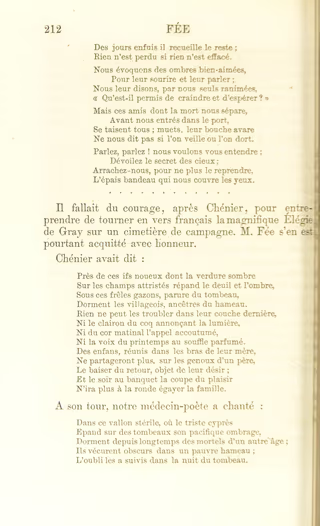
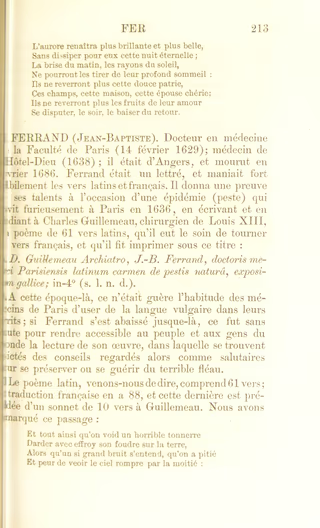
Dans ce vallon stérile, où le triste cyprès

Poet
Antoine-Laurent-Apollinaire Fée
Form
Alexandrine
Open the page in the book
The pages this poem fills. Each opens in the Le Parnasse médical français reader.

Hover or tap a word to see its match.

In this sterile valley, where the sad cypress

Spreads its peaceful shade over tombs,

Have slept for a long time mortals of another age;

They lived obscurely in a poor hamlet;

Oblivion has followed them into the night of the tomb.

The dawn will be reborn, more brilliant and more beautiful,

Without dispelling for them this eternal night;

The morning breeze, the rays of the sun,

Will not be able to draw them from their deep sleep:

They will no longer see this sweet homeland,

These fields, this house, this beloved wife;

They will no longer see the fruits of their love

Vying, in the evening, for the kiss of return.

Dans ce vallon stérile, où le triste cyprès

Epand sur des tombeaux son pacifique ombrage,

Dorment depuis longtemps des mortels d'un autre âge ;

Ils vécurent obscurs dans un pauvre hameau ;

L'oubli les a suivis dans la nuit du tombeau.

L'aurore renaîtra plus brillante et plus belle,

Sans dissiper pour eux cette nuit éternelle ;

La brise du matin, les rayons du soleil,

Ne pourront les tirer de leur profond sommeil :

Ils ne reverront plus cette douce patrie,

Ces champs, cette maison, cette épouse chérie;

Ils ne reverront plus les fruits de leur amour

Se disputer, le soir, le baiser du retour.
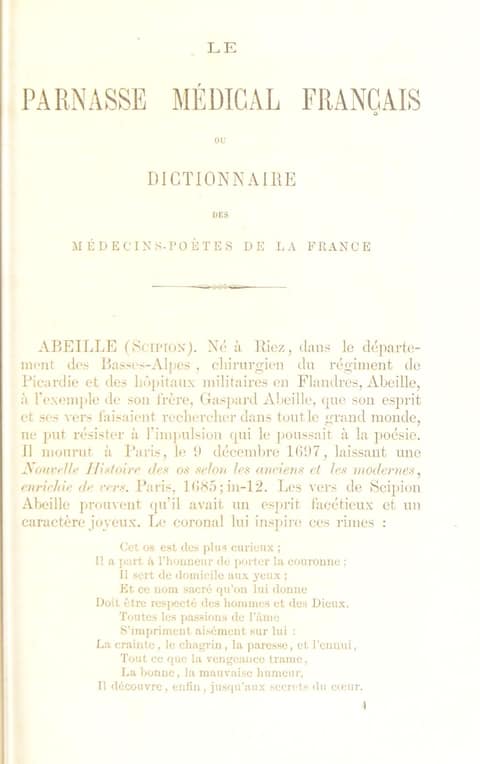
Title page of Le Parnasse médical français
Title page of Le Parnasse médical français , 1874

About this text

Provenance

This digital edition is derived from the Wellcome Collection copy of Achille Chéreau's 1874 dictionary of French physician-poets. The current reader uses the reacquired Wellcome IIIF JPEG corpus as the facsimile source of record.

Methodology

Each page is treated as a page-level unit. The page image remains the authority for the edition. Machine OCR is used as source OCR and reading aid, then corrected into French transcription, then translated into English. Word links connect the English translation to the French transcription and locations on the scans. Fifteen uncertain word-link decisions remain unlinked. Some links highlight only the text because the source word could not be located on the scan.

Rights

The source item is attributed to Wellcome Collection and marked with the Creative Commons Public Domain Mark. Poet Doctor's presentation adds generated transcription, translation, navigation metadata, and editorial context. No access control or anti-bulk-download measure should conflict with the public-domain status of the source material.

Original scans: Wellcome Collection ( Public Domain Mark 1.0 ).

Historian’s note. This text records the medicine of its own time, and later evidence has replaced most of it. It is not medical advice. We read it as history, and we ask what, if anything, connects it to medicine today. More on how we read old medical books