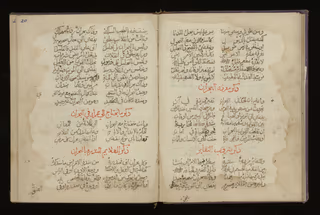
On the degrees of variation

ذكر مراتب التغاير

Poet
Ibn Sina
Form
Rajaz
Open the page in the book
The page this poem fills. Each opens in the Ibn Sina's Urjuza fi al-tibb and other medical works in MS Arabic 129 reader.

And variation has six kinds / in which diseases slow down suddenly

From a change of the body in times / of little variation and [few] conditions

It warns in what precedes it of what is praised / and that is a true, good crisis

And another is from a change that accelerates / leading to death and a terrifying evil

In which the path narrows for the physician / and that is a bad, destructive crisis

And a third is from a change that slows down / leading to a healthy, curing state

And it is not a crisis, but rather resolution / that came little by little

And a fourth slows down in change / entering the patient into the worst door

And it is not resolution, but rather wasting / that dissolves the faculties of the sick person

And a fifth is from a moderate change / leading to death and excessive evil

And a sixth leads to life / in a moderate period of time

And that is evident between the two afflictions / they are compound and they are opposites

And the good crisis is what is at the end / at the perfection of concoction with an excess of strength

And its opposite is what occurs during the ascent / and that is not a good crisis

والتغاير ضروبه ستة يبطئ فيها الامراض بغتة

من انقلاب للجسم في اوقات قليلة التغيير والحالات

ينذر فيما قبله فما يحمد وذاك بحران صحيح جيد

وغيره من انقلاب يسرع يفضي الى الموت وشر يفزع

يضيق فيه بالطبيب المسلك وذاك بحران ردي مهلك

وثالث من انقلاب يبطئ يفضي الى حال صحيح مبرئ

وليس بالبحران بل تحليل اتى على القليل فالقليل

ورابع يبطئ في انقلاب يدخل بالمريض شر باب

وليس بالتحليل بل ذبول يحل القوى من العليل

وخامس من انقلاب وسط يفضي الى الموت وشر مفرط

وسادس يفضي الى الحياة في زمن متوسط من الاوقات

وذاك بين الآفتين عيان مركبان وهما ضدان

وجيد البحران ما في المنتهى عند كمال النضج مع فرط القوى

وضده ما كان في التصعيد وهو من البحران غير جيد
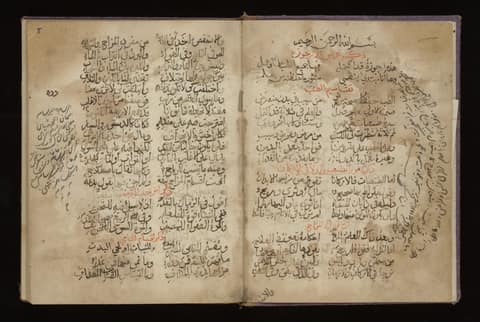
Title page of Ibn Sina's Urjuza fi al-tibb and other medical works in MS Arabic 129
Title page of Ibn Sina's Urjuza fi al-tibb and other medical works in MS Arabic 129 , 1700

About this text

Provenance

MS Arabic 129 is a handwritten Arabic medical volume held by Wellcome Collection in London. It is a composite manuscript: a single volume that brings together 11 separate works. They cover bloodletting, circumcision, the seasons, anatomy, the pulse, and urine, and most are in verse. Most of the verse in this edition is Ibn Sina's Urjuza fi al-tibb, a long poem on medicine, identified from the catalog card in the scans and from the poem's opening lines. Wellcome also names Ibn al-Tilmidh and Ibn Makki among the authors. Shams al-Din ibn Makki wrote three short poems here, and some pieces cannot be identified from the book. The manuscript is undated, and Wellcome estimates it as 18th century.

Methodology

Each scan is treated as a page-level unit. The page image remains the authority for the edition. Local Arabic Kraken OCR was weak and used only as auxiliary context; Gemini generated scan-grounded Arabic transcription and English translation primarily from the manuscript images and the approved glossary. Some word links remain uncertain, and some words have no reliable location on the scan.

Rights

The Wellcome Collection source record marks the digital surrogate with the Public Domain Mark 1.0. Poet Doctor's presentation adds generated OCR, transcription, translation, navigation metadata, and editorial context.

Original scans: Wellcome Collection ( Public Domain Mark 1.0 ).

Historian’s note. This text records the medicine of its own time, and later evidence has replaced most of it. It is not medical advice. We read it as history, and we ask what, if anything, connects it to medicine today. More on how we read old medical books