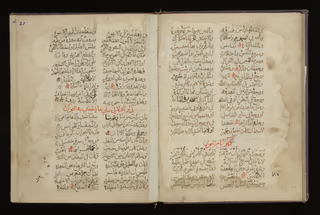
ذكر ايام البحران

Poet
Ibn Sina
Form
Rajaz
Open the page in the book
The page this poem fills. Each opens in the Ibn Sina's Urjuza fi al-tibb and other medical works in MS Arabic 129 reader.

Hover or tap a word to see its match.

And the cause of the crisis, if the report is correct / is that in diseases there is the influence of the moon

Because it is something rapid in movement / traversing its orbit in a short period

And sometimes it strengthens and sometimes it weakens / and the reckoner of the movement of the stars knows

Its influence is not in the sensible / nor in the zenith of its unfortunate cycle

When its shape becomes clear to the sense / by what has become in it of the light of the sun

And its quarter becomes distinct in the week / and its half illuminates in the week

The illness is not without an interruption / in which its good fortune weakens by nature

So if the moon persists in good fortunes / the sick person lives and his life is prolonged

And if it persists in misfortunes, he dies / and life is cut off for him and passes away

If the crisis comes in the temperaments / sometimes, and sometimes it came in the sevens

Then this crisis in them is good / leading to recovery and manifest concoction

And these run on cycles / inevitably in amount

And other than this, it has no exactness / nor consideration of its shapes

And it has no concoction and no warning / but rather in its symptoms there are dangers

And these are not praiseworthy / except in what its proportion is bad

وسبب البحران ان صح الخبر / فان في الامراض تأثير القمر

لانه شيء سريع الحركة / يقطع في عهد قليل فلكه

وتارة يقوى وطوراً يضعف / فخاب مسحة النجوم يعرف

تأثيره ليس في المحسوس / لافي سمو دوره المنحوس

حين يبين شكله للحس / ما صار فيه من ضياء الشمس

وربعه يبادر في الاسبوع / ونصفه يضيء في الاسبوع

السقم لا يكون دون قطع / يضعف فيه سعده عن طبع

فان تمادى في السعود القمر / عاش العليل واستطال العمر

وان تمادى في النحوس ماتا / وانقطع العمر به وفاتا

اذا اتا البحران في الامازج / طوراً وطوراً جافي الاسابع

فهذه البحران فيها جيد / يقضي الى برء ونضج اشهد

وهذه تجري على ادوار / لامحالة في المقدار

وغير هذي فلادق ولَه / ولامراعاة باشكاله

وما لها نضج ولا انذار / بل وفي اعراضها اخطار

وهذه ليست بمحموده / الا بما نسبته رديئه
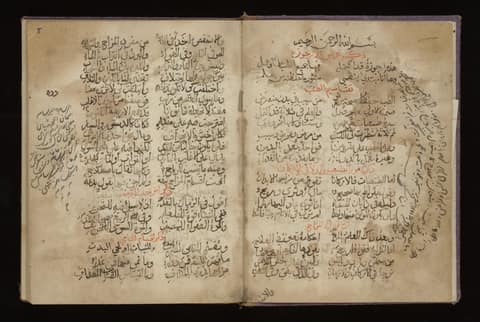
Title page of Ibn Sina's Urjuza fi al-tibb and other medical works in MS Arabic 129
Title page of Ibn Sina's Urjuza fi al-tibb and other medical works in MS Arabic 129 , 1700

About this text

Provenance

MS Arabic 129 is a handwritten Arabic medical volume held by Wellcome Collection in London. It is a composite manuscript: a single volume that brings together 11 separate works. They cover bloodletting, circumcision, the seasons, anatomy, the pulse, and urine, and most are in verse. Most of the verse in this edition is Ibn Sina's Urjuza fi al-tibb, a long poem on medicine, identified from the catalog card in the scans and from the poem's opening lines. Wellcome also names Ibn al-Tilmidh and Ibn Makki among the authors. Shams al-Din ibn Makki wrote three short poems here, and some pieces cannot be identified from the book. The manuscript is undated, and Wellcome estimates it as 18th century.

Methodology

Each scan is treated as a page-level unit. The page image remains the authority for the edition. Local Arabic Kraken OCR was weak and used only as auxiliary context; Gemini generated scan-grounded Arabic transcription and English translation primarily from the manuscript images and the approved glossary. Some word links remain uncertain, and some words have no reliable location on the scan.

Rights

The Wellcome Collection source record marks the digital surrogate with the Public Domain Mark 1.0. Poet Doctor's presentation adds generated OCR, transcription, translation, navigation metadata, and editorial context.

Original scans: Wellcome Collection ( Public Domain Mark 1.0 ).

Historian’s note. This text records the medicine of its own time, and later evidence has replaced most of it. It is not medical advice. We read it as history, and we ask what, if anything, connects it to medicine today. More on how we read old medical books