Hover or tap a word to see its match.
Aurora, the prompter of tasks, having put the shadows to flight,
Reddens in the morning, borne by the swift Medusean steed.
A former age declared that this horse, with the strikes of his winged foot,
Drew forth the veins of a new spring,
Where Helicon nourishes the maiden laurels, the rewards of poets,
And the Aonian assembly holds its shrines.
Reveal, O Pegasides, why the origin of this water
Is called Pegasus, the winged horse of Aurora?
The time (says Clio) near the rising of Memnon's mother
Is accustomed to be pleasing to the Aonian bards.
Then a greater vigor stirs within, then hearts grow warm with heaven,
As the first light favors their talents.
Thence flow the sacred waters, and eagerly the open spring
Pours forth its perennial streams in the morning.
But why is the spirited horse added to the radiant stars,
And why does the hoof that dug the waters shine so brightly?
They shine conspicuously (said the goddess) like a star,
Whom monuments of genius forbid to die.
But why does he now fly on the shield of the poet Sabinus?
Thus I spoke, and thus Clio straightaway began to answer:
Just as Pegasus is swifter than all nimble wings,
So is that man foremost in unequally joined measures.
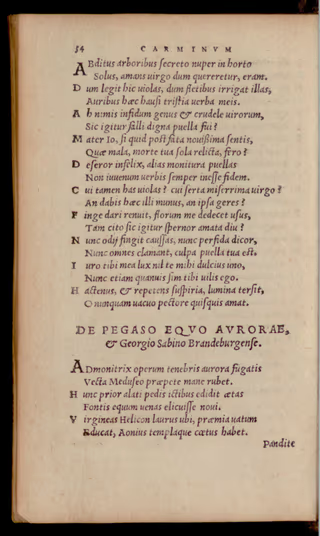
A Dmonitrix operum tenebris aurora fugatis
Vecta Meduſeo præpete mane rubet.
H unc prior alati pedis ictibus edidit ætas
Fontis equum uenas elicuiſſe noui.
V irgineas Helicon laurus ubi, præmia uatum
Educat, Aonius templaque cœtus habet.
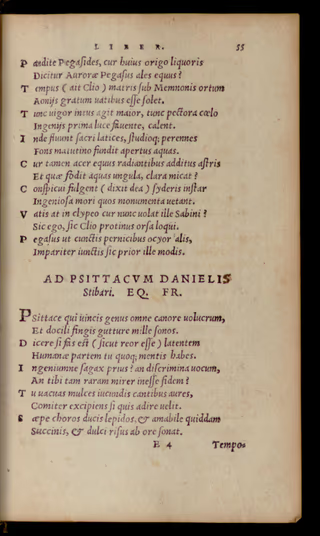
Pandite Pegaſides, cur huius origo liquoris
Dicitur Auroræ Pegaſus ales equus?
Tempus ( ait Clio ) matris ſub Memnonis ortum
Aonijs gratum uatibus eſſe ſolet.
Tunc uigor intus agit maior, tunc pectora cœlo
Ingenijs prima luce fauente, calent.
Inde fluunt ſacri latices, ſtudioq; perennes
Fons matutino fundit apertus aquas.
Cur tamen acer equus radiantibus additus aſtris
Et quæ fodit aquas ungula, clara micat?
Conſpicui fulgent ( dixit dea ) ſyderis inſtar
Ingenioſa mori quos monumenta uetant.
Vatis at in clypeo cur nunc uolat ille Sabini?
Sic ego, ſic Clio protinus orſa loqui.
Pegaſus ut cunctis pernicibus ocyor alis,
Impariter iunctis ſic prior ille modis.