Hover or tap a word to see its match.
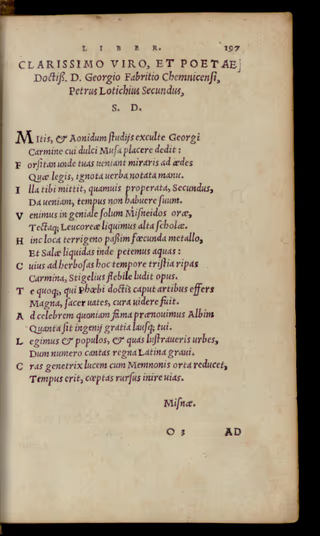
Gentle Georgius, refined by the studies of the Aonides,
to whom the Muse has granted to please with sweet song:
perhaps you wonder from where these words you read,
written by an unknown hand, come to your house.
Secundus sends them to you, although they are hurried;
grant them pardon, they did not have their proper time.
We have come to the pleasant soil of the region of Meissen,
and have left the lofty roofs of the school of Leucorea.
From here we shall make for the places everywhere rich in earth-born metal,
and from there the clear waters of the Saale:
at whose grassy banks at this time Stigelius
composes sad songs, a tearful work.
To see you too, holy bard, who raise your head
through the learned arts of Phoebus, was my great desire.
Since by reputation we knew beforehand at the famous Elbe
how great is the grace and praise of your genius.
We have read both of the peoples and the cities you have traversed,
while you sing of the Latin realms in solemn verse.
Tomorrow, when the risen mother of Memnon brings back the light,
it will be time to enter again upon the paths we have begun.
Mitis, & Aonidum studijs exculte Georgi
Carmine cui dulci Musa placere dedit:
Forsitan unde tuas ueniant miraris ad ædes
Quæ legis, ignota uerba notata manu.
Illa tibi mittit, quamuis properata, Secundus,
Da ueniam, tempus non habuere suum.
Venimus in geniale solum Misneidos oræ,
Tectaqꝫ Leucoreæ liquimus alta scholæ.
Hinc loca terrigeno passim fœcunda metallo,
Et Salæ liquidas inde petemus aquas:
Cuius ad herbosas hoc tempore tristia ripas
Carmina, Stigelius flebile ludit opus.
Te quoqꝫ, qui Phœbi doctis caput artibus effers
Magna, sacer uates, cura uidere fuit.
Ad celebrem quoniam fama prænouimus Albim
Quanta sit ingenij gratia lausqꝫ tui.
Legimus & populos, & quas lustraueris urbes,
Dum numero cantas regna Latina graui.
Cras genetrix lucem cum Memnonis orta reducet,
Tempus erit, cœptas rursus inire uias.