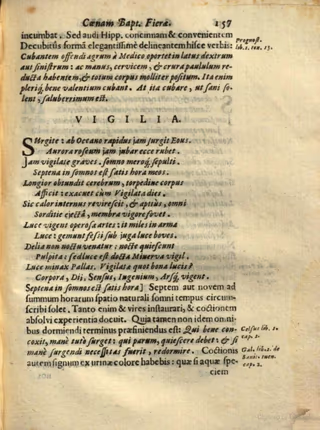
V I G I L I A.

Poet
Baptista Fiera
Form
Elegiac couplet
Open the page in the book
The page this poem fills. Each opens in the Coena, sive De cibariorum virtutibus reader.

Hover or tap a word to see its match.

A Rise: the swift morning star now rises from the Ocean.

Behold, the rosy radiance of Aurora now reddens.

Now wake up, you heavy ones, buried in sleep and unmixed wine.

Seven hours are enough for my sleep.

A longer one dulls the brain, afflicts the body

with torpor: whereas a wakeful day will sharpen it.

Thus internal heat is revived, and more aptly, with all

filth cast out, it warms the limbs with vigor.

By daylight the laborious arts flourish: the soldier goes to arms

by daylight: tired oxen groan under the yoke by daylight.

Delia does not hunt at night: at night the

stages are quiet: but by daylight learned Minerva is awake.

By daylight Pallas is threatening. How many are the goods of wakeful light?

Bodies, Gods, Senses, Intellect, and Art flourish.

SUrgite : ab Oceano rapidus jam ſurgit Eous.

Auroræ roſeum jam jubar ecce rubet.

Jam vigilate graves, ſomno meroqꝫ ſepulti.

Septena in ſomnos eſt ſatis hora meos.

Longior obtundit cerebrum, torpedine corpus

Afficit: exacuet cùm Vigilata dies.

Sic calor internus revireſcit, & aptiùs, omni

Sorditie ejectâ, membra vigore fovet.

Luce vigent operoſæ artes: it miles in arma

Luce: gemunt feſsi ſub juga luce boves.

Delia non noctu venatur: nocte quieſcunt

Pulpita: ſed luce eſt docta Minerva vigil.

Luce minax Pallas. Vigilata quot bona lucis?

Corpora, Dii, Senſus, Ingenium, Arſqꝫ vigent.
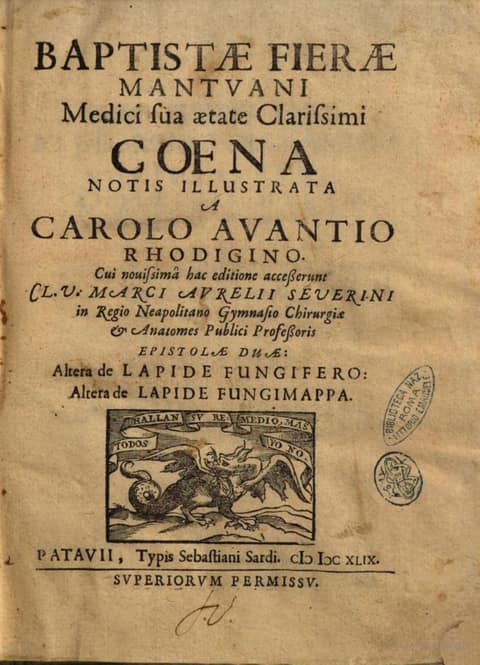
Title page of Coena, sive De cibariorum virtutibus
Title page of Coena, sive De cibariorum virtutibus , 1649

About this text

Provenance

This digital edition is derived from the Internet Archive copy of Battista Fiera's 1649 _Coena, sive De cibariorum virtutibus_, a Latin medical dinner poem with Carlo Avanzi's notes and related material.

Methodology

Each scan is treated as a page-level unit. The page image remains the authority for the edition. Local Kraken OCR used the Reichenau Latin early-print model as a reading aid, then Gemini generated scan-grounded Latin transcription and scholarly English translation from the images, the OCR aid, and the approved glossary. Word links connect the English translation to the Latin transcription and locations on the scans. 32 uncertain word-link decisions remain unlinked. Some links highlight only the text because the source word could not be located on the scan.

Rights

The Internet Archive metadata and IIIF manifest record the digital surrogate under the Creative Commons Public Domain Mark 1.0. Poet Doctor's presentation adds generated OCR, transcription, translation, navigation metadata, and editorial context.

Original scans: Internet Archive / Google Books ( Public Domain Mark 1.0 ).

Historian’s note. This text records the medicine of its own time, and later evidence has replaced most of it. It is not medical advice. We read it as history, and we ask what, if anything, connects it to medicine today. More on how we read old medical books