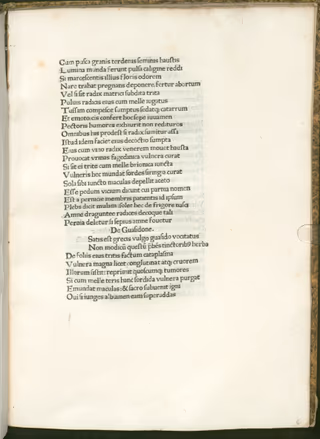
De Guaſidone.

Poet
Macer
Form
Hexameter
Open the page in the book
The page this poem fills. Each opens in the De viribus herbarum reader.

Hover or tap a word to see its match.

It is *isatis* to the Greeks, commonly called *guasido*,

an herb providing no small profit to dyers.

A poultice made from its crushed leaves

glues together wounds, even great ones, and their blood

it stops; it represses whatever tumors.

If you crush it with honey, it purges dirty wounds.

It cleanses spots, and comes to the aid of the sacred fire

if you join the white of an egg and apply it.

Iſatis eſt grecis vulgo guaſido vocitatus

Non modicū queſtū p̄bēs tinctoribꝰ herba

De foliis eius tritis factum cataplaſma

Vulnera magna licet conglutinat atqꝫ cruorem

Illorum ſiſtit: reprimit quoſcumqꝫ tumores

Si cum melle teris hanc ſordida vulnera purgat

Emundat maculas: & ſacro ſubuenit igni

Oui ſi iunges albumen eam ſuperaddas

Title page of De viribus herbarum
Title page of De viribus herbarum , 1477

About this text

Provenance

This digital edition is derived from the Bayerische Staatsbibliothek digitization of an early printed edition of De viribus herbarum, the Latin herbal poem traditionally attributed to Macer Floridus or Odo of Meung.

Methodology

Each scan is treated as a page-level unit. The page image remains the authority for the edition. Local Kraken OCR was used as a reading aid, then Gemini generated scan-grounded Latin transcription and English translation from the images, the OCR aid, and the approved glossary. Word links connect the English translation to the Latin transcription and locations on the scans. 95 uncertain word-link decisions remain unlinked. Some links highlight only the text because the source word could not be located on the scan.

Rights

The BSB IIIF manifest declares the digital surrogate under the Public Domain Mark 1.0. Poet Doctor's presentation adds generated OCR, transcription, translation, navigation metadata, and editorial context.

Original scans: Bayerische Staatsbibliothek ( Public Domain Mark 1.0 ).

Historian’s note. This text records the medicine of its own time, and later evidence has replaced most of it. It is not medical advice. We read it as history, and we ask what, if anything, connects it to medicine today. More on how we read old medical books