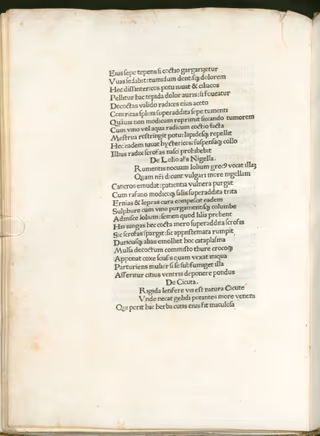
On Lolium alias Nigella.

De Lolio al̓s Nigella.

Poet
Macer
Form
Hexameter
Open the page in the book
The page this poem fills. Each opens in the De viribus herbarum reader.

Hover or tap a word to see its match.

The Greek calls that [plant], harmful to crops, *lolium*,

which our people commonly call *nigella*.

It cleanses chancres; it purges enduring wounds.

Crushed and applied with radish and a little salt,

by the same treatment it checks hernias and leprosy.

Mix *lolium* with sulfur, wine, and pigeon droppings;

join to these the seed that lilies provide;

these boiled in unmixed wine [and] applied to scrofula,

thus it scatters scrofula; thus it breaks apostemes;

and this poultice will soften other indurations.

Boiled in mead with frankincense and saffron mixed in,

let him apply it to a hip which severe sciatica troubles.

If a woman giving birth fumigates herself from below with it,

she is said to deposit the burden of her womb more quickly.

Rumentis nocuam lolium grecꝰ vocat illaꝫ

Quam nr̄i dicunt vulgari more nigellam

Cancros emūdat: patientia vulnera purgat

Cum rafano modicoqꝫ ſalis ſuperaddita trita

Ernias & lepras cura compeſcit eadem

Sulphure cum vino purgamentiſqꝫ columbe

Admiſce lolium: ſemen quod lilia prebent

His iungas hec cocta mero ſuperaddita ſcrofis

Sic ſcrofas ſpargit: ſic appnſtemata rumpit

Duriciaſqꝫ alias emolliet hoc cataplaſma

Mulſa decoctum commiſto thure crocoqꝫ

Apponat coxe ſciaſis quam vexat iniqua

Parturiens mulier ſi ſe ſubfumiget illa

Aſſeritur citius ventris deponere pondus

Title page of De viribus herbarum
Title page of De viribus herbarum , 1477

About this text

Provenance

This digital edition is derived from the Bayerische Staatsbibliothek digitization of an early printed edition of De viribus herbarum, the Latin herbal poem traditionally attributed to Macer Floridus or Odo of Meung.

Methodology

Each scan is treated as a page-level unit. The page image remains the authority for the edition. Local Kraken OCR was used as a reading aid, then Gemini generated scan-grounded Latin transcription and English translation from the images, the OCR aid, and the approved glossary. Word links connect the English translation to the Latin transcription and locations on the scans. 95 uncertain word-link decisions remain unlinked. Some links highlight only the text because the source word could not be located on the scan.

Rights

The BSB IIIF manifest declares the digital surrogate under the Public Domain Mark 1.0. Poet Doctor's presentation adds generated OCR, transcription, translation, navigation metadata, and editorial context.

Original scans: Bayerische Staatsbibliothek ( Public Domain Mark 1.0 ).

Historian’s note. This text records the medicine of its own time, and later evidence has replaced most of it. It is not medical advice. We read it as history, and we ask what, if anything, connects it to medicine today. More on how we read old medical books