Hover or tap a word to see its match.
It is called *dragius* in Greek and *portulaca* in Latin:
By the custom of the common people it is called *pes pulli*.
Its virtue is said to be moist and cold;
Third degree for moisture, and second degree for cold.
Hence it helps the fever which Greece calls *causon*
If the green herb, crushed, is placed over the stomach.
The juice provides the same if it is taken, and the chewed herb,
Or taken as a vegetable, it is accustomed to soothe heat.
Chewed or drunk, it is able to restrain an excessive flux
Of blood, and to check a harmful flux of the belly.
When crushed, it prevents the teeth from being numb.
And crushed and applied, it is beneficial for swollen eyes.
Eaten in summer, it does not allow the heat of the sun to do harm:
And it softens the belly with wine and with salt.
And eaten, it is accustomed to soothe pain of the bladder.
And often eaten, this is healthy for *haemoptoicis*.
Pliny testifies that *accidula* has similar virtues to this
In almost all respects, and equal effects.
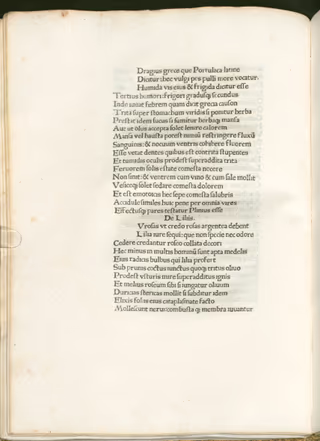
Dragius grece que Portulaca latine
Dicitur: hec vulgi pes pulli more vocatur.
Humida vis eius & frigida dicitur eſſe
Tertius humori: frigori graduſqꝫ ſecundus
Inde iuuat febrem quam dicit grecia cauſon
Trita ſuper ſtomachum viridis ſi ponitur herba
Preſtat idem ſucus ſi ſumitur herbaqꝫ manſa
Aut ut olus accepta ſolet lenire calorem
Manſa vel hauſta poteſt nimiū reſtringere fluxū
Sanguinis: & nocuum ventris cohibere fluorem
Eſſe vetat dentes quibus eſt contrita ſtupentes
Et tumidis oculis prodeſt ſuperaddita trita
Feruorem ſolis eſtate comeſta nocere
Non ſinit: & ventrem cum vino & cum ſale mollit
Veſiceqꝫ ſolet ſedare comeſta dolorem
Et eſt emotoicis hec ſepe comeſta ſalubris
Accidule ſimiles huic pene per omnia vires
Effectuſqꝫ pares teſtatur Plinius eſſe