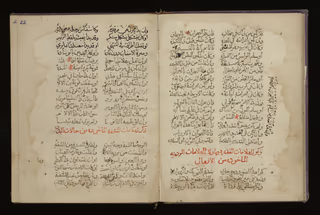
ذكر العلامات المنذره واولا العلامات الرديه المأخوذة من الافعال

Poet
Ibn Sina
Form
Rajaz
Open the page in the book
The page this poem fills. Each opens in the Ibn Sina's Urjuza fi al-tibb and other medical works in MS Arabic 129 reader.

Hover or tap a word to see its match.

Aversion to light and flowing tears / with violent movement and descending

And smallness in the eye on one side / and the mouth is open without yawning

And the person is lying on his back / his hands or his legs having gone limp

And if he begins to slip from his bed / uncovering his skin and his hand

Or he forms an unnatural shape / and begins to fiddle, picking at fluff

Or his extremities become heavy at the end / or he appears closed off from what he sees

And grinding of teeth uncharacteristically / and the hands obsessively touching the pillow

Or if he imagines a black boy / who wants to kill him when he **appears**

Or if he is in an illness with acuity / and **pus** escapes from it

Or if he appears confused in his delirium / or if he appears picking at his nostril

Or if he complains of blindness and deafness / or his strength fails from the pain

Or if he sees at the end in his sleep / snow beginning to fall upon his body

And continuous breath with coldness / that is high, for that is a fatal thing

And his waking at night and sleeping by day / or the patient lacking all sleep

Or the condition worsens with this sleep / equally, and it was the extreme of pains

And if his physician applies the Canon / and does not see a clear result for his action

كراهة الضوء ودمع جاري / بشدة التحريك وانحداري

وصغر في عين بفرد جانب / والفم مفتوح بلا تثاوب

والمرء مستلقي على قفاه / قد ارتخت يداه أو رجلاه

وان بدا يزل عن مرقده / وكاشفا من جلد ومن يده

او كان يشكل بشكل منكر / وقد بدا يعبث بلقط الزبر

او ثقلت اطرافه في المنتهى / او قد بدا مغلقا عما يرى

وصرة الاسنان دون عادة / وولع اليدين بالوسادة

او ان تخيل بغلام اسودا / يريد ان يقتله اذا **بدا**

او ان يكن في مرض ذي حده / فإنه يهرب منه **المده**

او ان بدا مبلبلا في هذيه / او ان بدا حائكا في منخره

او ان تشكى بالعمى والصمم / او سقطت قوته من الالم

او ان يراي في المنتهى في نومه / ثلجا بدا ينزل فوق جسمه

ونفس مضطرد ذو برد / عال فإن ذاك شيئاً مردي

وسهره الليل ونوم اليوم / او عدم المريض كل النوم

او ساءت الحال بذا المنام / سواء فكان غاية الآلام

وان اتى طبيبه القانونا / ولم يري لفعله مبينا
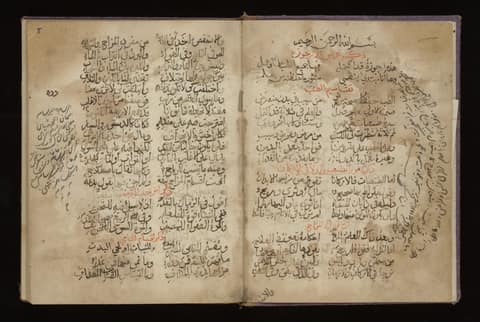
Title page of Ibn Sina's Urjuza fi al-tibb and other medical works in MS Arabic 129
Title page of Ibn Sina's Urjuza fi al-tibb and other medical works in MS Arabic 129 , 1700

About this text

Provenance

MS Arabic 129 is a handwritten Arabic medical volume held by Wellcome Collection in London. It is a composite manuscript: a single volume that brings together 11 separate works. They cover bloodletting, circumcision, the seasons, anatomy, the pulse, and urine, and most are in verse. Most of the verse in this edition is Ibn Sina's Urjuza fi al-tibb, a long poem on medicine, identified from the catalog card in the scans and from the poem's opening lines. Wellcome also names Ibn al-Tilmidh and Ibn Makki among the authors. Shams al-Din ibn Makki wrote three short poems here, and some pieces cannot be identified from the book. The manuscript is undated, and Wellcome estimates it as 18th century.

Methodology

Each scan is treated as a page-level unit. The page image remains the authority for the edition. Local Arabic Kraken OCR was weak and used only as auxiliary context; Gemini generated scan-grounded Arabic transcription and English translation primarily from the manuscript images and the approved glossary. Some word links remain uncertain, and some words have no reliable location on the scan.

Rights

The Wellcome Collection source record marks the digital surrogate with the Public Domain Mark 1.0. Poet Doctor's presentation adds generated OCR, transcription, translation, navigation metadata, and editorial context.

Original scans: Wellcome Collection ( Public Domain Mark 1.0 ).

Historian’s note. This text records the medicine of its own time, and later evidence has replaced most of it. It is not medical advice. We read it as history, and we ask what, if anything, connects it to medicine today. More on how we read old medical books