Hover or tap a word to see its match.
Parrot, who surpass the entire race of birds in song,
And fashion a thousand sounds with your teachable throat.
If it is lawful to say (as I believe it to be), you also
Possess a hidden portion of the human mind.
Should I marvel first at your sagacious intellect? Or the modulations of your voice,
Or that such rare loyalty resides in you?
You soothe idle ears with pleasant songs,
Courteously welcoming whoever wishes to approach.
Often you lead charming dances, and sing something
Lovely, and laughter rings from your sweet mouth.
Yet at fixed times you offer fitting silence,
Your mind ponders the work of whatever you are soon to sing.
Nor do you, as an informer, reveal anyone's committed fault with your voice,
No one has suffered harm from your talkativeness.
But why do you often call the black one? Does the black turtledove
Cling at all to your breast, faithful parrot?
You love this one, equal neither in honor nor in the gifts of a sweet voice,
Though yours is a form of rare color.
What ought we to do, endowed with human senses,
When birds revere the name of friendship?
Evidently, parrot, you adapt yourself to your master's character,
Hence comes this dexterity, hence such great loyalty in you.
May the gods grant that each of you survives for long years,
You, the glory of birds, and he, the glory of his time.
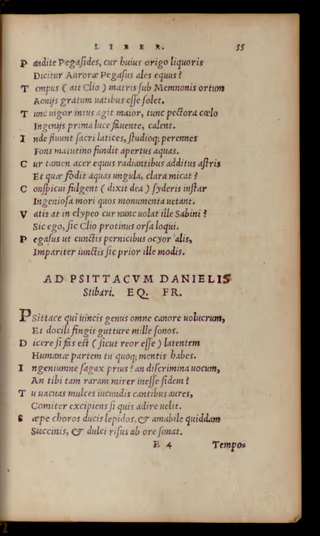
Psittace qui uincis genus omne canore uolucrum,
Et docili fingis gutture mille ſonos.
Dicere ſi fas eſt ( ſicut reor eſſe ) latentem
Humanæ partem tu quoq; mentis habes.
Ingeniumne ſagax prius? an diſcrimina uocum,
An tibi tam raram mirer ineſſe fidem?
Tu uacuas mulces iucundis cantibus aures,
Comiter excipiens ſi quis adire uelit.
Sæpe choros ducis lepidos, & amabile quiddam
Succinis, & dulci riſus ab ore ſonat.
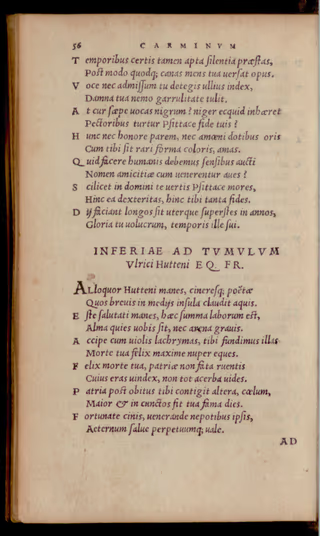
Temporibus certis tamen apta ſilentia præſtas,
Poſt modo quodq; canas mens tua uerſat opus.
Voce nec admiſſum tu detegis ullius index,
Damna tua nemo garrulitate tulit.
At cur ſæpe uocas nigrum? niger ecquid inhæret
Pectoribus turtur Pſittace fide tuis?
Hunc nec honore parem, nec amœni dotibus oris
Cum tibi ſit rari forma coloris, amas.
Quid facere humanis debemus ſenſibus aucti
Nomen amicitiæ cum uenerentur aues?
Scilicet in domini te uertis Pſittace mores,
Hinc ea dexteritas, hinc tibi tanta fides.
Dij faciant longos ſit uterque ſuperſtes in annos,
Gloria tu uolucrum, temporis ille ſui.