Hover or tap a word to see its match.
There are reported to be twin species of Celedonia.
By physicians: the first species is called the greater.
The other is called the lesser: both heal the eyes.
With this, the mother swallow restores the eyes to her blinded chicks,
As Pliny writes: she restores them even if they have been plucked out.
He says this grows when those birds arrive,
And dries up as they depart in their usual manner.
And from this it has the name celidonia, for chelidon
Is what this bird is said to be called in the custom of the Greeks.
Let the juice of the flowering plant be cooked with honey in bronze
Over a light fire until it casts off all its foam,
And the decoction takes on a thickness like that of honey;
They say no medicine is more useful for the eyes,
Which darkness oppresses, if they are often anointed with this.
Its root is crushed, with vinegar added to it,
And thus it is taken with white wine by the jaundiced.
Crushed, it prevents the pain of their teeth;
If a poultice from its crushed leaves
Is made with wine: they say it wipes away spots.
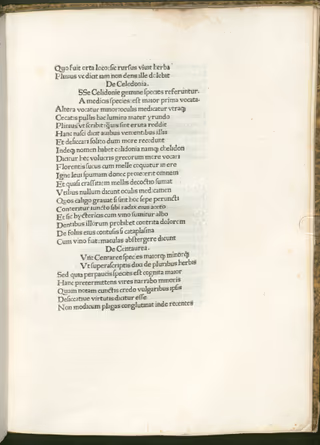
SSe Celidonie gemine ſpecies referuntur.
A medicis ſpecies: eſt maior prima vocata.
Altera vocatur minor:oculis medicatur vtraqꝫ
Cecatis pullis hac lumina mater yrundo
Plinius vt ſcribit:qͣuis ſint eruta reddit
Hanc naſci dicit auibus venientibus illis
Et deſiccari ſolito dum more recedunt
Indeqꝫ nomen habet celidonia namqꝫ chelidon
Dicitur hec volucris grecorum more vocari
Florentis ſucus cum melle coquatur in ere
Igne leui ſpumam donec proiecerit omnem
Et quaſi craſſitiem mellis decoctio ſumat
Vtilius nullum dicunt oculis medicamen
Quos caligo grauat ſi ſint hoc ſepe peruncti
Conteritur iuncto ſibi radix eius aceto
Et ſic hyctericis cum vino ſumitur albo
Dentibus illorum prohibet contrita dolorem
De foliis eius contuſis ſi cataplaſma
Cum vino fiat:maculas abſtergere dicunt