Hover or tap a word to see its match.
To be hot and dry in the first degree the skilled
Testify that spica [is]: which is called Indian nard.
Drunk, it comforts the liver: and the pain of the stomach
It mitigates: and thus its decoction cures the kidneys.
It helps the bladder: it purges urine and menses.
It is beneficial for the jaundiced: it opposes harmful humors
Which the head often transmits to the chest through the uvula.
It removes punctures and internal gripings.
Drunk, it is accustomed to drive out wind enclosed in the stomach.
Applied as a suppository, it restrains excessive flux of the womb.
If given with cold water, this is said to soothe swelling
Of the heart: and nausea is stopped by it.
This arouses sexual desire: when its liquor is often taken.
Its decoction resolves uterine hardenings
By its fomentation through the lower parts.
If those eyes are fomented quite often with it warm,
They affirm that they are rendered free from sharp itching.
And the hairs of the eyelids are well strengthened by the same.
And the species of nard which is called Celtic spikenard,
Because it grows only in the region of the Celts,
Is said to be able to do all things which Indian nard is effective for:
Although it seems to have lesser powers.
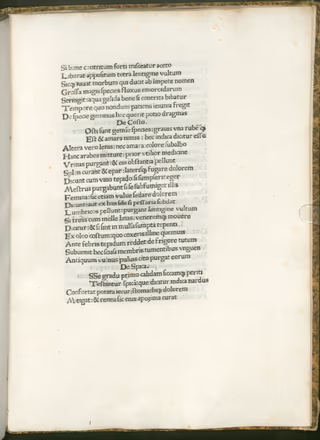
SSe gradu primo calidam ſiccamqꝫ periti
Teſtantur ſpicā: que dicitur indica nardus
Confortat potata iecur: ſtomachiqꝫ dolorem
Mitigat: & renes ſic eius apozima curat
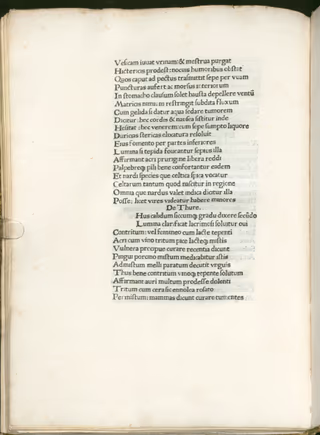
Veſicam iuuat vrinam: & meſtrua purgat
Hictericis prodeſt: nocuis humoribus obſtat
Quos caput ad pectus traſmittit ſepe per vuam
Puncturas aufert ac morſus interiorum
In ſtomacho clauſum ſolet hauſta depellere ventū
Matricis nimium reſtringit ſubdita fluxum
Cum gelida ſi datur aqua ſedare tumorem
Dicitur: hec cordis & nauſea ſiſtitur inde
Excitat: hec venerem: cum ſepe ſumpto liquore
Duricias ſtericas elixatura reſoluit
Eius fomento per partes inferiores
Lumina ſi tepida foueantur ſepius illa
Affirmant acri prurigine libera reddi
Palpebreqꝫ pili bene confortantur eadem
Et nardi ſpecies que celtica ſpica vocatur
Celtarum tantum quod naſcitur in regione
Omnia que nardus valet indica dicitur illa
Poſſe: licet vires videatur habere minores