Hover or tap a word to see its match.
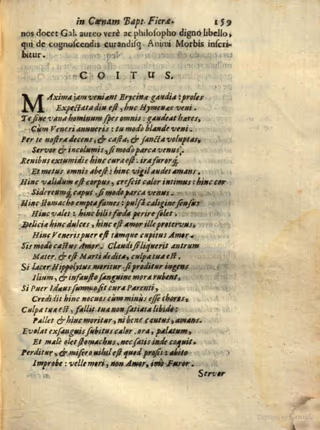
Now let the greatest joys of Erycina come: offspring
Has long been awaited, come hither, Hymenaeus.
Without you, all the hope of men is vain: let the heir rejoice,
When you have assented to Venus: only come charmingly.
Through you our pleasure is proper, and chaste, and holy,
And I am kept safe, if only Venus is sparing.
Hence there is a cure for swollen kidneys: anger and fury
And all fear are absent: hence the wakeful lover dares.
Hence the body is strong, the innermost heat grows: hence the heart
And head are starry, if only Venus is sparing.
Hence hunger is purchased for the stomach: with darkness driven away, the sense
Hence is strong: hence foul bile is accustomed to perish.
Hence are sweet delights, hence is that forward love,
Hence is the boy of Venus, and so-desired Love.
If only you are chaste Love. If the Mother has left the cave of the Lame One,
And is devoted to Mars, the fault is yours.
If torn Hippolytus dies, if massive Ilium
Is betrayed, and mulberries blush with unlucky blood,
If the Idaean Boy is a care to the highest Parent,
Since he believed beds to be less harmful hence.
The fault is yours, your unsatisfied lust deceives:
And hence the lover grows pale and dies, unless well cautious.
The sudden bloodless heat flies away, the mouth, the palate,
And the stomach smell bad, nor does it digest enough from there.
He is ruined, and there is nothing that benefits the wretched man: begone,
Wicked one: to wish to die is not Love, but indeed Madness.
MAxima jam veniant Erycinæ gaudia: proles
Expectata diu eſt, huc Hymenæe veni.
Te ſine vana hominum ſpes omnis : gaudeat hæres,
Cùm Veneri annueris : tu modò blande veni.
Per te noſtra decens, & caſta, & ſancta voluptas,
Servor & incolumis, ſi modò parca venus.
Renibus extumidis hinc cura eſt: ira furorq́;
Et metus omnis abeſt : hinc vigil audet amans.
Hinc validum eſt corpus, creſcit calor intimus: hinc cor
Sidereumq́; caput, ſi modò parca venus.
Hinc ſtomacho empta fames : pulſâ caligine ſenſus
Hinc valet : hinc bilis fœda perire ſolet.
Deliciæ hinc dulces, hinc eſt amor ille protervus,
Hinc Veneris puer eſt tamque cupitus Amor.
Sis modò caſtus Amor. Claudi ſi liquerit antrum
Mater, & eſt Marti dedita, culpa tua eſt.
Si lacer Hippolytus moritur, ſi proditur ingens
Ilium, & infauſto ſanguine mora rubent,
Si Puer Idæus ſummo ſit cura Parenti,
Credidit hinc nocuos cùm minùs eſſe thoros.
Culpa tua eſt, fallit tua non ſatiata libido:
Pallet & hinc moritur, ni bene cautus, amans.
Evolat exſanguis ſubitus calor, ora, palatum,
Et malè olet ſtomachus, nec ſatis inde coquit.
Perditur, & miſero nihil eſt quod proſit : abito
Improbe : velle mori, non Amor, imò Furor.