Hover or tap a word to see its match.
I come as a guest into this city, with few companions;
be greeted, gods and goddesses of the place.
You fertile mountains, and wholesome fields,
may you waters prove beneficial for me to have visited.
If anyone here knows both my country's name and my own,
let him extend a gentle hand to a weary man.
As to why I move slow footsteps with an unaccustomed pace,
we have made our way here from far away from the river Loire.
As to why the color on my face is dark, the sun has scorched my features;
as to why a paleness sits on the rest of my body, I am in love.
As to why my temples are not bound with the Aonian laurel,
I have not drunk as a poet from the Castalian spring.
May it be lawful for me to climb the hills celebrated by Apollo,
may it be lawful for me to set foot upon the sacred mountain.
O for someone who might show me the cultivation and character of these places,
and whatever of wonder this new region holds!
Thus I spoke; thus one man, not ignorant of the ancient age,
said: "You will be better informed by me (for we know you).
Here the lake takes its name from the Volsci; there grass-bearing
Mount Setius seeks the stars with its airy ridges.
Here dolphins used to approach the gatherings of men,
and often play among the wandering ships.
Here they drove the wandering fish into nets for the sailors,
when they leapt forth to the shallows from the broad sea.
Then making for the left, "This was once the most solid earth,"
he says, "now it is a bay; Marius excavated these shores."
One man, leading me through every detail, related such things,
and he related the customs of the people, and the wealth of the city.
A great reward for the journey, and I do not regret having endured the heat of the air,
nor the South winds so often mingled with rain.
Phoebus himself (who could believe it?) now urges his retreating
horses through the head of the Haemonian old man.
Yet the mildness of a placid sky warms the fields,
and the times pass as soothingly as those of early spring.
Neither are grasses lacking in the plains, nor shade in the mountains,
and the soil is fruitful with herbs and trees.
Here rise the rich olives, and the Citrus tree in pleasant gardens,
and the Myrtle beloved by the Idalian goddess.
And the reward for learned bards, whose labors have earned it,
is the Laurel clothed in its own berries.
And the white Mulberry is present, and it holds no monuments of blood,
whether yours, Thisbe, or yours, Pyramus.
And golden apples grow forth on sweet-smelling branches,
apples fit to be gathered even in the winter months.
And those which, imitating the pure gems of the Red Sea,
cover their bright seeds with a pale rind.
Nor are the green palms lacking, the rewards of victors,
nor the soft Lindens, and the grove of the Heliades.
You, however, I will mention first, sweetest Lotus;
imbue my songs with your juices.
How pleasing it is to visit these hills around with their leafy peak?
and to bind my hair with an untouched flower?
Rosemary, and the spikes of fragrant nard everywhere,
And thymes flourish green with two-colored juniper.
And the pleasing herb turning itself to the light of the departing sun,
From which it derived the reason for its name.
And that which, although rejoicing in streams, is made wet by no
Sprinkling, nor becomes moist when touched by rainy waters.
No less those which the Stoechades produce in the middle of the sea,
And those which, in great numbers, love the reedy shore.
Nor is the dusky red, or very similar to Tyrian purple,
Tender flower, dyed with Oebalian blood, absent.
Nor Narcissus surrounding its saffron center with white flowers,
And beautiful Adonis, born from his own grandfather.
And whatever other herbs (for I shall not list them all now)
Bear names not suited for soft elegies.
Add the fish of the sea, and in what song shall I sing of you,
Sweet wines rivaling Gnosian wine?
I shall sing of you too, Laedus, who with silent waves gently
Divide this land, twisted by no whirlpool.
The Dryads and Nymphs cherish you, and accustomed to your banks,
Many a bird soothes the river with its throat.
Here therefore it will be a delight to catch the sweet scents,
Here I shall gather violets in the purple Spring.
On these hills I shall avoid the fierce heat,
While the parched earth thirsts under the summer Dog Star.
Hail, region rich in wealth, to which the Delphic land
Yields, and shining Delos in the middle of the waters.
Hail, city, whose name the farthest fold of the world
Hears, and the rising and the setting day.
For your sake it was pleasing to endure such great labors,
You will be the one rest for my cares.
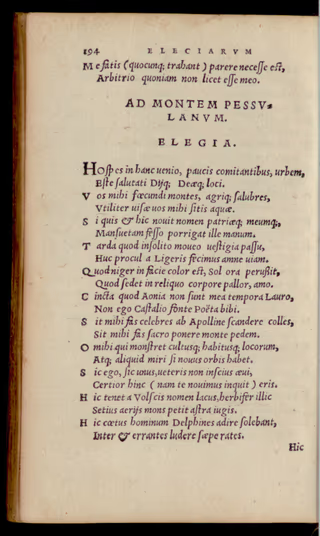
Hoſpes in hanc uenio, paucis comitantibus, urbem,
Eſte ſalutati Dijq; Deæq; loci.
Vos mihi fœcundi montes, agriq; ſalubres,
Vtiliter uiſæ uos mihi ſitis aquæ.
Si quis & hic nouit nomen patriæq; meumq;,
Manſuetam feſſo porrigat ille manum.
Tarda quod inſolito moueo ueſtigia paſſu,
Huc procul a Ligeris fecimus amne uiam.
Quod niger in facie color eſt, Sol ora peruſsit,
Quod ſedet in reliquo corpore pallor, amo.
Cincta quod Aonia non ſunt mea tempora Lauro,
Non ego Caſtalio fonte Poëta bibi.
Sit mihi fas celebres ab Apolline ſcandere colles,
Sit mihi fas ſacro ponere monte pedem.
O mihi qui monſtret cultusq; habitusq; locorum,
Atq; aliquid miri ſi nouus orbis habet.
Sic ego, ſic unus, ueteris non inſcius æui,
Certior hinc ( nam te nouimus inquit ) eris.
Hic tenet a Volſcis nomen lacus, herbifer illic
Setius aërijs mons petit aſtra iugis.
Hic cœtus hominum Delphines adire ſolebant,
Inter & errantes ludere ſæpe rates.
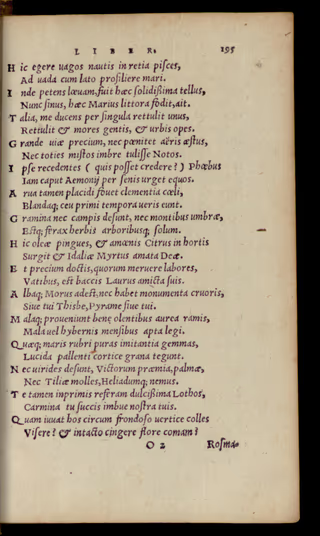
H ic egere uagos nautis in retia piſces,
Ad uada cum lato proſiliere mari.
I nde petens læuam,fuit hæc ſolidiſsima tellus,
Nunc ſinus, hæc Marius littora fodit,ait.
T alia, me ducens per ſingula rettulit unus,
Rettulit & mores gentis, & urbis opes.
G rande uiæ precium, nec pœnitet aëris æſtus,
Nec toties miſtos imbre tuliſſe Notos.
I pſe recedentes ( quis poſſet credere? ) Phœbus
Iam caput Aemonij per ſenis urget equos.
A rua tamen placidi ſouet clementia cœli,
Blandaq; ceu primi tempora ueris eunt.
G ramina nec campis deſunt, nec montibus umbræ,
Eſtq; ferax herbis arboribusq; ſolum.
H ic oleæ pingues, & amœnis Citrus in hortis
Surgit & Idaliæ Myrtus amata Deæ.
E t precium doctis,quorum meruere labores,
Vatibus, eſt baccis Laurus amicta ſuis.
A lbaq; Morus adeſt,nec habet monumenta cruoris,
Siue tui Thisbe,Pyrame ſiue tui.
M alaq; proueniunt benę olentibus aurea ramis,
Mala uel hybernis menſibus apta legi.
Q uæq; maris rubri puras imitantia gemmas,
Lucida pallenti cortice grana tegunt.
N ec uirides deſunt, Victorum præmia,palmæ,
Nec Tiliæ molles,Heliadumq; nemus.
T e tamen inprimis referam dulciſsima Lothos,
Carmina tu ſuccis imbue noſtra tuis.
Q uam iuuat hos circum frondoſo uertice colles
Viſere? & intacto cingere flore comam?
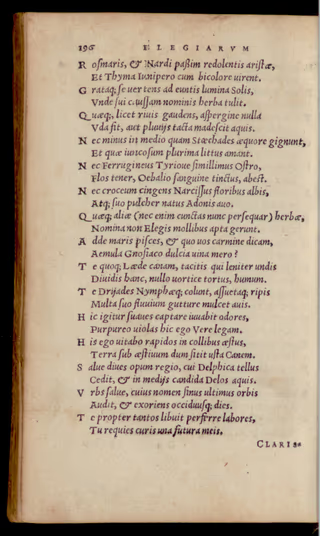
Roſmaris, & Nardi paßim redolentis ariſtæ,
Et Thyma Iunipero cum bicolore uirent.
Grataq; ſe uertens ad euntis lumina Solis,
Vnde ſui cauſſam nominis herba tulit.
Quæq;, licet riuis gaudens, aſpergine nulla
Vda ſit, aut pluuijs tacta madeſcit aquis.
Nec minus in medio quam Stœchades æquore gignunt,
Et quæ iuncoſum plurima littus amant.
Nec Ferrugineus Tyrioue ſimillimus Oſtro,
Flos tener, Oebalio ſanguine tinctus, abeſt.
Nec croceum cingens Narciſſus floribus albis,
Atq; ſuo pulcher natus Adonis auo.
Quæq; aliæ (nec enim cunctas nunc perſequar) herbæ,
Nomina non Elegis mollibus apta gerunt.
Adde maris piſces, & quo uos carmine dicam,
Aemula Gnoſiaco dulcia uina mero?
Te quoq; Læde canam, tacitis qui leniter undis
Diuidis hanc, nullo uortice tortus, humum.
Te Drijades Nymphæq; colunt, aſſuetaq; ripis
Multa ſuo fluuium gutture mulcet auis.
Hic igitur ſuaues captare iuuabit odores,
Purpureo uiolas hic ego Vere legam.
His ego uitabo rapidos in collibus æſtus,
Terra ſub æſtiuum dum ſitit uſta Canem.
Salue diues opum regio, cui Delphica tellus
Cedit, & in medijs candida Delos aquis.
Vrbs ſalue, cuius nomen ſinus ultimus orbis
Audit, & exoriens occiduuſq; dies.
Te propter tantos libuit perferre labores,
Tu requies curis una futura meis.