Hover or tap a word to see its match.
Friend to the Muses, dedicated to the Graces,
Bononia, flower of cities.
Or if you prefer to be called cultured Felsina,
beautiful by either name.
Hail, O charming city, which the Rhenus
wanders through with its glassy stream.
It is now the fifth day since from your blessed walls
I, forced, set forth my foot.
Following my Marius, and sincere Glauburg,
under an ill-omened bird.
And I saw Mutina, and Rhegium, and Parma,
the fatherland of fierce men.
As when a stag traverses the high ridges,
While the unbridled heat rages:
He sighs for resting places wet with the streams
Of hidden valleys.
So I, a poor traveler, alas, from my inmost
Breast have longed for you.
The day was bitter, the night more bitter,
The night, privy to a harsh love.
But now I return, O my hope and rest,
Weary in all my marrow.
I call to witness the divine power of the immortal Gods,
And the golden radiance of the Sun:
I would not more joyfully revisit my dearest
Homeland after five lustra.
Scarcely do I see the towers, and with the greatest
Joy my heart begins to leap.
My spirit melts, and sweet pleasure
Draws forth copious tears.
Go, scatter flowers; go, boy, cover my
Doors with soft marjoram.
Why do you murmur, idle neighborhood?
It is not right to know everything.
Hail, O three and four times beautiful Felsina,
And bless your inhabitants.
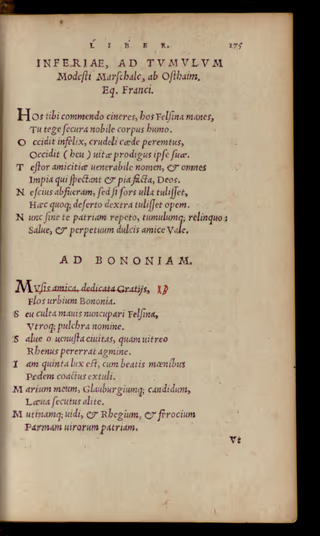
Mvſis amica, dedicata Gratijs,
Flos urbium Bononia.
Seu culta mauis nuncupari Felſina,
Vtroq; pulchra nomine.
Salue o uenuſta ciuitas, quam uitreo
Rhenus pererrat agmine.
Iam quinta lux eſt, cum beatis mœnibus
Pedem coactus extuli.
Marium meum, Glauburgiumq; candidum,
Læua ſecutus alite.
Mutinamq; uidi, & Rhegium, & ferocium
Parmam uirorum patriam.
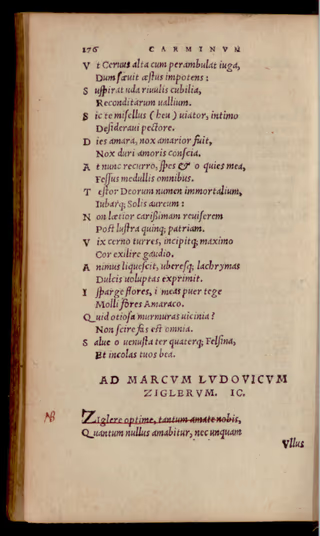
Vt Ceruus alta cum perambulat iuga,
Dum ſæuit æſtus impotens:
Suſpirat uda riuulis cubilia,
Reconditarum uallium.
Sic te miſellus (heu) uiator, intimo
Deſideraui pectore.
Dies amara, nox amarior fuit,
Nox duri amoris conſcia.
At nunc recurro, ſpes & o quies mea,
Feſſus medullis omnibus.
Teſtor Deorum numen immortalium,
Iubarq; Solis aureum:
Non lætior cariſsimam reuiſerem
Poſt luſtra quinq; patriam.
Vix cerno turres, incipitq; maximo
Cor exilire gaudio.
Animus liqueſcit, ubereſq; lachrymas
Dulcis uoluptas exprimit.
I ſparge flores, i meas puer tege
Molli fores Amaraco.
Quid otioſa murmuras uicinia?
Non ſcire fas eſt omnia.
Salue o uenuſta ter quaterq; Felſina,
Et incolas tuos bea.