Hover or tap a word to see its match.
As when the Lord had forged the new bodies of the world,
The Spirit of God warmed them with its fire,
And gave fruitful growth to newborn things,
Rendering all things full of vigor by its power:
So may you offer comforts to the wretched in a harsh time,
So may you warm the pious assemblies, O gentle Spirit.
With you as guide, let the Church lay aside her complaining sorrows,
freed from the weight of cares by your divine power.
And as she is oppressed by evils and weary with aged years,
refresh her languishing limbs with your breath.
Dispel anxious terrors, supply strength,
allow hearts to harbor nothing of blind night.
Let a zeal that loves truth be present, and uprightness, and faith,
through which we enter the path to the heavenly dwelling.
And let the almighty breath of your breeze strengthen us,
a solace in all evils when the enemy rages.
Raise up the fearful, and those in need of heavenly help,
protect them, just as a bird covers its eggs with soft feathers.
You are the rest of the mind, your fire tempers all things,
whatever breathes anywhere is your gift.
You govern the wondrous work of the threefold world,
and you teach all things to keep eternal faith.
And the liquid tracts of the air, and the paths of heaven,
and whatever is born in the whole world, you cherish.
Your power makes the great heaven move in a swift whirl,
with uninterrupted courses.
You rule, rising against them with an oblique effort,
all the stars that shine by fixed laws.
And the brightest lights that complete their motions,
without you the sun and moon would stand still with halted horses.
Your power clothes the fruitful hills with greening grass
and adorns the ground with countless flowers.
You soothe the wide plains with a fertile breeze,
so that the fields may load their heavy laps with crops.
Thus look upon the wretched, thus console the fallen,
help with your health-bringing dew, O kindly Spirit.
May blessed hearts grow warm as you stir them with flames,
And may God be the one whom alone they wish to please.
And let not threatening commands turn us from the sacred word,
May death also yield, conquered by your help.
So that, when it leaves the fragile limbs with the final light,
The spirit may live in the citadel of the eternal home.
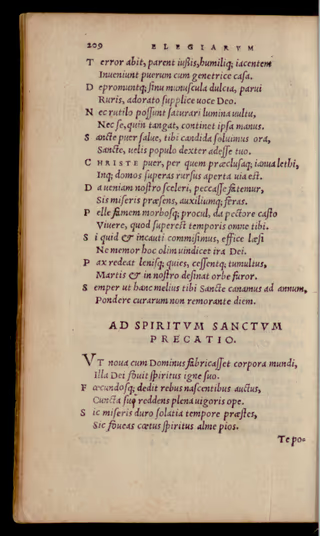
VT noua cum Dominus fabricaſſet corpora mundi,
Illa Dei fouit ſpiritus igne ſuo.
Fœcundoſq; dedit rebus naſcentibus auctus,
Cuncta ſuo reddens plena uigoris ope.
Sic miſeris duro ſolatia tempore præſtes,
Sic foueas cœtus ſpiritus alme pios.
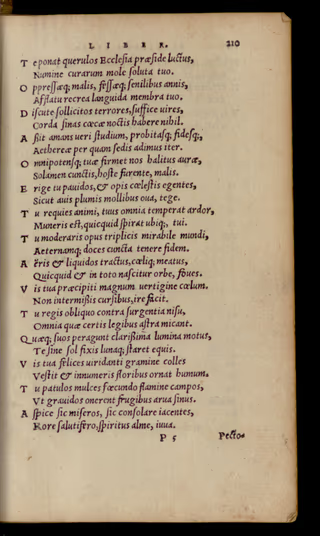
T e ponat querulos Eccleſia præſide luctus,
Numine curarum mole ſoluta tuo.
O ppreſſæq; malis, feſſæq; ſenilibus annis,
Afflatu recrea languida membra tuo.
D iſcute ſollicitos terrores, ſuffice uires,
Corda ſinas cæcæ noctis habere nihil.
A ſsit amans ueri ſtudium, probitaſq; fideſq;,
Aethereæ per quam ſedis adimus iter.
O mnipotenſq; tuæ firmet nos halitus auræ,
Solamen cunctis, hoſte furente, malis.
E rige tu pauidos, & opis cœleſtis egentes,
Sicut auis plumis mollibus oua, tege.
T u requies animi, tuus omnia temperat ardor,
Muneris eſt, quicquid ſpirat ubiq;, tui.
T u moderaris opus triplicis mirabile mundi,
Aeternamq; doces cuncta tenere fidem.
A ëris & liquidos tractus, cœliq; meatus,
Quicquid & in toto naſcitur orbe, foues.
V is tua præcipiti magnum uertigine cœlum,
Non intermiſsis curſibus, ire facit.
T u regis obliquo contra ſurgentia niſu,
Omnia quæ certis legibus aſtra micant.
Q uæq; ſuos peragunt clariſsima lumina motus,
Te ſine ſol fixis lunaq; ſtaret equis.
V is tua felices uiridanti gramine colles
Veſtit & innumeris floribus ornat humum,
T u patulos mulces fœcundo flamine campos,
Vt grauidos onerent frugibus arua ſinus.
A ſpice ſic miſeros, ſic conſolare iacentes,
Rore ſalutifero, ſpiritus alme, iuua.
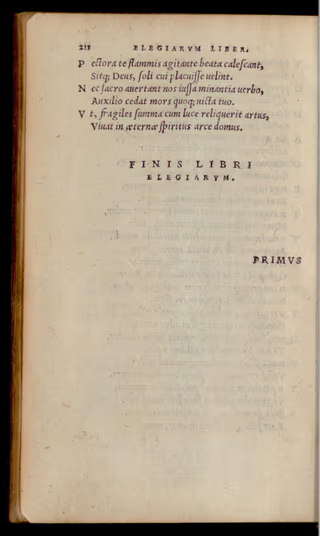
Pectora te flammis agitante beata caleſcant,
Sitq; Deus, ſoli cui placuiſſe uelint.
Nec ſacro auertant nos iuſſa minantia uerbo,
Auxilio cedat mors quoq; uicta tuo.
Vt, fragiles ſumma cum luce reliquerit artus,
Viuat in æternæ ſpiritus arce domus.