Hover or tap a word to see its match.
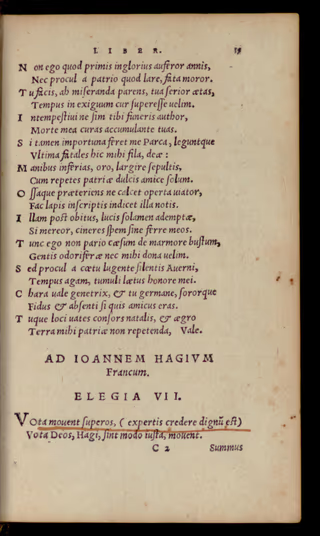
Prayers move the gods above (it is right to believe those who have experienced it);
Prayers move the gods, Hagius, provided they are just.
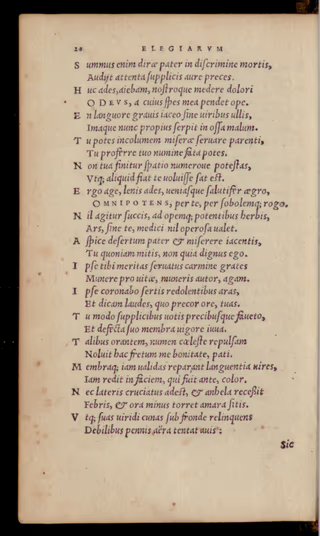
For the highest Father, in the crisis of dire death,
Heard the prayers of the suppliant with an attentive ear.
"Draw near," I said, "and heal my pain,
O GOD, upon whose help my hope depends.
Behold, heavy with illness I lie without any strength,
And now the sickness creeps closer into my inmost bones.
You are able to keep me safe for my wretched parent,
You can defer my fate by your divine will.
Your power is not bounded by space or number,
And for something to happen, it is enough that you have willed it.
Come then, be present gently, and come bringing health to the sick,
ALMIGHTY, by yourself, and by your Son, I pray.
Nothing is accomplished by potions, and by herbs potent for help,
Without you, the laborious art of the physician avails nothing.
Look upon the forsaken, Father, and take pity on him who lies low,
Since you are merciful, not because I am worthy.
I myself, preserved, will give you deserved thanks in song,
In return for the gift of life, O author of the gift.
I myself will wreathe your altars with fragrant garlands,
And will speak your praises with the mouth with which I pray.
Only look with favor upon my suppliant vows and prayers,
And aid my limbs, drained of their vigor."
As I prayed with such words, the heavenly power did not wish
Me, relying on this goodness, to suffer a refusal.
And now my languishing limbs recover robust strength,
Now the color that was there before returns to my face.
Nor is the agony of my side present, and the panting fever
Has receded, and bitter thirst scorches my mouth less.
And as a bird, leaving its cradle beneath the green foliage,
Tests the air with feeble wings:
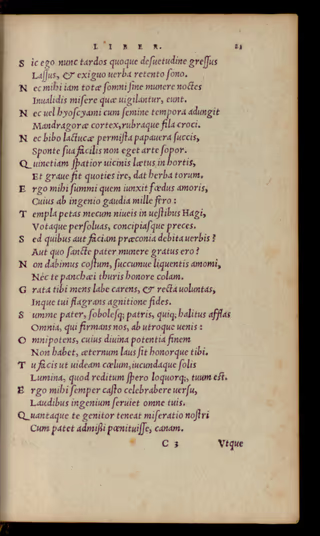
Thus I now also, weary from disuse, attempt my slow steps again,
And my words with a faint sound.
Nor do whole nights now pass for me without the gift of sleep,
Which are wretchedly spent awake by the sick.
Nor does the bark of mandrake, along with the seed of henbane,
And the red threads of saffron, anoint my temples.
Nor do I drink poppies mixed with the juices of lettuce;
My sleep, easy of its own accord, needs no art.
Moreover, I gladly walk in the neighboring gardens,
And whenever walking is burdensome, the grass provides a bed.
Therefore, you whom the bond of highest love has joined to me,
From whose mind I derive a thousand joys:
Seek the temples with me in snow-white garments, Hagius,
And fulfill your vows, and utter prayers.
But with what words shall I make the due praises?
Or with what gift, holy Father, shall I be grateful?
We shall not give costus, or the juice of liquid amomum,
Nor shall I worship you with the honor of Panchaean frankincense.
Pleasing to you is a mind lacking blemish, and a righteous will,
And a faith burning in the acknowledgment of you.
Highest Father, and offspring of the Father, and you, the Breath who breathe upon
All things, who, strengthening us, come from both:
Almighty One, whose divine power has no end,
Let there be eternal praise and honor to you.
You make it so that I see the sky, and the sun's pleasant
Lights; that I hope for a return and speak, is your doing.
Therefore you will always be celebrated by me in chaste verse;
All my talent will serve your praises.
And I will sing how great a compassion for us possesses you, Father,
When it is clear that we have repented of our offense.
And how the Son was brought forth from the womb of the Palestinian virgin,
not less than his boundless Father.
Then I shall speak of the cruel punishments, and the bitter death,
and the human race, the great reward of death.
Only do not allow the wars that now roar in motion, horrid wars,
to proceed further through sad delays.
So that fierce discord, the mother of civil war,
and martial fury may cease in our world.
Then it will be a joy to strike the resounding strings for you, a work of peace,
then to ply the plectrum of the unaccustomed lyre for you.
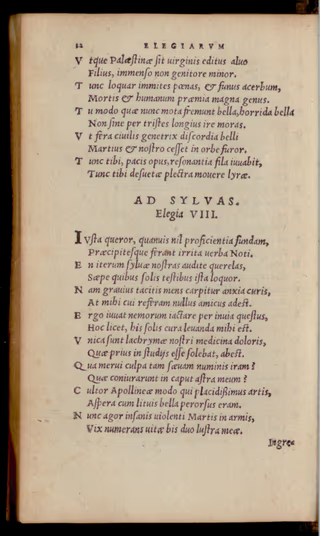
Vota mouent ſuperos, (expertis credere dignũ eſt)
Vota Deos, Hagi, ſint modo iuſta, mouent.
Summus enim diræ pater in diſcrimine mortis,
Audijt attenta ſupplicis aure preces.
Huc ades, aiebam, noſtroque medere dolori
O DEVS, a cuius ſpes mea pendet ope.
En languore grauis iaceo ſine uiribus ullis,
Imaque nunc propius ſerpit in oſſa malum.
Tu potes incolumem miſeræ ſeruare parenti,
Tu proferre tuo numine fata potes.
Non tua finitur ſpatio numeroue poteſtas,
Vtq; aliquid fiat te uoluiſſe ſat eſt.
Ergo age, lenis ades, ueniaſque ſalutifer ægro,
OMNIPOTENS, per te, per ſobolemq; rogo.
Nil agitur ſuccis, ad opemq; potentibus herbis,
Ars, ſine te, medici nil operoſa ualet.
Aſpice deſertum pater & miſerere iacentis,
Tu quoniam mitis, non quia dignus ego.
Ipſe tibi meritas ſeruatus carmine grates
Munere pro uitæ, muneris autor, agam.
Ipſe coronabo ſertis redolentibus aras,
Et dicam laudes, quo precor ore, tuas.
Tu modo ſupplicibus uotis precibuſque faueto,
Et defecta ſuo membra uigore iuua.
Talibus orantem, numen cœleſte repulſam
Noluit hac fretum me bonitate, pati.
Membraq; iam ualidas reparant languentia uires,
Iam redit in faciem, qui fuit ante, color.
Nec lateris cruciatus adeſt, & anhela receßit
Febris, & ora minus torret amara ſitis.
Vtq; ſuas uiridi cunas ſub fronde relinquens
Debilibus pennis aëra tentat auis:
S ic ego nunc tardos quoque deſuetudine greſſus
Laſſus, & exiguo uerba retento ſono.
N ec mihi iam totæ ſomni ſine munere noctes
Inualidis miſere quæ uigilantur, eunt.
N ec uel hyoſcyami cum ſemine tempora adungit
Mandragoræ cortex, rubraque fila croci.
N ec bibo lactucæ permiſta papauera ſuccis,
Sponte ſua facilis non eget arte ſopor.
Q uinetiam ſpatior uicinis lætus in hortis,
Et graue ſit quoties ire, dat herba torum.
E rgo mihi ſummi quem iunxit fœdus amoris,
Cuius ab ingenio gaudia mille fero:
T empla petas mecum niueis in ueſtibus Hagi,
Votaque perſoluas, concipiaſque preces.
S ed quibus aut faciam præconia debita uerbis?
Aut quo ſancte pater munere gratus ero?
N on dabimus coſtum, ſuccumue liquentis amomi,
Nec te panchæi thuris honore colam.
G rata tibi mens labe carens, & recta uoluntas,
Inque tui flagrans agnitione fides.
S umme pater, ſoboleſq; patris, quiq; halitus afflas
Omnia, qui firmans nos, ab utroque uenis:
O mnipotens, cuius diuina potentia finem
Non habet, æternum laus ſit honorque tibi.
T u facis ut uideam cœlum, iucundaque ſolis
Lumina, quod reditum ſpero loquorq;, tuum eſt.
E rgo mihi ſemper caſto celebrabere uerſu,
Laudibus ingenium ſeruiet omne tuis.
Q uantaque te genitor teneat miſeratio noſtri
Cum patet admiſsi pœnituiſſe, canam.
V tque Palæſtinæ ſit uirginis editus aluo
Filius, immenſo non genitore minor.
T unc loquar immites pœnas, & funus acerbum,
Mortis & humanum præmia magna genus.
T u modo quæ nunc mota fremunt bella, horrida bella
Non ſine per triſtes longius ire moras.
V t fera ciuilis genetrix diſcordia belli
Martius & noſtro ceſſet in orbe furor.
T unc tibi, pacis opus, reſonantia fila iuuabit,
Tunc tibi deſuetæ plectra mouere lyræ.