Hover or tap a word to see its match.
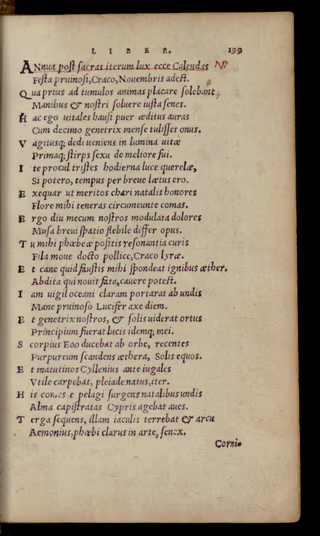
Behold, Craco, the annual festive day is here again
after the sacred Calends of frosty November,
on which our ancestors formerly used to appease souls at the tombs,
and pay their due rites to the shades.
On this day I was born a boy and drew in the breath of life,
when my mother had carried her burden into the tenth month.
And I uttered cries coming into the light of life,
and I was the first offspring of the stronger sex.
Go far away, sad complaints, on this day's light;
if I am able, I shall be joyful for a brief time,
so that I may perform the deserved honors of my dear birthday,
with a flower encircling my tender locks.
Therefore, Muse, who has long sung our sorrows with me,
delay your tearful work for a short space.
You, Craco, set cares aside and strike the resounding strings
of the Phoebean lyre with your learned thumb for me,
and sing what the heavens promise me with auspicious fires.
He who knows hidden fates can take precaution.
Already wakeful Lucifer had brought the bright day from the ocean waves
on his frosty morning axle.
And my mother had seen both my birth and the sun's rising:
the beginning of the daylight was also my own.
Scorpio was leading the fresh horses of the Sun from the Eastern realm,
climbing the purple heavens.
And the Cyllenian, born of a Pleiad, was making
his useful journey before the morning steeds.
As a companion to these, rising from her natal sea-waves,
nurturing Cypris was driving her harnessed birds.
Following behind her, the Haemonian old man, renowned in Phoebus's art,
was terrifying her with his darts and bow.
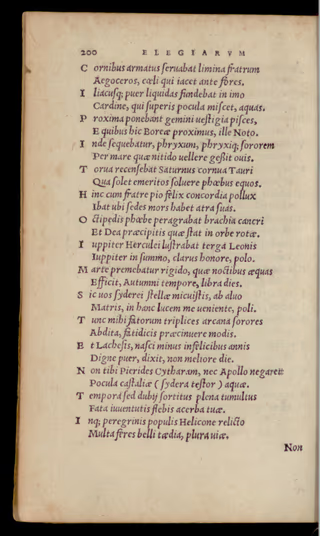
Armed with horns, Aegoceros was guarding the thresholds of the brothers,
he who lies before the doors of heaven.
And the Trojan boy, who mixes cups for the gods above,
was pouring liquid waters at the lowest cardinal point.
The twin fishes were placing their nearest footprints,
of which this one is closest to Boreas, that one to Notus.
Then followed the sheep with the shining fleece,
which carried Phrixus and the sister of Phrixus across the sea.
Saturn was surveying the grim horns of the Bull,
where Phoebus is wont to unyoke his weary horses.
From here Pollux, a happy concord with his pious brother,
was going where black death holds its seats.
Phoebe was wandering through the arms of the eight-footed Crab,
and the Goddess who stands upon the orb of the rushing wheel.
Jupiter was traversing the back of the Herculean Lion,
Jupiter at the highest pole, bright with honor.
The Balance, which makes the days equal to the nights
in the season of Autumn, was pressed by rigid Mars.
Thus did you shine, you stars of the starry heaven,
as I came from my mother's womb into this light.
Then the threefold sisters of the fates foretold
hidden secrets to me in prophetic measures.
And Lachesis said, "Boy, worthy to be born in less unhappy years,
but not on a better day:
The Pierides would not deny you the cithara, nor would Apollo
the cups of Castalian water (I call the stars to witness).
But, having been allotted times full of uncertain tumult,
you will weep for the bitter fates of your youth.
And among foreign peoples, with Helicon left behind,
you will endure many wearinesses of war, and more of the road."
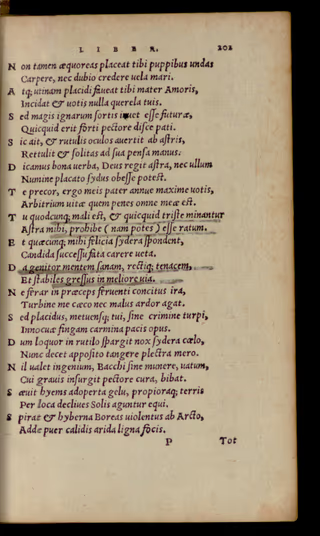
But let it not please you to traverse the sea's waves in ships,
Nor to entrust your sails to the uncertain ocean.
And I pray the mother of gentle Love favors you,
And that no grievance befalls your prayers.
But may it rather help to be ignorant of the fate to come;
Learn to endure whatever shall be with a courageous heart.
Thus she spoke, and turned her eyes away from the glowing stars,
And returned her hands to their customary tasks:
Let us speak auspicious words; God governs the stars, nor can
Any star bring harm when His divine will is appeased.
Therefore I beseech you, Almighty Father, grant my prayers,
You in whose power lies the entire governance of my life.
Whatever evil there is, and whatever sorrow the stars
Threaten me with, forbid it (for you are able) to come to pass.
And whatever fortunate things the stars promise me,
Forbid that these bright destinies lack success.
Grant, Father, a healthy mind, tenacious of what is right,
And firm steps upon the better path.
Let me not be carried headlong, spurred by burning wrath,
Nor let evil passion drive me in a blind whirlwind.
But peaceful, and in fear of you, without base crime,
Let me fashion verses, the work of harmless peace.
While I speak, night scatters stars in the glowing sky;
Now it is fitting to strike the lyre with wine served near.
The talent of poets is worth nothing without the gift of Bacchus;
Let him whose breast swells with heavy care, drink.
Winter rages, cloaked in frost, and nearer to the lands
Through the regions the descending horses of the Sun are driven.
And the violent North Wind blows from the wintry Bear;
Boy, add dry logs to the warm hearth fires.
Let Craco take as many cups as the years of Nestor,
And while he drinks, let the rest of the crowd keep reverent silence.
Let Stoius drain the melodious strings of your lyre for me, O Orpheus,
Which was able to move barbarian hearts.
And let Lucanus recount the stars that have slipped beneath the earth,
And the bright ones that have risen at the time of my birth.
Thus let the night pass for me with the cithara, and with wine bringing on slumber,
Until gentle sleep bows my eyes.
Hail, excellent birthday, and return better every year
As the season of tranquil peace passes.
So that always, on the day following the honored calends,
I may joyfully sing of you in a song, but a better one.
May the gods only grant me to spend softly in sweet studies
All that remains of my life.
ANnua poſt ſacras iterum lux ecce Calendas
Feſta pruinoſi, Craco, Nouembris adeſt.
Qua prius ad tumulos animas placare ſolebant,
Manibus & noſtri ſoluere iuſta ſenes.
Hac ego uitales hauſi puer æditus auras
Cum decimo genetrix menſe tuliſſet onus.
Vagitusq; dedi ueniens in lumina uitæ
Primaq; ſtirps ſexu de meliore fui.
Ite procul triſtes hodierna luce querelæ,
Si potero, tempus per breue lætus ero.
Exequar ut meritos chari natalis honores
Flore mihi teneras circumeunte comas.
Ergo diu mecum noſtros modulata dolores
Muſa breui ſpatio flebile differ opus.
Tu mihi phœbeæ poſitis reſonantia curis
Fila moue docto pollice, Craco lyræ.
Et cane quid fauſtis mihi ſpondeat ignibus æther.
Abdita qui nouit fata, cauere poteſt.
Iam uigil oceani claram portarat ab undis
Mane pruinoſo Lucifer axe diem.
Et genetrix noſtros, & ſolis uiderat ortus
Principium fuerat lucis idemq; mei.
Scorpius Eoo ducebat ab orbe, recentes
Purpureum ſcandens æthera, Solis equos.
Et matutinos Cyllenius ante iugales
Vtile carpebat, pleiade natus, iter.
His comes e pelagi ſurgens natalibus undis
Alma capiſtratas Cypris agebat aues.
Terga ſequens, illam iaculis terrebat & arcu
Aemonius, phœbi clarus in arte, ſenex.
Cornibus armatus ſeruabat limina fratrum
Aegoceros, cœli qui iacet ante fores.
Iliacuſq; puer liquidas fundebat in imo
Cardine, qui ſuperis pocula miſcet, aquas.
Proxima ponebant gemini ueſtigia piſces,
E quibus hic Boreæ proximus, ille Noto.
Inde ſequebatur, phryxum, phryxiq; ſororem
Per mare quæ nitido uellere geſsit ouis.
Torua recenſebat Saturnus cornua Tauri
Qua ſolet emeritos ſoluere phœbus equos.
Hinc cum fratre pio felix concordia pollux
Ibat ubi ſedes mors habet atra ſuas.
Octipedis phœbe peragrabat brachia cancri
Et Dea præcipitis quæ ſtat in orbe rotæ.
Iuppiter Herculei luſtrabat terga Leonis
Iuppiter in ſummo, clarus honore, polo.
Marte premebatur rigido, quæ noctibus æquas
Efficit, Autumni tempore, libra dies.
Sic uos ſyderei ſtellæ micuiſtis, ab aluo
Matris, in hanc lucem me ueniente, poli.
Tunc mihi fatorum triplices arcana ſorores
Abdita, fatidicis præcinuere modis.
Et Lacheſis, naſci minus infelicibus annis
Digne puer, dixit, non meliore die.
Non tibi Pierides Cytharam, nec Apollo negaret
Pocula caſtaliæ ( ſydera teſtor ) aquæ.
Tempora ſed dubij ſortitus plena tumultus
Fata iuuentutis flebis acerba tuæ.
Inq; peregrinis populis Helicone relicto
Multa feres belli tædia, plura uiæ.
N on tamen æquoreas placeat tibi puppibus undas
Carpere, nec dubio credere uela mari.
A tq; utinam placidi faueat tibi mater Amoris,
Incidat & uotis nulla querela tuis.
S ed magis ignarum ſortis iuuet eſſe futuræ,
Quicquid erit forti pectore diſce pati.
S ic ait, & rutulis oculos auertit ab aſtris,
Rettulit & ſolitas ad ſua penſa manus:
D icamus bona uerba, Deus regit aſtra, nec ullum
Numine placato ſydus obeſſe poteſt.
T e precor, ergo meis pater annue maxime uotis,
Arbitrium uitæ quem penes omne meæ eſt.
T u quodcunq; mali eſt, & quicquid triſte minantur
Aſtra mihi, prohibe (nam potes) eſſe ratum.
E t quæcunq; mihi felicia ſydera ſpondent,
Candida ſucceſſu fata carere ueta.
D a genitor mentem ſanam, rectiq; tenacem,
Et ſtabiles greſſus in meliore uia.
N e ferar in præceps feruenti concitus ira,
Turbine me cæco nec malus ardor agat.
S ed placidus, metuenſq; tui, ſine crimine turpi,
Innocuæ fingam carmina pacis opus.
D um loquor in rutilo ſpargit nox ſydera cœlo,
Nunc decet appoſito tangere plectra mero.
N il ualet ingenium, Bacchi ſine munere, uatum,
Cui grauis inſurgit pectore cura, bibat.
S æuit hyems adoperta gelu, propioraq; terris
Per loca decliues Solis aguntur equi.
S pirat & hyberna Boreas uiolentus ab Arcto,
Adde puer calidis arida ligna focis.
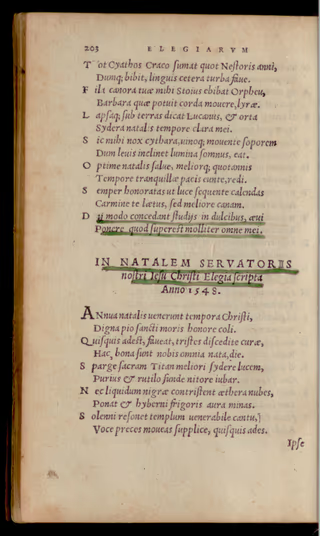
Tot Cyathos Craco ſumat quot Neſtoris anni,
Dumq; bibit, linguis cetera turba faue.
Fila canora tuæ mihi Stoius ebibat Orpheu,
Barbara quæ potuit corda mouere, lyræ.
Lapſaq; ſub terras dicat Lucanus, & orta
Sydera natalis tempore clara mei.
Sic mihi nox cythara, uinoq; mouente ſoporem
Dum leuis inclinet lumina ſomnus, eat.
Optime natalis ſalue, meliorq; quotannis
Tempore tranquillæ pacis eunte, redi.
Semper honoratas ut luce ſequente calendas
Carmine te lætus, ſed meliore canam.
Dij modo concedant ſtudijs in dulcibus, æui
Ponere quod ſupereſt molliter omne mei.