Hover or tap a word to see its match.
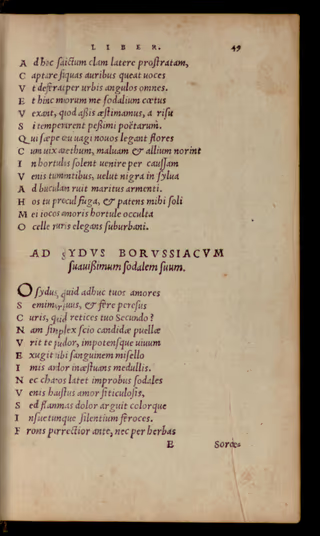
O Sydus, why still your loves,
Half-dead, and almost eaten up
By cares, why do you keep secret from your Secundus?
For I know the simple modesty of a fair girl
Burns you, and an uncontrollable passion boiling
In your deepest marrow sucks the living blood from wretched you.
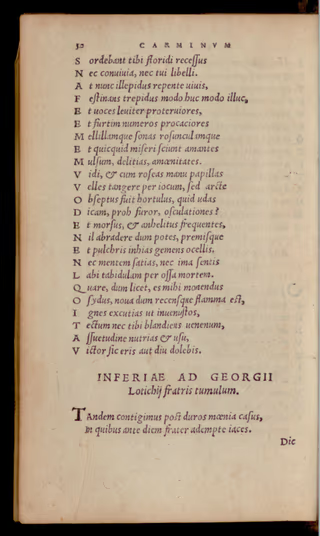
Nor is the wicked love, drawn in by thirsty veins,
Hidden from your dear companions,
But your pain, your complexion, and your unaccustomed silence
Betray the fierce flames.
Your brow was more relaxed before, nor through the grass
Flowery retreats held no appeal for you,
Nor banquets, nor your books.
But now suddenly you live without grace,
Hurrying anxiously now here, now there,
And you utter slightly wanton words,
And stealthily forward verses,
And you sound out "little honey" and "little rose,"
And whatever honeyed wine, delights, and pleasantries
Miserable lovers know.
I saw, too, when you wanted to touch her rosy breasts
With your hand in jest, but tightly
Fenced off was the little garden; why should I mention
The wet kisses, oh madness?
And the bites, and the frequent panting,
While you can scrape nothing away, and you press her
And groan, gaping at her beautiful eyes,
And you do not satisfy your mind, nor do you feel
That a wasting death is slipping through your inmost bones.
Therefore, while it is allowed, I must warn you,
O Sydus, while the flame is new and fresh,
To shake off these unlovely fires,
And not to nourish this hidden, coaxing poison
Through habit and use;
Thus you will be the victor, or else you will grieve for a long time.
O ſydus, quid adhuc tuos amores
Semimortuus, & fere pereſus
Curis, quid retices tuo Secundo?
Nam ſimplex ſcio candidæ puellæ
Vrit te pudor, impotenſque uiuum
Exugit tibi ſanguinem miſello
Imis ardor inæſtuans medullis.
Nec charos latet improbus ſodales
Venis hauſtus amor ſiticuloſis,
Sed flammas dolor arguit colorque
Inſuetumque ſilentium feroces.
Frons porrectior ante, nec per herbas
S ordebant tibi floridi receſſus
N ec conuiuia, nec tui libelli.
A t nunc illepidus repente uiuis,
F eſtinans trepidus modo huc modo illuc,
E t uoces leuiter proteruiores,
E t furtim numeros procaciores
M ellillamque ſonas roſunculamque
E t quicquid miſeri ſciunt amantes
M ulſum, delitias, amœnitates.
V idi, & cum roſeas manu papillas
V elles tangere per iocum, ſed arcte
O bſeptus fuit hortulus, quid udas
D icam, proh furor, oſculationes ?
E t morſus, & anhelitus frequentes,
N il abradere dum potes, premiſque
E t pulchris inhias gemens ocellis,
N ec mentem ſatias, nec ima ſentis
L abi tabidulam per oſſa mortem.
Q uare, dum licet, es mihi monendus
O ſydus, noua dum recenſque flamma eſt,
I gnes excutias ut inuenuſtos,
T ectum nec tibi blandiens uenenum,
A ſſuetudine nutrias & uſu,
V ictor ſic eris aut diu dolebis.