Hover or tap a word to see its match.
I kept warning you, Herdesianus, that the journey lay through ambushes;
I said so many times: beware of this entire route.
Did you, nevertheless, dare to travel roads besieged by the soldiery of a foreign nation,
Against the wishes of everyone?
Could neither parent restrain your purpose, nor could a faithful girl
Sway you with tearful cheeks?
I was stunned, and suddenly, upon hearing, I felt my chest,
Cold with dread, freeze stiff with fear.
For a companion from your homeland and on your journey recounted
Everything to me, and it was my concern to inquire.
There is a place (he said), the left part fit for bearing crops,
But the right, planted with trees, is green.
In the middle is a valley moist with woodland streams,
Fit indeed for an ambush, but less fit for flight.
Here, while we direct our steps in the morning through the dewy grass,
And take turns lightening the journey with pleasant conversation:
Behold, an enemy, threatening with drawn swords,
Is suddenly upon us from the left side (I shudder as I speak).
And he rushes on like a foaming torrent from a high peak,
Which drags uprooted rocks with a rushing crash.
The enemy, driving flocks of sheep and herds of cattle with him;
The inhabitant gives way far and wide wherever he rushes.
And already we see them approaching, already calling to us with shouts,
and no means of escape is left.
A path leads through the rough rocks into a grove thick
with holm oaks; this shows the first way to safety.
And while the wandering flocks, the burdensome plunder,
and the valley wet with constant waters delay the pursuers:
we struggle up to the high ridge of the opposite mountain
(a miserable plight), as men whose lives must be saved by flight.
And we search out lairs concealed in the darkening woods,
and places which hold less of the hated light.
The image of tearful slaughter hovers before our eyes,
and every thicket holds its own horror.
Thus under the open sky, while Phoebus provides light, we lie hidden,
and thus too when night follows the deadly day.
Neither in the dark night, nor in the time of Phoebus, did
sleep come into our watchful eyes, nor food into our mouths.
With our ears we catch the laments of the crowd through the shadow,
and the whole grove echoes with constant complaints.
Each parent weeps for their children, and children for their parents,
the husband deplores the misfortunes of his wife, and she those of her husband.
And a little boy, left in the thickets by his mother,
cries out, "Oh mother, hidden in the woods, where are you?
Oh mother, if you are alive, where are you?" Who could hear such things
with dry cheeks, without wetting his face with tears?
And now the stars were growing pale as the darkness was about to recede,
and you, birds, were singing your plaintive songs in the morning.
We rise at the first twilight of the longed-for dawn,
and the urge to go, which we had, remains.
Phoebus had risen, the enemy returns, and behold, the fierce
leader of the cohort seeks us out on his panting horse.
We stand still, and we say that we, cultivators of the Aonian art,
have kept our hands innocent of war.
At the name of the Aonides, he said, "Sit down, young men,
the gentle Goddesses have instructed us too.
Nor did an impious desire for plunder draw me into arms,
my concern was to see lands and their peoples."
Thus he spoke, and he provided us a safe journey to the city
which the Saale bounds, where Caesar was encamped.
Go now, and consider it shameful to lend your ears
to faithful warnings; go suddenly, and let no fear hinder you.
Rash courage does not have peaceful outcomes;
fear also these things which you might think safe.
Tell me however, O youth rescued from such great dangers,
without whom it would now be sad for me to live:
When you saw grim death before your eyes,
what was your spirit then? What was the color of your face?
Perhaps in this fate you were also mindful of me,
turning your eyes hither through the empty air?
And you said, "Farewell, you who are a part of my dear ones;
today's light is the last for my eyes."
You will tell me these things, to which you will add what you drank in with your ears,
and the many things seen in the time of your anxious journey:
How good liberty, which the labors of a thousand kings previously produced,
now falls into ruin as an empty name;
And how great leaders did not disdain (alas, the disgrace!), laying down their arms,
to willingly undergo a shameful yoke;
And how the Elbe saw on its banks many thousands of men
die by an unspeakable betrayal.
Alas, where is holy faith? You cavalry squadrons fled,
and the unavenged soldier sought help in vain.
You will tell me these things when I revisit your walls,
all that each of us will bury in his silent breast.
For I am touched again by love for my native place,
and the welcome hope of an approaching peace is at hand.
But unless the presages of my mind deceive me, I will be with you
when Phoebus approaches Erigone.
O day that will give me perpetual joy along with peace,
day three and four times fortunate for me,
on which I shall leave the martial camps gleaming with standards,
and the fields that the Bear sees beneath the icy pole.
And again I shall begin to be mindful of my former life,
reminded of sacred song, and of myself.
And I shall follow you through the Aonian mountains, O my joys:
Phoebus, inventor of the lyre, and the nine Goddesses.
And I will speak to the sweet friends whom I enjoyed before,
O day that I must hold solemn forever.
That the mother of Memnon may bring this day with a swift sunrise,
add your prayers to ours, Herdesianus.
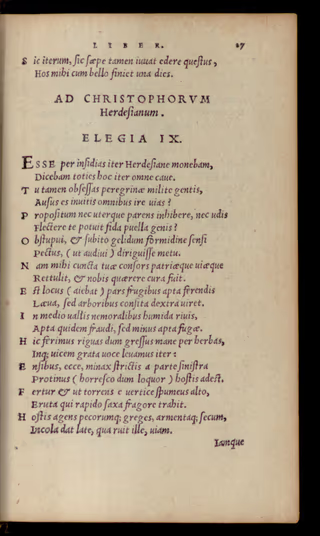
E SSE per inſidias iter Herdeſiane monebam,
Dicebam toties hoc iter omne caue.
T u tamen obſeſſas peregrinæ milite gentis,
Auſus es inuitis omnibus ire uias?
P ropoſitum nec uterque parens inhibere, nec udis
Flectere te potuit fida puella genis?
O bſtupui, & ſubito gelidum formidine ſenſi
Pectus, (ut audiui) diriguiſſe metu.
N am mihi cuncta tuæ conſors patriæque uiæque
Rettulit, & nobis quærere cura fuit.
E ſt locus (aiebat) pars frugibus apta ferendis
Læua, ſed arboribus conſita dextra uiret.
I n medio uallis nemoralibus humida riuis,
Apta quidem fraudi, ſed minus apta fugæ.
H ic ferimus riguas dum greſſus mane per herbas,
Inq; uicem grata uoce leuamus iter:
E nſibus, ecce, minax ſtrictis a parte ſiniſtra
Protinus (horreſco dum loquor) hoſtis adeſt.
F ertur & ut torrens e uertice ſpumeus alto,
Eruta qui rapido ſaxa fragore trahit.
H oſtis agens pecorumq; greges, armentaq; ſecum,
Incola dat late, qua ruit ille, uiam.
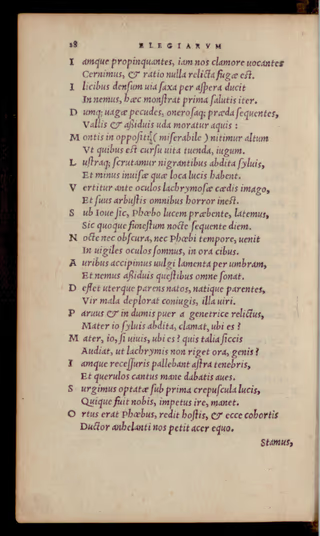
I amque propinquantes, iam nos clamore uocantes
Cernimus, & ratio nulla relicta fugæ eſt.
I licibus denſum uia ſaxa per aſpera ducit
In nemus, hæc monſtrat prima ſalutis iter.
D umq; uagæ pecudes, oneroſaq; præda ſequentes,
Vallis & aſsiduis uda moratur aquis :
M ontis in oppoſiti ( miſerabile ) nitimur altum
Vt quibus eſt curſu uita tuenda, iugum.
L uſtraq; ſcrutamur nigrantibus abdita ſyluis,
Et minus inuiſæ quæ loca lucis habent.
V ertitur ante oculos lachrymoſæ cædis imago,
Et ſuus arbuſtis omnibus horror ineſt.
S ub Ioue ſic, Phœbo lucem præbente, latemus,
Sic quoque funeſtum nocte ſequente diem.
N octe nec obſcura, nec Phœbi tempore, uenit
In uigiles oculos ſomnus, in ora cibus.
A uribus accipimus uulgi lamenta per umbram,
Et nemus aſsiduis queſtibus omne ſonat.
D eflet uterque parens natos, natique parentes,
Vir mala deplorat coniugis, illa uiri.
P aruus & in dumis puer a genetrice relictus,
Mater io ſyluis abdita, clamat, ubi es ?
M ater, io, ſi uiuis, ubi es ? quis talia ſiccis
Audiat, ut lachrymis non riget ora, genis ?
I amque receſſuris pallebant aſtra tenebris,
Et querulos cantus mane dabatis aues.
S urgimus optatæ ſub prima crepuſcula lucis,
Quique fuit nobis, impetus ire, manet.
O rtus erat Phœbus, redit hoſtis, & ecce cohortis
Ductor anhelanti nos petit acer equo.
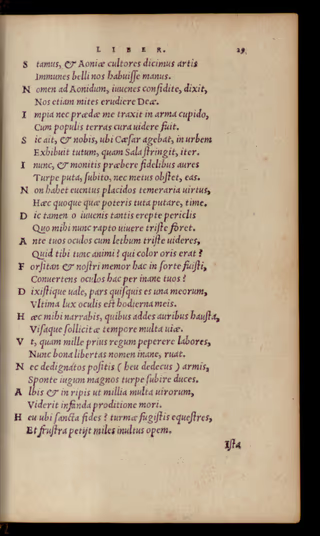
S tamus, & Aoniæ cultores dicimus artis
Immunes belli nos habuiſſe manus.
N omen ad Aonidum, iuuenes conſidite, dixit,
Nos etiam mites erudiere Deæ.
I mpia nec prædæ me traxit in arma cupido,
Cum populis terras cura uidere fuit.
S ic ait, & nobis, ubi Cæſar agebat, in urbem
Exhibuit tutum, quam Sala ſtringit, iter.
I nunc, & monitis præbere fidelibus aures
Turpe puta, ſubito, nec metus obſtet, eas.
N on habet euentus placidos temeraria uirtus,
Hæc quoque quæ poteris tuta putare, time.
D ic tamen o iuuenis tantis erepte periclis
Quo mihi nunc rapto uiuere triſte foret.
A nte tuos oculos cum lethum triſte uideres,
Quid tibi tunc animi? qui color oris erat?
F orſitan & noſtri memor hac in ſorte fuiſti,
Conuertens oculos hac per inane tuos?
D ixiſtique uale, pars quiſquis es una meorum,
Vltima lux oculis eſt hodierna meis.
H æc mihi narrabis, quibus addes auribus hauſta,
Viſaque ſollicitæ tempore multa uiæ.
V t, quam mille prius regum peperere labores,
Nunc bona libertas nomen inane, ruat.
N ec dedignatos poſitis (heu dedecus) armis,
Sponte iugum magnos turpe ſubire duces.
A lbis & in ripis ut millia multa uirorum,
Viderit infanda proditione mori.
H eu ubi ſancta fides? turmæ fugiſtis equeſtres,
Et fruſtra petijt miles inultus opem.
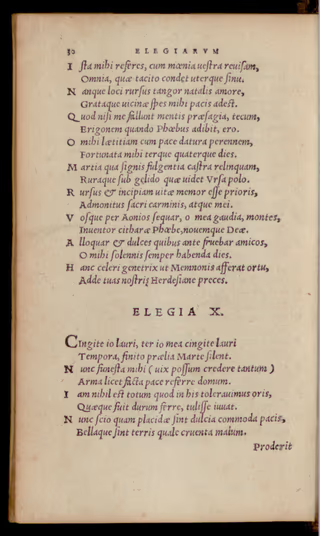
Iſta mihi referes, cum mœnia ueſtra reuiſam,
Omnia, quæ tacito condet uterque ſinu.
Nanque loci rurſus tangor natalis amore,
Grataque uicinæ ſpes mihi pacis adeſt.
Quod niſi me fallunt mentis præſagia, tecum,
Erigonem quando Phœbus adibit, ero.
O mihi lætitiam cum pace datura perennem,
Fortunata mihi terque quaterque dies.
Martia qua ſignis fulgentia caſtra relinquam,
Ruraque ſub gelido quæ uidet Vrſa polo.
Rurſus & incipiam uitæ memor eſſe prioris,
Admonitus ſacri carminis, atque mei.
Voſque per Aonios ſequar, o mea gaudia, montes,
Inuentor citharæ Phœbe, nouemque Deæ.
Alloquar & dulces quibus ante fruebar amicos,
O mihi ſolennis ſemper habenda dies.
Hanc celeri genetrix ut Memnonis afferat ortu,
Adde tuas noſtris Herdeſiane preces.