Hover or tap a word to see its match.
This sky, and the great air by which we are surrounded,
Often reveal future events by their signs.
And they warn by portents that, when the divine will of the gods is offended,
The avenging hands of the divine power are behind our heads.
Why should I seek examples of the ancients, when in our time
No place in the world lacks prodigies:
An apparition was also recently seen in the nearby air,
A dire messenger of new fear, not to be scorned.
An ancient city lies there (the inhabitant calls it the mountain of iron),
It separates the Thuringian soil from the Meisseners.
Toward the blasts of the West Wind Thuringia spreads out from there,
And Meissen looks toward the Eastern horses of the sun.
There, when no clouds had wreathed the upper air,
And Titan was holding his course of midday light,
Behold, two swift snakes with rolling coils
Seized the slanting paths of the air.
Both flash with fire, flames glow red through the azure,
Am I deceived, or was that color blood-red?
Immediately, with a great hissing through the opposing breezes,
They wage wars born of sudden fury.
And they drag their winding coils with entwined tails,
Just as twisting seaweed entangles bare feet.
And so they mangle each other's backs with alternating wounds,
Anxious dread shakes the bones of the people.
Add that in the midst, between their deadly jaws,
The fiery image of a terrifying cross shone forth.
Believe, mortals, dreadful battles remain,
Horrid battles for the fatherland, and for the faith.
But you, supreme Father, whom heaven and air serve,
Under whose guidance all things carry out their movements,
Almighty, who are held by no law of fate,
Make these terrible signs void by your nod.
Those indeed may have been the heralds of cruel grief,
But your anger is swayed by pure prayers.
If, however, these perils seek out deserving nations,
Preserve the remnants of your host yourself.
We shall always sing your name and your praises,
For, whatever we are, it is entirely of your divine will.
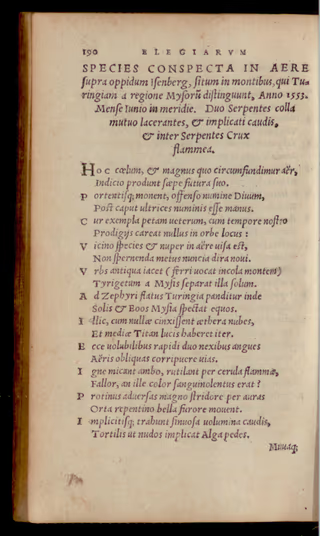
Hoc cœlum, & magnus quo circumfundimur aër,
Indicio produnt sæpe futura suo.
Portentisq; monent, offenso numine Diuum,
Post caput ultrices numinis esse manus.
Cur exempla petam ueterum, cum tempore nostro
Prodigijs careat nullus in orbe locus:
Vicino species & nuper in aëre uisa est,
Non spernenda metus nuncia dira noui.
Vrbs antiqua iacet (ferri uocat incola montem)
Tyrigetum a Mysis separat illa solum.
Ad Zephyri flatus Turingia panditur inde
Solis & Eoos Mysia spectat equos.
Illic, cum nullæ cinxissent æthera nubes,
Et mediæ Titan lucis haberet iter.
Ecce uolubilibus rapidi duo nexibus angues
Aëris obliquas corripuere uias.
Igne micant ambo, rutilant per cerula flammæ,
Fallor, an ille color sanguinolentus erat?
Protinus aduersas magno stridore per auras
Orta repentino bella furore mouent.
Implicitisq; trahunt sinuosa uolumina caudis,
Tortilis ut nudos implicat Alga pedes.
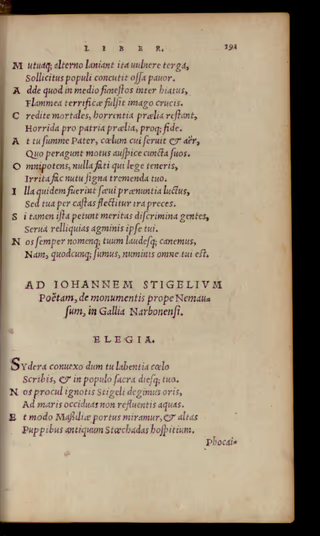
Mutuaq; alterno laniant ita uulnere terga,
Sollicitus populi concutit oſſa pauor.
Adde quod in medio funeſtos inter hiatus,
Flammea terrificæ fulſit imago crucis.
Credite mortales, horrentia prælia reſtant,
Horrida pro patria prælia, proq; fide.
At tu ſumme Pater, cœlum cui ſeruit & aër,
Quo peragunt motus auſpice cuncta ſuos.
Omnipotens, nulla fati qui lege teneris,
Irrita fac nutu ſigna tremenda tuo.
Illa quidem fuerint ſæui prænuntia luctus,
Sed tua per caſtas flectitur ira preces.
Si tamen iſta petunt meritas diſcrimina gentes,
Serua relliquias agminis ipſe tui.
Nos ſemper nomenq; tuum laudeſq; canemus,
Nam, quodcunq; ſumus, numinis omne tui eſt.