Hover or tap a word to see its match.
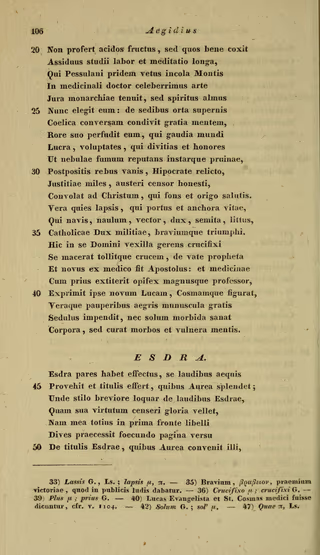
*Esdra* has equal effects, it promotes itself with equal praises
And extols itself with the titles with which *Aurea* shines;
Hence I shall speak with a shorter pen concerning the praises of *Esdra*,
Than its glory of virtues would wish to be reckoned,
For on the very first front of my entire little book
My rich page preceded with fertile verse
Concerning the titles of *Esdra*, in which *Aurea* agrees with it,
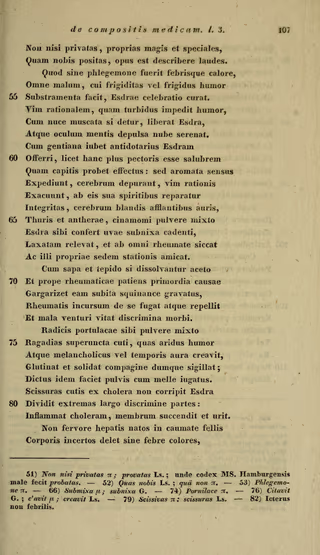
There is no need to describe any praises except its private ones,
Which are more proper and special than those set forth by us.
Every malady that is without phlegmon and the heat of fever,
For which coldness or a cold humor
Provides the foundation, the administration of *Esdra* cures.
The rational faculty, which a turbid humor impedes,
*Esdra* frees, if it is given with nutmeg,
And clears the eye of the mind by driving away the cloud.
The antidotary orders *Esdra*
To be offered with gentian, although its effect proves
That it is more salutary for the chest than for the head:
But aromatics clear the senses,
Purify the brain, sharpen the faculty of reason;
By them their integrity is restored to the spirits,
With mild breezes blowing upon the brain,
With a mixed powder of frankincense and anthera and cinnamon,
*Esdra*, applied beneath the falling uvula, is beneficial to it,
Raises it when relaxed, dries it from all rheum,
And reconciles it to the seat of its proper station.
If they are dissolved with sapa and warm vinegar
And a patient, near the beginnings of the rheumatic cause,
Burdened by a sudden squinancy, gargles it,
He puts to flight and repels the onset of the rheum from himself
And avoids the evil perils of the coming disease.
With the powder of the root of purslane mixed into it,
Smeared over the skin, it glues together the rhagades, which a dry
And melancholic humor or the weather has created,
And consolidates and at the same time seals them with a bond;
The said powder will do the same when combined with honey.
*Esdra* does not close up the fissures of the skin arising from choler,
It separates the extreme parts with a wide division:
It inflames the choler, sets the limb on fire, and burns it.
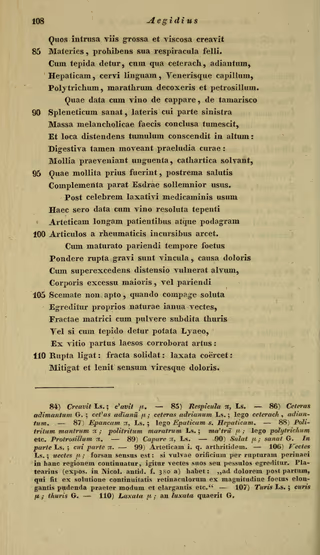
It deletes the uncertain colors of the body born from the heat
Of the liver in the burning heat of the gall without fever,
Which a thick and viscous matter, intruded into the pathways, has created,
Denying its own outlets to the gall.
Let it be given warm, with which you have boiled down ceterach, maidenhair fern,
Liverwort, hart's tongue, and Venus' hair,
Golden maidenhair, fennel, and parsley.
Which, given with wine of caper, of tamarisk,
Cures the splenetic patient, in the left part of whose side
A confined mass of melancholic dregs swells,
And, distending the places, climbs into a high mound:
Let digestives, however, set in motion the preludes of the cure:
Let soft ointments precede, let cathartics dissolve
Those things which were previously softened, and the more customary use
Of *Esdra* prepares the final complements of health.
After the frequent use of a laxative medicine,
This, given late in the day dissolved with warm wine,
Wards off the joints from rheumatic attacks
For those suffering long-standing arthritis and gout.
When, at the mature time of giving birth, the bonds
Are ruptured by the heavy weight of the fetus, when the cause of pain,
An excessive distension, wounds the womb,
Due to the excess of a larger body, or of giving birth
With an unsuited posture, when, with the structure loosed,
The door of nature passes beyond its proper bars,
Placed beneath the torn womb with the powder of frankincense
Or if it is given to be drunk with warm *Lyaeus*,
It strengthens the limbs injured by the defect of the birth:
It binds what is ruptured: it solidifies what is broken: it restrains what is loosened:
It mitigates and soothes the feeling and the forces of pain.
It washes ears running with rheum and painful ones,
It comforts the teeth and, smeared on, helps women in labor
Having taken on for itself the shape of a plug in the guise of lint,
Let cotton smeared with *musceleum* be dipped in *Esdra*.
When this visits rheumatic ears throughout the night,
It dries and cleans out the purulent matter, and removes the pain:
Or if it irrigates a rheumatic ear drop by drop,
*Esdra* dissolved in unmixed wine or mixed with *musceleum* will help.
They come to the aid of teeth struck by rheum and weighed down by cold humor,
The gums then being smeared.
When Lucina, rival of nature, is unable to complete
The labor of bringing forth light with its proper end,
When the Goddess who stands as the faithful bridesmaid of childbirth,
The little servant of nature, never prevails by any efforts
So as to consign the boy to the vital breezes,
But rather the woman is more hard-pressed, more tormented:
Lying down does not help, sitting does not help her,
An uneven gait does not, nor uneven carrying,
A thin sound is of no benefit, nor a sharp cry,
And that which usually benefits others, which expedites women in labor
So that they give birth—no compression of the voice
Enacted with clenched teeth, helps her elevation,
The provident caution of holding the breath is of no benefit,
Which thrusts the groans down to the lower parts;
He who recites psalms and sacred names over her
Is of no avail here in bowing his head to the shaven priest.
While anxious labor thus badly torments the pregnant womb
And the savage force of pain overcomes the laws of childbirth,
For this cause, offered and allied with wine of rue,
*Esdra* given as a drink is a sufficiently proven medicine,
To which, if the artemisia-infused power is committed,
It is no less welcome, no less apt to strike back at the fates,
Whether it is given by mouth, or placed in the lowest part.
Let the aching belly of the patient be anointed
With *Esdra* and musk oil, to which the juices of fresh
Artemisia have been mixed, and the birth is hastened more:
But let it be quickly removed, lest a greater penalty follow,
If it should be relaxed and the womb should prolapse.
Green artemisia provides these aids for you
If it has been well pounded and bound to the thigh,
It generally removes the perils of a difficult birth:
A young girl, who is inexperienced and still a novice, having suffered no
Yoke of childbirth, and not yet accustomed to the labor,
Because she knows not the laws of giving birth and its rendings,
Is burdened in childbirth, although she has experienced the nuptial
Enticements and the commerce of carnal union.
For Venus and childbirth are not moved on an equal balance,
Because if childbirth proceeded with equal steps as Venus,
A woman would rush to unchastity without law, with the rein
Of lust loosened: but the arduous law of giving birth,
Which is full of the peril of great pain
And as a herald of vice declares the fault without a voice,
Bridles many and keeps them from forbidden embraces.
A ready, over-hasty, and immature lust
Which, impatient of delay, does not endure the sluggish years:
Which, faster than the years, outstrips the swift horses of age
And flies ahead of age on rapid wings,
No longer awaiting the age of mature nature,
When the limbs in the childish body are not yet complete,
While she feels the motions of Venus and pleasant unions,
Achieves conception under the persuasive stimulus of heat.
But harsh Lucina will demand punishment for the lawless copulation,
As a torturer of the fault and an avenger of the guilt,
Profaning the delights of premature Venus,
condemning the little vessels of an age not yet complete,
which are less suited to their functions, although the perverse
will of men insists upon them more fiercely and more.
A fragile shape of the body, wasting, and weak strength
driven by non-natural causes,
since she is proven less suited for dispensing Venus,
she whom Venus accuses, the rule of childbirth condemns.
A very fat, overly fleshy woman either never stamps
a conception in herself, her womb being closed,
or the birth is difficult, because the fat obstructs
the passages, closes the ways, and seals the gate,
setting fleshy barriers against the one striving into the light.
Sometimes a thick humor of viscous blood,
which in the time preceding conception did not have
its customary flow of flux during the lunar hours,
but made the saphenous veins full and tense with swelling,
does not allow the fetus to be exposed to the vital breezes.
Generally, a tumor or an apostasis brings about that same thing,
this [is caused by] a stricture of the natural small matrix.
Often the fetus will be two-headed, or possess a large
head, or be large overall, or dropsical, or triplets
or twins will trouble the innards of the wretched mother.
A dead fetus, or a living one being born in an incorrect posture,
no less torments and twists the wretched parent.
When it is weighed and proven from grave causes
that the birth will be difficult and full of peril,
in the very first movements around the preludes of birth,
let fomentations, vapors, repeated in frequent turns,
and baths precede, to which let these things supply strength:
With *branca*, mallow, *linochidis*, and savin,
southernwood, rue, flax, together with *arthemesia*
Mixing these at the same time with fenugreek and laurel.
Let a decoction of these drench soft wools,
A pile of which, pressed after the liquid has been poured off,
Should bind around the heavy belly from the region of the sides,
Until it reaches the furthest edges of the pubis,
With the hips and belly anointed with warm *musceleum*,
An ophthalmic species ought to be applied to the nostril
With the powder of dittany mixed with the weight of a dram
Of castoreum, let a decoction of fenugreek be drunk:
Or, if she is wealthy, you should offer balsams mixed with wine
To the weight of half a scruple to be drunk:
To the weak let *Diamargariton* and *Rhodozaccara* be given,
And let her languishing face be washed with a rosy stream.
Those whom an asthmatic sound, whom a panting cough strikes,
If you wish to cure them, this potion is the supreme remedy,
And given with *ptisana* it makes the sick person healthy in body. —
For snake bites it is effective, and dog bites,
With a poultice made from it and the juice of mint;
Taken in a drink it is more ready for such things.
*Esdra* remains for a long time in a stable and proper vigor,
And having become seven years old it surpasses itself, and beyond
What it had been at first, it grows into strong acts.
But then it is asserted by many, under a false image of the truth,
That the virtue of this antidote is too small, that it is nothing:
For where so discordant an assembly of spices comes together,
Where there is so much confusion of things,
The sheer number subverts the individual items: and the merit of vigor
Both the parts take away from the whole and the whole from the parts.
Esdra pares habet effectus, se laudibus aequis
Provehit et titulis effert, quibus Aurea splendet;
Unde stilo breviore loquar de laudibus Esdrae,
Quam sua virtutum censeri gloria vellet,
Nam mea totius in prima fronte libelli
Dives praecessit foecundo pagina versu
De titulis Esdrae, quibus Aurea convenit illi,
Non nisi privatas, proprias magis et speciales,
Quam nobis positas, opus est describere laudes.
Quod sine phlegemone fuerit febrisque calore,
Omne malum, cui frigiditas vel frigidus humor
Substramenta facit, Esdrae celebratio curat.
Vim rationalem, quam turbidus impedit humor,
Cum nuce muscata si detur, liberat Esdra,
Atque oculum mentis depulsa nube serenat.
Cum gentiana iubet antidotarius Esdram
Offerri, licet hanc plus pectoris esse salubrem
Quam capitis probet effectus: sed aromata sensus
Expediunt, cerebrum depurant, vim rationis
Exacuunt, ab eis sua spiritibus reparatur
Integritas, cerebrum blandis afflantibus auris,
Thuris et antherae, cinamomi pulvere mixto
Esdra sibi confert uvae subnixa cadenti,
Laxatam relevat, et ab omni rheumate siccat
Ac illi propriae sedem stationis amicat.
Cum sapa et tepido si dissolvantur aceto
Et prope rheumaticae patiens primordia causae
Gargarizet eam subita squinance gravatus,
Rheumatis incursum de se fugat atque repellit
Et mala venturi vitat discrimina morbi.
Radicis portulacae sibi pulvere mixto
Ragadias superuncta cuti, quas aridus humor
Atque melancholicus vel temporis aura creavit,
Glutinat et solidat compagine dumque sigillat;
Dictus idem faciet pulvis cum melle iugatus.
Scissuras cutis ex cholera non corripit Esdra
Dividit extremas largo discrimine partes:
Inflammat choleram, membrum succendit et urit.
Non fervore hepatis natos in caumate fellis
Corporis incertos delet sine febre colores,
Quos intrusa viis grossa et viscosa creavit
Materies, prohibens sua respiracula felli.
Cum tepida detur, cum qua ceterach, adiantum,
Hepaticam, cervi linguam, Venerisque capillum,
Polytrichum, marathrum decoxeris et petrosillum.
Quae data cum vino de cappare, de tamarisco
Spleneticum sanat, lateris cui parte sinistra
Massa melancholicae faecis conclusa tumescit,
Et loca distendens tumulum conscendit in altum:
Digestiva tamen moveant praeludia curae:
Mollia praeveniant unguenta, cathartica solvant,
Quae mollita prius fuerint, postrema salutis
Complementa parat Esdrae sollemnior usus.
Post celebrem laxativi medicaminis usum
Haec sero data cum vino resoluta tepenti
Arteticam longam patientibus atque podagram
Articulos a rheumaticis incursibus arcet.
Cum maturato pariendi tempore foetus
Pondere rupta gravi sunt vincula, causa doloris
Cum superexcedens distensio vulnerat alvum,
Corporis excessu maioris, vel pariendi
Scemate non apto, quando compage soluta
Egreditur proprios naturae ianua vectes,
Fractae matrici cum pulvere subdita thuris
Vel si cum tepido detur potata Lyaeo,
Ex vitio partus laesos corroborat artus:
Rupta ligat: fracta solidat: laxata coërcet:
Mitigat et lenit sensum viresque doloris.
Rheumate currentes aures lavat atque dolentes
Confortat dentes et inuncta iuvat parientes
Sub licini specie tentae sibi nacta figuram
Illita musceolo bombax tingatur in Esdra.
Haec cum rheumaticas per noctem visitat aures,
Siccat et emundat saniem, tollitque dolorem:
Vel si rheumaticam guttatim compluat aurem
Esdra soluta mero vel musceleata iuvabit.
Rheumate percussis gelidoque humore gravatis
Dentibus occurrunt, gingivis inde perunctis.
Aemula naturae lucis quando pariendi
Fine suo complere nequit Lucina laborem,
Cum Dea quae partus exstat paranympha fidelis
Vernula naturae nunquam conatibus ullis
Praevalet, ut puerum mandet vitalibus auris,
Sed magis urgetur mulier, magis excruciatur:
Non iuvat accubitus, non sessio, non iuvat illam
Gressus inaequalis, non deportatio dispar,
Non confert sonus exilis, non clamor acutus,
Quaeque aliis conferre solet, quae parturientes
Expedit, ut pariant, nulla hanc compressio vocis
Adiuvat alturam constrictis dentibus acta,
Provida non confert flatus cautela retenti,
Quae gemitus partes detrudit ad inferiores;
Qui super hanc psalmos et nomina sacra recenset,
Non valet hic raso caput inclinare luperco.
Dum male sic cruciat gravidam labor anxius alvum
Et partus leges superat vis saeva doloris,
Huic causae oblata rutae vino sociata
Esdra propinata satis est medicina probata,
Cui si mandata vis est arthemesiata
Non minus est grata, minus apta retundere fata,
Sive sit ore data, vel in ima parte locata.
Ex Esdra cum musceleo, cui iura recentis
Sint arthemesiae commixta, dolens patientis
Alvus inungatur, partus magis acceleratur:
Sed cito tollatur, ne maior poena sequatur,
Si dissolvatur et matrix egrediatur.
Haec tibi subsidia viridis facit arthemesia
Si bene pistata fuerit femorique ligata,
Difficilis plerumque movet discrimina partus:
Primula, quae rudis est et adhuc tiruncula, nullum
Partus passa iugum, nondumque assueta labori,
Quae quia non leges pariendi et scismata novit,
Est gravis ad partum, quamvis experta iugales
Illecebras et carnalis commercia nexus.
Nam Venus et partus non aequa lance moventur,
Quod si cum Venere pedibus procederet aequis
Partus, ad incestum mulier sine lege, soluto
Luxuriae fraeno, rueret: sed lex pariendi
Ardua, quae magni est discrimine plena doloris
Et vitii praeco culpam sine voce profatur,
Fraenat et a vetitis multas amplexibus arcet.
Promptula, praeproperans ac immatura libido
Quaeque morae impatiens pigros non sustinet annos:
Quae celeres aetatis equos velocior annis
Praevenit et rapidis aetatem praevolat alis,
Jam non expectans naturae puberis aevum,
Nondum completis puerili in corpore membris,
Dum Veneris motus et nexus sentit amoenos,
Conceptum celebrat stimulo suadente caloris.
Dura sed exlegis coitus Lucina reposcet
Supplicium, culpae tortor vindexque reatus,
Praeproperae Veneris oblectamenta profanans,
Aetatis nondum completae vascula damnans,
Officiis minus apta suis, licet acrius illis
Et magis insistat hominum perversa voluntas.
Corporis effigies fragilis, consumtio, virtus
Debilis ex causis non naturalibus acta
Cum dispensandae Veneri minus apta probetur,
Quam Venus accusat, pariendi regula damnat.
Praepinguis mulier nimium carnosa vel in se
Conceptum nunquam clausa matrice monetat,
Vel gravis est partus, quoniam pinguedo meatus
Oppilat clauditque vias portamque sigillat,
Nitenti in lucem carnosa repagula ponit.
Interdum grossus viscosi sanguinis humor
Tempore conceptum qui praecurrente fluoris
Non habuit celebrem cursum lunaribus horis,
Sed fecit plenas tensasque tumore saphenas
Non sinit exponi fetum vitalibus auris.
Illud idem plerumque tumor vel apostasis infert,
Hoc naturalis parvae strictura monetae.
Saepe biceps fetus erit, aut magno capitatus
Vertice, vel totus magnus, vel hydropicus, aut tres
Aut gemini miserae vexabunt viscera matris.
Mortuus aut vivus non recto scemate nascens
Non minus excruciat miseram torquetque parentem.
Cum partus fore dissimilis discrimine plenus
Ex causis gravibus perpenditur atque probatur,
Motibus in primis circa praeludia partus,
Per crebros iterata vices fomenta, vapores,
Balnea praecedant, vires quibus ista ministrent:
Cum branca, malva, linochidis atque savina,
Abrotanum, ruta, linum, simul arthemesia
His simul admiscens graecum cum dannide foenum.
Horum perfundat molles decoctio lanas,
Quarum congeries effuso pressa liquore
A laterum regione gravem circumliget alvum,
Donec ad extremas pertingat pectinis oras,
Musceleo calido coxis et ventre perunctis,
Debet adaptari species ophthalmica nari
Pulvere diptanni mixto cum pondere dragmae
Castorei, foeni potetur apozema graeci:
Vel, si dives erit, cum vino balsama mixto
Ad medii pondus scrupuli potanda propines:
Debilibus Diamargariton Rhodozaccara dentur,
Et facies languens roseo se compluat amne.
Quos sonus asthmaticus, quos tussis pulsat anhela,
Si curare velis, haec potio summa medela,
Et data cum ptisano facit aegrum corpore sano. —
Ad serpentinos morsus valet atque caninos
Ex ipsa et succo menthae cataplasmate facto
In potu sumta magis est ad talia promta.
Esdra diu manet in stabili proprioque vigore,
Factaque septennis sese transscendit et ultra
Quae primo fuerat validos grandescit in actus.
Sed tum a multis falsa sub imagine veri
Astruitur, quod parva nimis, quod nulla sit huius
Antidoti virtus: ubi namque coit specierum
Tam discors synodus, ubi tot confusio rerum,
Singula subvertit numerus: meritumque vigoris
Et toti partes et totum partibus aufert.